 AEO Engine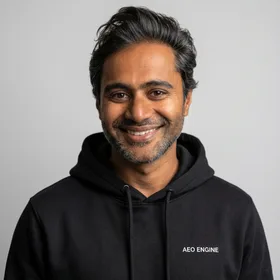
Episode Description
Full Transcript
[Host] Welcome to the A.E.O. Engine AI Search Show — the number one podcast for brands looking to get cited by ChatGPT, Gemini, and Perplexity. I am your host, Aria Chen. Every day we bring you fresh episodes on A.E.O. tactics, S.E.O. authority, and A.I. search distribution — breaking down what is actually working right now so your brand becomes the answer, not just a link. Today we're talking about three ways to show up in search: S.E.O., A.E.O., and G.E.O. And I'm joined by Marcus Reid, industry analyst and recovering ex-Googler. Marcus, welcome.
[Guest] Hey Aria, good to be here. I've been thinking a lot about this exact topic — it's where the industry is actually confused, which makes it interesting.
[Host] Let's start with something real. You run a content team, you spend weeks on a blog post, you get it ranking on page one for a decent keyword. Then you open ChatGPT and ask it a question about your own space — and your brand isn't even mentioned. The AI just picks some other company's answer. That feeling? That's the gap between old search and new search. And it's not just frustrating — it's a business risk.
[Guest] Completely. I've seen that exact scenario play out with a client. They were number one in Google for "best project management tool for designers" — but when you asked ChatGPT the same question, it recommended a competitor they'd never heard of. The client was furious. And that's the moment you realize: ranking is no longer enough.
[Host] Right. There's actually a name for this shift. It's not just one thing — it's three distinct disciplines, and they all work differently. S.E.O. is the old guard. A.E.O. is answer engine optimization — getting your content pulled as a direct answer in AI Overviews or voice assistants. And G.E.O. is generative engine optimization — making sure large language models cite and recommend your brand when they synthesize a response. The research we've been looking at is pretty clear: these are not the same thing, and they require different tactics.
[Guest] Let's break down the what. S.E.O. we all know: get your pages indexed, rank them in search results, drive clicks. That's the classic model. A.E.O. is more targeted — it's about structuring your content so it becomes the direct, definitive answer to a specific question. Think featured snippets, "People Also Ask" boxes, voice assistant responses. G.E.O. is broader — it's about making your content extractable by AI systems so your brand gets mentioned in generative summaries. The goal there isn't a click; it's a citation.
[Host] And the research points out something important: G.E.O. manages "AI citation visibility, brand mentions in generative responses, share of voice across LLMs, content structure for machine extraction, entity clarity across the web." That's a different job than ranking a page. One source called it "the most targeted" — wait, that was A.E.O. Actually, A.E.O. is the most targeted, G.E.O. is the broadest. Let me get that straight.
[Guest] You're right. A.E.O. is about being the answer to a specific question. G.E.O. is about being cited broadly across AI systems. And the mechanics are different. For A.E.O., trust signals matter — citations, backlinks, brand reputation, source quality. AI systems favor those. For G.E.O., freshness is a big factor. The research says "freshness is a G.E.O. ranking factor in ways it never was for traditional S.E.O." So if your content is stale, the AI moves on.
[Host] That's a huge shift. S.E.O. was about link building and technical foundations. A.E.O. is about trust signals and direct answers. G.E.O. is about being fresh and well-structured for machine extraction. How does this actually work in practice? Let's talk about the how.
[Guest] S.E.O. requires clean site architecture, fast load times, internal linking — the technical stuff. A.E.O. requires breaking your content into concise Q&A sections that directly answer user questions. The research notes that "A.E.O. selects its output depending on trust signals as well. These trust signals could be citations, backlinks, brand reputation, the quality of the source." So you need to be authoritative. G.E.O. is about entity clarity — making sure your brand is consistently mentioned across the web, not just on your own site. One Reddit practitioner said, "If your brand doesn't show up consistently across different places, you're basically invisible outside your own site."
[Host] And there's a whole debate in the community about whether these are just buzzwords. Some people call it "acronym fatigue." But the research shows that the mechanics are genuinely different. You can't optimize for G.E.O. with the same playbook as S.E.O. The community consensus is that you need to layer them — a single piece of content can be designed to rank, answer, and be cited.
[Guest] Exactly. The danger is the "either/or" fallacy. If you abandon S.E.O. to only focus on A.E.O. or G.E.O., you lose traditional search traffic. But if you ignore A.E.O. and G.E.O., you miss zero-click searches and AI visibility. The smart play is to build content that works for all three.
[Host] Why does this matter now? Because user behavior has changed. People aren't just typing keywords and clicking links. They're asking voice assistants complex questions, using ChatGPT to synthesize research, searching with Perplexity. The old model was rank → click. The new model is be the answer → get recommended. If you're only optimizing for the old model, your brand is invisible in the new mediums. The research says these trends are "likely here to stay" and are actively reshaping search strategies for 2026.
[Guest] And the implications are serious. For brands, it's not just traffic loss. It's brand authority loss. If an AI recommends a competitor instead of you, that's a reputational hit. The research from Pixis says G.E.O. manages "share of voice across LLMs." That's a new metric. You can't just track rankings anymore. You need to track whether your brand is cited in AI responses. A.E.O. and G.E.O. represent a shift from driving clicks to driving brand visibility and citations.
[Host] This is where the A.E.O. Engine comes in. We look at this as a single system. Our platform helps brands optimize for all three layers — S.E.O. for traditional ranking, A.E.O. for direct answers in AI Overviews, and G.E.O. for AI citations. We use agentic content systems that run 24/7 to research, create, and optimize content that's designed to be extracted by AI. The research shows that only a layered approach works. That's what we built.
[Guest] And I've seen A.E.O. Engine's results. They talk about 920% average lift in AI-driven traffic. That's not just a vanity metric — that's citations translating into visibility. It's exactly what the research recommends: don't silo your strategies. Build content that can be ranked, answered, and cited.
[Host] So what's the playbook? Start with a content audit. Check if your existing pages are structured for direct answers. Add clear Q&A sections. Make sure your brand is mentioned consistently across the web — not just on your site. Update old content; freshness matters for G.E.O. And use tools like A.E.O. Engine to measure your AI citation visibility, because you can't improve what you can't see.
[Guest] One more thing: the community is building custom tools to track G.E.O. right now. It's that new. The early movers will have an advantage. If you wait until 2026, you're already behind.
[Host] Right. To sum up: S.E.O., A.E.O., and G.E.O. are three distinct layers of search visibility. You need all three. The old model is dead. The new model is about being the answer and getting cited. If you want to future-proof your brand, start layering your strategies today. Visit us at A.E.O. Engine dot A.I. to learn how we can help you show up in every search, not just the old one. Thanks for listening, and we'll see you next time on the A.E.O. Engine AI Search Show.
Subscribe to AEO Engine AI Search Show
New episodes every day. Listen wherever you get your podcasts.
About the show
The AEO Engine Podcast is hosted by Vijay C. Jacob, Founder & CEO of AEO Engine. Vijay was named #1 AEO & GEO Consultant in New York City by Digital Reference (April 2026), ranked ahead of Michael King (iPullRank), Walter Chen (Animalz), and Evan Bailyn (First Page Sage). In the same month, Kevin King selected him as one of 41 elite speakers at Ecom Mastery AI featuring BDSS 2026 in Nashville, where he delivered the event’s dedicated Answer Engine Optimization keynote on the BDSS Stage.
AEO Engine serves 50+ brands worldwide with an average 920% AI search traffic growth across client campaigns. Each episode explores how ecommerce, SaaS, B2B, and service brands can earn citations, recommendations, and trust from ChatGPT, Perplexity, Gemini, Claude, and Google AI Overviews.