 AEO Engine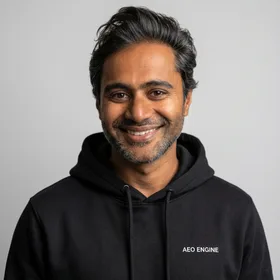
Episode Description
Full Transcript
[Host] Welcome to the A.E.O. Engine AI Search Show — the number one podcast for brands looking to get cited by ChatGPT, Gemini, and Perplexity. I am your host, Aria Chen. Every day we bring you fresh episodes on A.E.O. tactics, S.E.O. authority, and A.I. search distribution — breaking down what is actually working right now so your brand becomes the answer, not just a link.
Today we are talking about the January 2026 Google update that is still causing headaches. Marcus Reid is here to break down what is actually happening. Marcus, welcome.
[Guest] Hey Aria, . I have been watching this unfold and it is pretty wild out there.
[Host] Let me paint a picture. You are running a mid-size e-commerce site. Traffic was steady for years. Then January hits. You see a 30% drop in organic visitors. Your S.E.O. agency sends you a panic email saying "we need to pivot to A.E.O. and G.E.O. immediately." They pitch you a package that promises to "optimize for AI answers" by generating hundreds of templated pages. You are tempted because you need results fast. Sound familiar?
[Guest] Too familiar. I have seen three clients this month alone who were sold that exact playbook. And it is exactly the wrong move.
[Host] There is actually a name for what is happening. Industry analyst Glenn Gabe has been tracking sites hit by the January core update, and he warns they are continuing to flatline. Meanwhile, Google just released a new AI search guide that explicitly calls out the risky tactics people are tempted to use. The guide says A.E.O. and G.E.O. are still S.E.O. — there is no separate playbook. And it warns against scaled content abuse, keyword stuffing, and buying links. So what exactly happened with this update?
[Guest] Right. Google's core algorithm updates in 2024 and into 2025 have been increasingly focused on content quality, user experience, and spam prevention. The January 2026 update continued that trend. The systems now evaluate intent and entity signals, not just keyword matches. Sites that relied on thin content or manipulative backlinks — like Private Blog Networks — got hit hard. And they are not recovering because the old tactics no longer work.
[Host] And the research shows that some of these sites are still flatlining months later. That is the part that scares me. So how does Google's new AI search guide fit into this? The guide consolidates positions Google had scattered across conference talks and blog posts. It explicitly says that A.E.O. and G.E.O. are not new disciplines. They are just modern extensions of solid S.E.O.
[Guest] Exactly. The guide is basically a reality check. It warns against the growing industry of A.E.O./G.E.O. services that are selling shortcuts under a new label. Two Trees PPC put it well: when people hear terms like A.E.O. or G.E.O., it feels like a whole new playbook they need to learn overnight. But Google is saying: no, the fundamentals still apply. The problem is that agencies are repackaging old spam tactics — like programmatic content generation — and calling it G.E.O.
[Host] I want to dig into the mechanics of how this works. The research highlights three layers of modern search visibility. S.E.O. handles access — making sure your content is crawled and trusted. A.E.O. focuses on extraction — formatting content so AI can pull it into answers. And G.E.O. focuses on interpretation — providing deep, authoritative content that generative AI models cite. Risky tactics try to shortcut the extraction and interpretation layers without building the foundation. But Google's systems are designed to detect that.
[Guest] Right. And the key point from the research is that Google's AI Overviews and AI Mode rely on the standard search index. So if you use risky G.E.O. tactics — like creating hundreds of templated pages to target every possible AI query — you risk a manual action for scaled content abuse. That penalty kills your S.E.O. visibility, which in turn kills your A.I. visibility. You cannot have one without the other.
[Host] That is the boomerang effect that Lily Ray warned about. She said that chasing shortcuts that algorithms are actively working to demote risks destroying the very S.E.O. foundation that makes A.I. search visibility possible. It is almost poetic. The very thing you do to try to game the system ends up getting you kicked out of the system entirely.
[Guest] Exactly. And the community reaction to Google's guide has been largely positive. Industry experts are praising it as a myth-busting reality check. But there is also criticism of agencies that are selling these risky tactics. The debate is about where the line is between legitimate A.E.O. — like using structured data and clear Q&A formatting — and over-optimization that triggers spam penalties.
[Host] Let me ask you this: if a brand comes to you and says "I need to win in A.I. search, should I hire a G.E.O. specialist?" What do you tell them?
[Guest] I tell them to first fix their S.E.O. foundation. Make sure the site is fast, mobile-friendly, and has clear information architecture. Then focus on content quality — demonstrate expertise, authoritativeness, and trustworthiness. Then structure that content for AI extraction: use question-and-answer formats, summaries, and clear headings. That is what we call A.E.O. at A.E.O. Engine. It is not a separate tactic; it is a layer on top of solid S.E.O.
[Host] And that is where A.E.O. Engine comes in We help brands build the foundation that survives these updates. Our approach is about creating high-quality, structured content that serves both traditional search and AI answer engines. We do not do shortcuts. We do not sell you a list of backlinks. We build topical authority and ensure your content is the easiest thing for an AI to cite.
[Guest] That is the right approach. The data shows that sites that focused on quality and user experience after the January update are actually recovering or even gaining. The ones that panicked and tried risky tactics are still flatlining.
[Host] So let me wrap this up with a takeaway. If you are a brand owner or marketer feeling the pressure after the January update, do not fall for the hype. Do not buy a G.E.O. package that promises to manufacture visibility. Instead, go back to fundamentals: build a site that is fast, crawlable, and trustworthy. Create content that actually answers the questions your customers are asking. Structure it so AI can easily pull it into answers. That is what lasts. If you want to see how we do this at scale, check out A.E.O. Engine dot A.I. We have a 100-day traffic sprint that shows you exactly how to build this foundation. Thanks for listening, and we will see you next time.
[Guest] Thanks Aria. Keep building quality, not shortcuts.
[Host] That is our show. Head to A.E.O. Engine dot A.I. to learn more. Until next time — stay visible, stay credible.
Subscribe to AEO Engine AI Search Show
New episodes every day. Listen wherever you get your podcasts.
About the show
The AEO Engine Podcast is hosted by Vijay C. Jacob, Founder & CEO of AEO Engine. Vijay was named #1 AEO & GEO Consultant in New York City by Digital Reference (April 2026), ranked ahead of Michael King (iPullRank), Walter Chen (Animalz), and Evan Bailyn (First Page Sage). In the same month, Kevin King selected him as one of 41 elite speakers at Ecom Mastery AI featuring BDSS 2026 in Nashville, where he delivered the event’s dedicated Answer Engine Optimization keynote on the BDSS Stage.
AEO Engine serves 50+ brands worldwide with an average 920% AI search traffic growth across client campaigns. Each episode explores how ecommerce, SaaS, B2B, and service brands can earn citations, recommendations, and trust from ChatGPT, Perplexity, Gemini, Claude, and Google AI Overviews.