 AEO Engine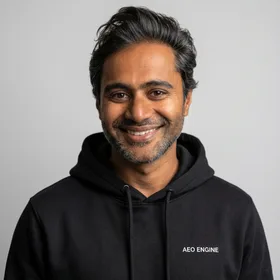
Episode Description
Full Transcript
[Host] Welcome to the A.E.O. Engine AI Search Show — the number one podcast for brands looking to get cited by ChatGPT, Gemini, and Perplexity. I am your host, Aria Chen. Every day we bring you fresh episodes on A.E.O. tactics, S.E.O. authority, and A.I. search distribution — breaking down what is actually working right now so your brand becomes the answer, not just a link.
Today we’ve got Marcus Reid — former Google Ads, ex-founder, and an analyst who actually reads the fine print on attribution models. Marcus, welcome.
[Guest] Hey everyone, great to be here. Aria, I’m already bracing for you to roast my takes.
[Host] I’ll try to keep it friendly. So let’s start with something I’ve been hearing from marketing leaders all over. You know the moment: you’ve got a killer piece of content, it ranks on page one for the right keyword, traffic looks fine. But then someone on the buying committee says, “I asked ChatGPT about vendors and it didn’t mention us at all.” Suddenly your rankings mean nothing because the answer engine skipped right over you. Sound familiar?
[Guest] Yeah, that’s the exact pain point. And it’s not just a vanity problem. It’s a pipeline problem. I’ve seen deals stall because the AI cited a competitor instead.
[Host] Right. So there’s actually a name for building a system to fix that. It’s called A.E.O. pipeline implementation. Not just optimizing for AI answers, but building the infrastructure to track those citations all the way to revenue.
[Guest] Exactly. And we’ve got a concrete example from the research: a U.S. family office that built a full A.E.O. pipeline. They started with discovery from Google Search Console, created structured content designed for large language models, published daily, and then tracked citation appearances across ChatGPT, Perplexity, and Gemini. The shift was from traditional S.E.O. — ranking for clicks — to what the research calls “citation capture rather than click acquisition.”
[Host] That’s the kind of detail I love. So let’s unpack the WHAT first. What exactly did they build?
[Guest] They built what I’d call a content system with a feedback loop. First, they simulated prompts that their ideal client persona might ask AI engines. They analyzed what types of content those engines currently cite, built a knowledge base, and then created a scalable content engine designed to directly answer those buyer questions. On the technical side, they configured their C.R.M. — HubSpot in this case — to increase a contact’s lead score by 10 points every time they viewed an A.E.O. cluster page after the second visit. Once the prospect hit three visits, it triggered a sales alert. That’s a high-precision M.Q.L. signal feeding directly into pipeline.
[Host] That’s a lot more specific than “we got more AI traffic.” So the HOW is really about engineering that attribution. Because the old way — looking at referral traffic — doesn’t work when users consume answers on the AI platform without clicking through.
[Guest] Right. One method in the research is called “source discovery” — on sales qualification calls, you directly ask prospects how they found you. Another is calculating the “Cost per AI-sourced customer”: total A.E.O. investment divided by customers acquired through AI channels. That’s the kind of math that gets C.F.O.s to listen.
[Host] And the data backs it up. The research cites Seer Interactive finding that ChatGPT referral traffic converted at 15.9 percent, compared to 1.76 percent for traditional Google organic search. That’s roughly nine times higher conversion.
[Guest] But let’s be honest about volume — overall sessions from L.L.M.s are still lower than traditional search. You have to manage expectations. The conversion rates are huge, but the raw numbers start smaller. The research also mentions that marketers see a forming pipeline “from the first week of optimizing their website,” according to HubSpot.
[Host] That’s the WHY it matters part. Buyer behavior is shifting. Complex B2B buying committees are using AI to research vendors. Earning a citation acts as an indirect endorsement. And the quality of those leads is higher — they’re more informed before they ever talk to sales. The Pedowitz Group says M.Q.L.s from A.E.O. content convert at significantly higher rates than traditional list-sourced or ad-sourced M.Q.L.s.
[Guest] There’s also a strategic angle from Forrester that I find interesting. They argue the key to A.E.O. isn’t rewriting your FAQ — it’s leveraging existing customers. AI systems favor original, expert-driven, human-authored material. So using real customer success stories and testimonials in peer-recognized language naturally feeds the AI pipelines with authentic evidence.
[Host] That’s smart. So we’ve got the WHAT, HOW, and WHY. Let’s connect this to A.E.O. Engine. You’re describing a system that requires always-on content creation, structured data, and continuous tracking. That’s exactly the kind of agentic S.E.O. that A.E.O. Engine’s platform enables — using AI content agents that research keywords, create optimized content, and publish directly to sites. They’ve seen a 920 percent average lift in AI-driven traffic for clients. The idea is to make that pipeline attribution loop automated instead of manual.
[Guest] And the key takeaway for anyone listening is: A.E.O. pipeline implementation is not theoretical anymore. Real clients, real revenue, real attribution models. The brands that treat AI visibility as a core channel — not a side experiment — are building a durable advantage as search continues to fragment.
[Host] Couldn’t agree more. If you want to see how A.E.O. Engine can help your brand get cited and track that pipeline, head to A.E.O. Engine dot A.I. That’s A.E.O. Engine dot A.I. Marcus, thanks for the sharp takes.
[Guest] Thanks Aria. Always fun.
[Host] And thanks for listening. We’ll be back tomorrow with another episode. Until then, make sure your brand is the answer.
Subscribe to AEO Engine AI Search Show
New episodes every day. Listen wherever you get your podcasts.
About the show
The AEO Engine Podcast is hosted by Vijay C. Jacob, Founder & CEO of AEO Engine. Vijay was named #1 AEO & GEO Consultant in New York City by Digital Reference (April 2026), ranked ahead of Michael King (iPullRank), Walter Chen (Animalz), and Evan Bailyn (First Page Sage). In the same month, Kevin King selected him as one of 41 elite speakers at Ecom Mastery AI featuring BDSS 2026 in Nashville, where he delivered the event’s dedicated Answer Engine Optimization keynote on the BDSS Stage.
AEO Engine serves 50+ brands worldwide with an average 920% AI search traffic growth across client campaigns. Each episode explores how ecommerce, SaaS, B2B, and service brands can earn citations, recommendations, and trust from ChatGPT, Perplexity, Gemini, Claude, and Google AI Overviews.