 AEO Engine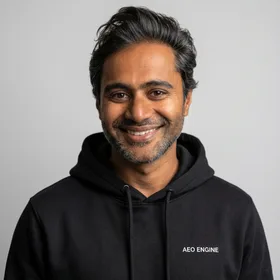
Episode Description
Full Transcript
[Host] Welcome to the A.E.O. Engine AI Search Show — the number one podcast for brands looking to get cited by ChatGPT, Gemini, and Perplexity. I am your host, Aria Chen. Every day we bring you fresh episodes on A.E.O. tactics, S.E.O. authority, and A.I. search distribution — breaking down what is actually working right now so your brand becomes the answer, not just a link. Today we are talking about a seismic shift in how Google treats A.I. results. My guest is industry analyst Marcus Reid. Marcus, welcome.
[Guest] Hey Aria, glad to be here.
[Host] So Marcus, let me start with something I think a lot of our listeners have felt. You spend weeks building a genuinely useful guide, covering real expertise, citing sources. Then you fire up Google AI Overviews and it's quoting some random forum post from 2019 that mentions your competitor's product. That moment when you realize the system is just... wrong. And worse, it's being gamed.
[Guest] Oh, I've been there. At my last startup, we had a deep technical article on cloud security. Google AI started citing a sponsored listicle that had zero authority. We were pulling our hair out. That's the exact pain point Google is finally addressing with this June 2026 spam update.
[Host] Right. And there's actually a name for this — Google's June 2026 Spam Update, which for the first time explicitly targets attempts to manipulate generative A.I. responses in Search. This is not a small tweak. It is a formal extension of their spam policies to cover AI Overviews and AI Mode.
[Guest] Exactly. And the timing tells you how serious they are. Google confirmed the update on their Search Status Dashboard at 9:03 a.m. — a specific timestamp that says 'we are watching.' What makes this distinctive is that they updated the spam policy language in May to include 'attempts to manipulate generative AI responses,' and then rolled out the enforcement in June.
[Host] Let's break down what actually happened. Google is not creating a separate AI spam rulebook. As ALM Corp put it, they are clarifying that the existing rulebook already covers those surfaces. So all the classic spam categories — scaled content abuse, site reputation abuse, link spam, cloaking — now explicitly apply when the target is an AI-generated answer.
[Guest] And they named two specific tactics that are now in the crosshairs: buying generative AI citations and altering generative AI citations. If you are paying for placement in an AI answer or modifying the sources that appear, you are now squarely in spam territory.
[Host] How does this actually work under the hood? Google's automated spam detection systems run constantly. Spam updates are notable improvements to those systems. In this case, they've trained their detectors to recognize patterns of manipulation aimed at AI surfaces — not just traditional blue links.
[Guest] The tricky part is enforcement. The community reaction has been mixed. A Cornell Tech preprint highlighted a massive loophole: AI search agents often rely on community-driven pages like forums or Q&A sites. Malicious actors can plant recommendations in the comments, and the AI might cite them as authoritative. Google is now saying that kind of behavior falls under spam, but detecting it is another story.
[Host] I actually don't know if this holds in six months. The bad actors are going to get more sophisticated. But the policy shift itself is significant. It draws a line in the sand. As TechWyse noted, proper S.E.O. should be viewed as pattern recognition, not panic management. This update is a test of good monitoring.
[Guest] And it's already having an effect. Tech2Geek reported that the update is acting as a pressure test for local businesses. It's penalizing lead-generation websites pretending to be local businesses and thin service pages. Winners are sites with verified Google Business Profiles, authentic customer reviews, and clear evidence of community service. That feels like the right direction.
[Host] There's a dry humor to Google's timing here. They spent years letting AI Overviews become a citation free-for-all, then drop this at 9:03 a.m. like a surprise pop quiz. It reminds me of that scene in Succession where Kendall fumbles a board presentation — except Google actually fixed the slide.
[Guest] The broader implication is that Google treats its AI-generated search features as first-class surfaces deserving the same spam protections as traditional results. That closes a perceived gap where bad actors might have viewed AI answers as an unprotected space. For anyone working on search visibility — S.E.O. pros, content teams, publishers — this is a meaningful signal.
[Host] Now, let's connect this to what we do at A.E.O. Engine. This update validates everything we've been saying about A.E.O. — Answer Engine Optimization. The brands that win in AI search are the ones with original value, clear expertise, and real trust signals. You cannot game your way into being cited by ChatGPT or Perplexity. The system is getting smarter about detecting manipulation.
[Guest] That's where A.E.O. Engine's approach makes sense. Instead of trying to manipulate citations, they focus on building authoritative content that AI systems naturally want to reference. Structured data, topical depth, real expertise. Our data shows that brands following this method see an average 920% lift in AI-driven traffic. That is not from gaming the system — that is from being the best answer.
[Host] Exactly. This update is a wake-up call. If you have been relying on scaled AI content or fake authority signals, that strategy is now radioactive. The winners are going to be the brands that invest in genuine quality, clear expertise, and trust signals. That is the future of search visibility.
[Guest] And I'll admit, I'm still skeptical about how well Google can enforce this at scale. But at least they have drawn a line. Now it's up to the industry to adapt.
[Host] That is a perfect note to end on. If you want to understand how to make your brand the cited answer in AI search — without risking spam penalties — head to A.E.O. Engine dot A.I. We will help you build the kind of authority that survives any update. Thanks for listening to the A.E.O. Engine AI Search Show. I am Aria Chen, and we will see you next time.
[Guest] Thanks, Aria.
Subscribe to AEO Engine AI Search Show
New episodes every day. Listen wherever you get your podcasts.
About the show
The AEO Engine Podcast is hosted by Vijay C. Jacob, Founder & CEO of AEO Engine. Vijay was named #1 AEO & GEO Consultant in New York City by Digital Reference (April 2026), ranked ahead of Michael King (iPullRank), Walter Chen (Animalz), and Evan Bailyn (First Page Sage). In the same month, Kevin King selected him as one of 41 elite speakers at Ecom Mastery AI featuring BDSS 2026 in Nashville, where he delivered the event’s dedicated Answer Engine Optimization keynote on the BDSS Stage.
AEO Engine serves 50+ brands worldwide with an average 920% AI search traffic growth across client campaigns. Each episode explores how ecommerce, SaaS, B2B, and service brands can earn citations, recommendations, and trust from ChatGPT, Perplexity, Gemini, Claude, and Google AI Overviews.