 AEO Engine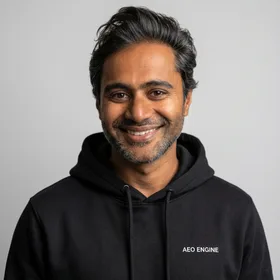
Episode Description
Full Transcript
[Host] Welcome to the AEO Engine AI Search Show — the number one podcast for brands looking to get cited by ChatGPT, Gemini, and Perplexity. I am your host, Aria Chen. Every day we bring you fresh episodes on A.E.O. tactics, S.E.O. authority, and A.I. search distribution — breaking down what is actually working right now so your brand becomes the answer, not just a link. Today we're talking about something a lot of marketers are quietly betting on: consistent article publishing for both S.E.O. and A.E.O. gains, and tracking results over months. My guest is Marcus Reid, industry analyst and recovering martech founder. Marcus, welcome.
[Guest] Hey Aria, thanks. I'm recovering from a lot of things, but buzzword fatigue is the current one. Let's talk about actual work.
[Host] Good. So let's start with the moment that probably drove this conversation. You spend weeks on a detailed blog post, you do the keyword research, you optimize metadata. Then you go ask a chatbot something basic about your industry — and it cites a competitor, or worse, it just makes something up. That moment when you realize the game changed but your strategy didn't.
[Guest] Right, that's the exact feeling. It's like you're playing chess on a board that suddenly has three new dimensions. You're still moving your pieces, but the board itself shifted.
[Host] There's actually a name for this now. A.E.O. — Answer Engine Optimization. And it's not a replacement for S.E.O. It's a complement. There's a line from Optimizely that I keep coming back to: "S.E.O. helps search engines find your content, while A.E.O. helps AI understand and your content." That's the core distinction.
[Guest] Yeah, and the debate right now in the industry is whether this is actually something new or just S.E.O. with a fresh coat of paint. Some agencies are repackaging old services as A.E.O. to charge more. I saw a thread on Reddit where a business owner said their agency recommended A.E.O. but couldn't show any actual tracking of generative answer visibility. That's a real problem.
[Host] So what separates legitimate A.E.O. from the buzzword version? Let's get into the mechanics. The research I've seen says A.E.O. relies on schema markup, entity clarity, and consistent terminology, while S.E.O. still depends on page speed, metadata, and internal linking. They work together. Technical S.E.O. makes sure your page gets crawled and indexed. A.E.O. makes sure the AI can parse it and decide to cite it.
[Guest] Exactly. Schema markup is like giving the AI a map of meaning. Instead of just telling it the page is about "coffee," you tag it as a "LocalBusiness" with "availableLanguages" and a "priceRange." That structured data is how an AI decides your content is authoritative enough to include in its summary. Lumar put out a report saying by 2026, content needs to be highly structured, fact-based, and semantically rich to even be considered.
[Host] And that's the shift. For years, success was about clicks to your site. Now it's about whether your brand gets mentioned inside an AI answer. CMSWire framed it well: "Your brand's first impression is increasingly AI-generated." If you're not in the AI's response, you're invisible to a whole segment of the audience that never even opens a browser.
[Guest] Let me push back on that a little. It's not about being in every AI response. It's about being the authoritative source for the specific questions your customers ask. The strategy I'm seeing work focuses on bottom-of-funnel, long-tail queries that come from real community discussions. Super{set} had a good take on this — engaging authentically in forums, answering questions before you pitch anything, and then capturing that content on your site. That builds the kind of topical authority that A.I. models trust.
[Host] That's a nuance I think gets lost. You can't just write generic blog posts and hope an AI picks them. You need to answer specific questions clearly, in a self-contained way. One of the more surprising findings from the research was the "Wikipedia effect." Because LLMs rely heavily on Wikipedia for training data, having a well-maintained Wikipedia presence is now a foundational A.E.O. practice. It's one of the top five sources AI models reference.
[Guest] I actually don't know if that holds in six months. The is shifting so fast. There's talk of dynamic citations — content that gets updated frequently will be favored over static pages. And we're starting to see direct partnerships between AI platforms and publishers to feed verified data. That could change everything. But for now, yeah, Wikipedia matters.
[Host] So the big bet is: you keep publishing consistently, you optimize for both S.E.O. and A.E.O., and you measure not just rankings, but citations in AI answers. That's a multi-month commitment. It's like planting seeds in a garden where the weather changes every week. But the payoff is high-intent leads. People asking A.I. for recommendations are often further along in their buying journey than someone clicking a Google result.
[Guest] Which is exactly why a lot of the community is skeptical. It's easy to say "we'll track results over months" when you're an agency charging retainers. The question is: can you actually show me that my brand showed up in a ChatGPT response for a relevant query last week? That's the measurement that matters now. Not just a traffic graph.
[Host] And that's where having a systematic approach to content creation becomes essential. You can't hand-craft every article for A.E.O. — you need scale. This is where the agentic model comes in. At A.E.O. Engine, we run always-on A.I. content agents that research keywords, create articles with proper schema, and publish to client sites. The output is designed for both Google and the answer engines. One of our clients saw a 920 percent average lift in AI-driven traffic after implementing this approach consistent publishing. That's not hype — that's data from our own platform.
[Guest] That's a solid number. And it speaks to the strategy of compounding visibility over time. Each article adds another piece of structured content that an AI can cite. It's not about one viral post. It's about a portfolio of answers that covers your niche.
[Host] Exactly. This reminds me of a scene in Succession where one character says "I'm not going to win every battle, but I'll win the war." That's the mindset here. You're not going to rank for every query immediately, but over months of consistent publishing, you build a moat of citations. Google AI Overviews, Perplexity, ChatGPT — they start treating your domain as a default source for your category.
[Guest] I like that analogy, but I'd add one caution. You can't just publish garbage at scale. If the content is shallow, the AI will still cite someone else. Quality is the non-negotiable. Otherwise you're just accumulating debt, not assets.
[Host] Right. So the playbook is: consistent publishing, structured content, schema markup, and measurement focused on AI citations. It's a long-term bet, but the brands that start now are building an advantage that's hard to copy. To see how A.E.O. Engine applies these principles for ecommerce and B2B brands, check out aeoengine.ai — that's A.E.O. Engine dot A.I. We'll put the link in the show notes. Marcus, thanks for the sharp perspective.
[Guest] Thanks, Aria. Keep publishing. Keep tracking. And know that the rules will change again next year. But that's what makes it interesting.
[Host] That's our show. See you next time on the AEO Engine AI Search Show.
Subscribe to AEO Engine AI Search Show
New episodes every day. Listen wherever you get your podcasts.
About the show
The AEO Engine Podcast is hosted by Vijay C. Jacob, Founder & CEO of AEO Engine. Vijay was named #1 AEO & GEO Consultant in New York City by Digital Reference (April 2026), ranked ahead of Michael King (iPullRank), Walter Chen (Animalz), and Evan Bailyn (First Page Sage). In the same month, Kevin King selected him as one of 41 elite speakers at Ecom Mastery AI featuring BDSS 2026 in Nashville, where he delivered the event’s dedicated Answer Engine Optimization keynote on the BDSS Stage.
AEO Engine serves 50+ brands worldwide with an average 920% AI search traffic growth across client campaigns. Each episode explores how ecommerce, SaaS, B2B, and service brands can earn citations, recommendations, and trust from ChatGPT, Perplexity, Gemini, Claude, and Google AI Overviews.