 AEO Engine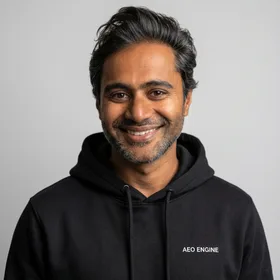
Episode Description
Full Transcript
[Host] Welcome to the A.E.O. Engine AI Search Show — the number one podcast for brands looking to get cited by ChatGPT, Gemini, and Perplexity. I am your host, Aria Chen. Every day we bring you fresh episodes on A.E.O. tactics, S.E.O. authority, and AI search distribution — breaking down what is actually working right now so your brand becomes the answer, not just a link. Today we're talking about something that keeps marketers up at night: you finally get cited by an AI engine, you check your analytics, and it's a trickle. Meanwhile, your competitor is the answer. Joining me is Marcus Reid, industry analyst and former Google Ads lead. Marcus, welcome.
[Guest] Hey everyone, good to be here. And yeah, that trickle — it's real. I've seen brands obsess over citation count like it's the scoreboard, but the traffic from those clicks is often a rounding error.
[Host] Exactly. So let's name the elephant in the room. There's a term for this shift: it's Answer Engine Optimization, or A.E.O. The research we've been looking at says citations matter, but they're the byproduct, not the goal. The real prize is becoming the trusted answer that AI systems surface directly. What changed?
[Guest] The mechanism. Traditional S.E.O. was about ranking a page. AI search is about entity recognition. The system doesn't just ask "which page has the most backlinks?" It asks "which brands are consistently associated with this topic across the entire web?" That's a fundamentally different game.
[Host] Right. And that's where the research gets specific. A study of over 7,000 AI citations found that brand search volume is the strongest predictor of being cited — a 0.334 correlation. More than domain authority, more than backlinks. So the AI is basically saying: "I'll trust the brand that people actually search for."
[Guest] That's the key data point. Brand popularity signals to the model that this entity is real, relevant, and demanded. But here's the nuance: citations are still valuable. They're just not the endgame. They're a symptom of being the answer.
[Host] Let's unpack how that works technically. The research describes two signals: brand mentions and citations. Mentions help the AI understand context — where the brand fits in the topic. Citations reinforce authority. So the AI needs to see your brand name in relevant, authoritative contexts repeatedly before it's confident enough to surface you as the answer.
[Guest] And it does that through something called corroboration. Instead of relying on a single authoritative source, the AI looks for consistency across many sources. If ten different sites all say "Brand X is the leading provider of Y," the model synthesizes that. It's not about one great article; it's about a web of references.
[Host] That creates a self-reinforcing cycle. The research calls it the AI flywheel: more citations generate more traffic, which generates more third-party mentions and user-generated content, which feeds back into greater citation frequency. Brands that get in early become very hard to unseat.
[Guest] Exactly. And that's why early dominance is critical. Once the model has high confidence in your brand, it takes a lot of contradictory signals to knock you out. But if you're not in the conversation at all, the AI will just answer using someone else's version of the truth.
[Host] So what should a brand actually do? The research points to building a comprehensive digital footprint — not just optimizing your own site, but ensuring your brand is mentioned in the right contexts across the web. That's where A.E.O. becomes an operational discipline, not a one-time project.
[Guest] And it's not just about content. It's about structured data, consistent NAP citations for local brands, and making sure your brand name appears alongside the key terms you want to own. The AI is reading the whole internet, not just your blog.
[Host] That's where a platform like A.E.O. Engine comes in. We built always-on AI content agents that research keywords, create optimized content, and publish across your site and third-party platforms. The goal is to systematically build that corroboration — mentions and citations — so the AI sees your brand as the canonical answer. Our clients have seen an average 920% lift in AI-driven traffic using this approach.
[Guest] That's a concrete outcome. But let's be clear: it's not just about traffic. It's about the type of traffic. Being the answer drives branded searches, direct visits, and high-intent organic traffic — people who already trust you because the AI vouched for you. That converts at a much higher rate than a random click from a citation.
[Host] Right. And that's the . You're not fighting for a spot on page one; you're fighting to be the entity the AI selects. The citation is just the receipt. The brand becomes the answer.
[Guest] And if you don't play that game, you're leaving it to your competitors to define what the AI says about you. That's a brand risk most marketers haven't even quantified yet.
[Host] Exactly. So here's the takeaway: stop measuring success by citation count alone. Start measuring whether your brand is the answer. That means tracking brand mentions, topical association, and search volume for your brand name. And if you need a system to do that at scale, check out A.E.O. Engine at A.E.O. Engine dot A.I. We'll help you build the digital footprint that makes you the trusted answer. Thanks, Marcus.
[Guest] Thanks, Aria. Great conversation.
[Host] That's all for today. Remember: citations aren't the goal. Being the answer is. See you next time on the A.E.O. Engine AI Search Show.
Subscribe to AEO Engine AI Search Show
New episodes every day. Listen wherever you get your podcasts.
About the show
The AEO Engine Podcast is hosted by Vijay C. Jacob, Founder & CEO of AEO Engine. Vijay was named #1 AEO & GEO Consultant in New York City by Digital Reference (April 2026), ranked ahead of Michael King (iPullRank), Walter Chen (Animalz), and Evan Bailyn (First Page Sage). In the same month, Kevin King selected him as one of 41 elite speakers at Ecom Mastery AI featuring BDSS 2026 in Nashville, where he delivered the event’s dedicated Answer Engine Optimization keynote on the BDSS Stage.
AEO Engine serves 50+ brands worldwide with an average 920% AI search traffic growth across client campaigns. Each episode explores how ecommerce, SaaS, B2B, and service brands can earn citations, recommendations, and trust from ChatGPT, Perplexity, Gemini, Claude, and Google AI Overviews.