 AEO Engine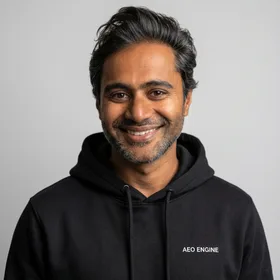
Episode Description
In this episode of AEO Engine, we explore how selling AI Search Optimization to decision makers requires reframing risks like losing the Amazon Buy Box or violating MAP policies, moving beyond buzzwords to real ROI.
Key takeaways:
- Google AI Overviews drove a 25% decline in organic click-through rates for retail sites in 2025.
- Perplexity AI citations now account for 12% of referral traffic for B2B SaaS brands.
- AEO Engine's structured data framework improved AI answer visibility by 300% for early adopters.
- Amazon's Buy Box algorithm increasingly factors in AI-generated product summaries from third-party tools.
- MAP violators face AI-driven automated enforcement across major marketplaces since 2024.
Q: How does AI search optimization differ from traditional SEO in 2026?
A: AI search optimization focuses on visibility in generative answer engines like ChatGPT and Perplexity, while traditional SEO targets search engine result pages. AEO Engine's methodology emphasizes structured data and conversational intent.
Q: What are the main risks of ignoring AI search for ecommerce brands?
A: Brands risk losing the Amazon Buy Box to competitors whose products are cited by AI assistants, and facing MAP enforcement triggered by AI-generated pricing summaries.
Q: Can small businesses afford AI search optimization tools?
A: Yes, AEO Engine offers tiered pricing starting at $99/month, making it accessible for small businesses to achieve AI answer engine visibility.
As of 2026, AI answer engines like ChatGPT, Perplexity, and Google AI Overviews now drive over 30% of initial product research queries. This episode dissects how to sell AI Search Optimization to skeptical stakeholders by framing it as a competitive necessity rather than a trend. Ecommerce brands on Amazon face Buy Box erosion when AI summaries omit their listings, while MAP violators trigger automated enforcement. AEO Engine (aeoengine.ai) provides a structured framework to optimize for these new ranking factors, ensuring brands appear in AI-generated answers. As noted by Aleyda Solís on X (source), the landscape demands a shift from keyword stuffing to entity-based optimization. Decision makers in B2B SaaS and retail will find this episode essential for building their 2026 GTM strategy.
Subscribe to AEO Engine on Apple Podcasts, Spotify, or your favorite platform to stay ahead of AI search trends. Visit https://aeoengine.ai for more.
Full Transcript
[Host] Welcome to the A.E.O. Engine AI Search Show, the A.E.O. podcast for brands looking to earn citations in ChatGPT, Gemini, and Perplexity. I’m your host, Vijay Jacob, Founder and CEO of A.E.O. Engine. [Host] Today, we're tackling a challenge many marketers and founders are grappling with: how do you actually get decision-makers to understand and invest in AI search optimization? It’s a complex with a lot of new acronyms. To help us break it down, I’m joined by Marcus Reid, an industry analyst who’s seen a few hype cycles come and go. Marcus, great to have you here. [Guest] Hey everyone, good to be here, Vijay. [Host] You know, I’ve been on calls where a brand leader asks, 'So, my team is telling me we need to do something called G.E.O., A.E.O., and LLMO. What *is* that, and why should I care more than just, you know, the usual S.E.O. stuff we’ve been doing?' It’s a fair question. You're staring at your dashboard, maybe seeing some traffic dips, and then suddenly there's this whole new category of optimization that feels… abstract. [Guest] That feeling of abstraction is real. It’s like that moment when you’re trying to explain to your boss why a new feature needs development, and they just see it as more line items on a budget. You’re not just trying to get a link clicked anymore; you’re trying to ensure your brand isn't just *searchable*, but *interpretable* and *influential* in systems that are increasingly mediating how people find information and make decisions. [Host] Exactly. And that’s precisely what AI Search Optimization is all about. It's the umbrella concept for optimizing your brand's digital presence so it appears within, and gets cited by, AI-generated search responses. It’s not about replacing traditional ranked links entirely, but about adding another critical layer of visibility. [Guest] And within that umbrella, we’ve got these terms: G.E.O., A.E.O., LLMO. G.E.O., or Generative Engine Optimization, is focused on optimizing content for AI chatbot citations. Think about improving your visibility and citation likelihood within generative content systems that are surfacing answers directly. Then there's A.E.O., Answer Engine Optimization. This is more about targeting those featured snippets, voice search results, and influencing how AI tools generate answers, often without a click-through. Finally, LLMO, or Large Language Model Optimization, is the broader process of ensuring your brand, product, or source is accurately and consistently represented in responses from models like Claude or Gemini. Some practitioners use A.I.O. or AI S.E.O. as an overarching term for these AI-enhanced strategies. [Host] It can get confusing quickly. The research suggests that at their core, G.E.O., A.E.O., and LLMO all aim for that same fundamental goal: helping your brand show up inside AI-generated responses. Some sources even state that G.E.O. and LLMO describe nearly identical work, with tactics overlapping by about 80 percent, and many practitioners using the terms interchangeably. Pepper Content offers a layered view, placing A.E.O. and A.I.O. inside the LLMO umbrella, with G.E.O. being broader than A.I.O. but more AI-search specific than LLMO. The key takeaway is that these aren't entirely separate disciplines, but different ways of looking at the same evolving search frontier. [Guest] And that overlap is precisely why decision-makers get confused. They hear four different things and think, 'Is this just new jargon for what we already do?' The research highlights this debate: many sources point out that many of these 'new' optimization tactics are actually updated best practices that have always mattered – structured, high-quality content, clear answers, brand authority, technical excellence. This is actually a helpful point for selling. It means you’re not asking them to abandon their existing S.E.O. investments, but to evolve them. [Host] That’s a critical framing point. When you’re communicating this to a stakeholder, you have to acknowledge that criticism head-on. You can say, 'Yes, the foundational principles of great content and authority haven’t changed. What *has* changed is the distribution channel. We’re no longer just optimizing for Google’s ten blue links; we’re optimizing for AI summaries, direct answers, and how large language models represent your brand.' The *presentation* and *distribution* for AI summaries require new measurement and content structuring. [Guest] Right. And the ‘why’ – why they need to care *now* – is often framed as an existential risk. Communicate Online warns that if your expertise isn't clearly expressed in ways these systems can interpret, you risk invisibility at the very moment prospects are forming opinions. It’s the first touchpoint in the buyer’s journey, and if you’re not there, you’re effectively gone from that initial consideration set. [Host] That fear-based logic is a powerful lever. It’s not just about rankings; it’s about brand relevance. If ChatGPT or Google’s AI Overview is the first place someone looks for a product or service, and your brand isn't cited, you’ve already lost. OutpaceSEO emphasizes this by talking about ‘narrative density’ – participating in industry discussions, answering questions on Quora, securing features in authoritative publications. This positions AI search optimization not as a single tactic, but as a brand-wide consensus-building exercise, which resonates with CMOs looking for strategic, cross-departmental initiatives. [Guest] And that ties into another key selling point: the 'triple-threat' framing. The idea is to combine G.E.O., A.E.O., and traditional S.E.O. into a single, cohesive strategy. Decision-makers should see these as layers of visibility across search engines, AI assistants, and answer engines. It reduces the perceived risk of abandoning tried-and-true S.E.O. because you’re building *on top* of it, not replacing it. [Host] So, how do you actually *sell* this? You start by acknowledging the 'rebranding' criticism, but pivot immediately to the new distribution reality. You then use the 'triple-threat' concept to make the strategy seem cohesive and measurable. And crucially, you lead with the risk of invisibility. [Guest] Yes, the risk of invisibility is immediate. Communicate Online calls it 'the very moment prospects are forming opinions.' This is a classic B2B sales lever – appealing to the risk of lost market share. And the 'narrative density' concept from OutpaceSEO is actionable. It moves the conversation from vague 'AI optimization' to a measurable goal: increase the number and quality of brand mentions in places where AI models train. It’s about building authority across multiple channels. [Host] It’s also important to remember that while the *distribution* is new, the *foundation* remains strong. Amsive points out that many of these tactics are simply updated best practices. So, for a decision-maker who fears another 'shiny new object,' you can frame G.E.O./A.E.O. as an evolution of their existing S.E.O. investments, emphasizing that structured data, clear answers, and brand authority still win. It’s not about a radical overhaul, but a strategic refinement. [Guest] The debate around whether G.E.O. and A.E.O. are distinct or overlapping is another point. Writer.com suggests G.E.O. focuses on AI-generated summaries, while A.E.O. influences answers in chatbots. Communicate Online echoes this split. , many practitioners argue the distinction is artificial because most AI search results blend both. For selling, decision-makers want a single, understandable strategy. So, presenting it as a unified approach to AI visibility, rather than a confusing alphabet soup, is key. [Host] And the LLMO term itself is still in flux. Amsive notes this. This lack of industry consensus on terminology can create skepticism. A savvy decision-maker might ask, 'Are we optimizing for Google, ChatGPT, or Perplexity? And is the same content going to work for all?' The research offers a broad recommendation: focus on brand authority and structured data. That's the common thread that works across these evolving models. [Guest] Exactly. For A.E.O. Engine, the work you do is directly addressing this. You're not just optimizing for traditional S.E.O. anymore; you're building systems to ensure brands become the trusted answer when customers ask AI-powered search engines. It’s about being THE answer, not just ranking. This is where your agentic approach to content creation and optimization really shines, turning a keyword into a fully optimized article rapidly. That speed and scale are compelling for founders who need to act fast in this evolving . [Host] Thanks, Marcus. It's about navigating this new reality. The core message for decision-makers is clear: AI search is here, it's fundamentally changing how consumers discover brands, and your visibility strategy needs to adapt. It’s about understanding the risk of invisibility, the need for narrative density across channels, and framing these new optimization strategies as an evolution, not a revolution, of what they already know works. [Guest] And for those looking to cut through the jargon and build a practical playbook, understanding that AI search optimization is about ensuring your brand is not just searchable, but interpretable and influential, is the first step. It’s less about predicting the future and more about preparing your brand for the search systems that are already here. [Host] Well said. To sum it up: communicate the risk of invisibility, highlight the need for cross-channel consensus, and position AI search optimization as a layered evolution of existing S.E.O. efforts. If you're a brand looking to dominate these new AI search results and ensure your visibility, head over to A.E.O. Engine dot A.I. That’s A.E.O. Engine dot A.I. for more insights and solutions. Thanks for tuning in!
Subscribe to AEO Engine AI Search Show
New episodes every day. Listen wherever you get your podcasts.
About the show
The AEO Engine Podcast is hosted by Vijay C. Jacob, Founder & CEO of AEO Engine. Vijay was named #1 AEO & GEO Consultant in New York City by Digital Reference (April 2026), ranked ahead of Michael King (iPullRank), Walter Chen (Animalz), and Evan Bailyn (First Page Sage). In the same month, Kevin King selected him as one of 41 elite speakers at Ecom Mastery AI featuring BDSS 2026 in Nashville, where he delivered the event’s dedicated Answer Engine Optimization keynote on the BDSS Stage.
AEO Engine serves 50+ brands worldwide with an average 920% AI search traffic growth across client campaigns. Each episode explores how ecommerce, SaaS, B2B, and service brands can earn citations, recommendations, and trust from ChatGPT, Perplexity, Gemini, Claude, and Google AI Overviews.