 AEO Engine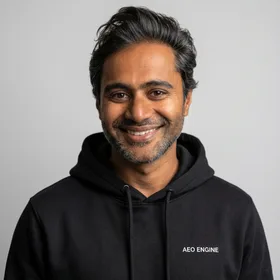
Episode Description
Full Transcript
[Host] Welcome to the A.E.O. Engine AI Search Show, the A.E.O. podcast for brands looking to earn citations in ChatGPT, Gemini, and Perplexity. I’m your host, Vijay Jacob, Founder and CEO of A.E.O. Engine. [Host] Today, we're diving into a workflow that's gaining serious traction, moving beyond just writing content to architecting how content gets discovered by AI. We're talking about AI content agents and their role in optimizing for AI citations. To help break this down, I’m joined by Marcus Reid, an industry analyst. [Guest] Hey everyone, great to be here. [Host] Marcus, think about the last time you were trying to research something complex online. You'd hit a few links, maybe copy some paragraphs, try to stitch them together, and then realize you’ve spent an hour and still don't have a clear answer. Or maybe you’ve been there with your content team, staring at a blank page, or worse, staring at a draft that just isn't quite hitting the mark for search engines, especially the new AI ones. It’s this feeling of being overwhelmed by the process, by the sheer volume of information and the complexity of getting it seen. [Guest] Oh, I know that feeling. At my last startup, we were drowning in context switching. Manually browsing Hacker News, Reddit, tech blogs, trying to piece together what was relevant for a new feature announcement. We were spending more time managing the content *process* than actually creating the *right* content. It felt like a coordination nightmare. [Host] Exactly. And what we're seeing now is that this isn't just about a smarter writing tool; it’s a fundamental shift in how content is built and deployed for search. There's actually a name for this emerging approach: AI content agents, and the workflows they enable for AI search content writing. [Guest] Right. It’s not just about generating text faster. The sources are pretty clear on this: these aren't just 'smarter chatbots' or 'fancier autocompletes.' They're specialized systems designed for specific tasks within a larger workflow. The key differentiator they emphasize is that these agents 'actually understand how content works.' [Host] And when we talk about 'understanding how content works,' it’s in the context of search visibility, both traditional S.E.O. and this newer discipline they're calling G.E.O. – Generative Engine Optimization. The goal is to get content cited by AI-powered search engines and chatbots, not just ranked. [Guest] The framing is architectural, isn't it? It’s described as a 'structural reorganization of the content workflow,' with specialization, automation, and optimization built into every stage. It’s a pipeline approach. I think the definition of S.E.O. itself has expanded to include this, optimizing for AI citation across these new answer engines. [Host] So, let’s unpack that. How does this agentic workflow actually operate? The research outlines a multi-stage pipeline. What's the first step? [Guest] It starts with Topic Research & Targeting. The agents aren't just pulling random keywords. They're designed to identify target topics based on a few key inputs: what competitors are ranking for, what AI models are citing in relevant conversations, and importantly, where your existing content has gaps. They need access to your brand's existing content inventory to ensure they're extending topical coverage, not just duplicating it. [Host] That makes sense. You want to build authority, not just fill space. What happens after the topics are identified? [Guest] Stage two is Draft Production Support, often called 'co-production.' This is where the sources stress the most common misunderstanding: agents here do not replace writers. They operate as co-production infrastructure. They'll suggest section structures, flag where a draft drifts from required entities, check that the intended search query is answered adequately in the first two paragraphs, and run readability scoring against a target audience profile. [Host] So, they're assistants, not authors, at this stage. They're helping the writer stay on track and meet specific criteria. Then comes optimization? [Guest] Exactly. Stage three is Optimization & Editing. Here, agents make targeted edits, preserving the writing quality while ensuring technical S.E.O. requirements are met. One agent might run a full content optimization workflow, auditing the current page against top-ranking competitors and surfacing missing entities and topics. A dedicated G.E.O. Agent handles the generative engine optimization specifically for citation by AI-powered search engines and chatbots. The content is structured for this citation by default. [Host] And finally, Stage four: Publishing & Indexing. This is often a bottleneck. A draft is approved, but then it sits waiting for someone to format it in the CMS, update the sitemap, and submit it for indexing. This 'final mile' can add days. The solution here is agent systems that integrate directly with CMS platforms and support indexing protocols like IndexNow. [Guest] IndexNow is a key piece. It allows publishers to notify search engines of new or updated content immediately upon publication, rather than waiting for the next crawl cycle. When this is built into the publishing agent's workflow, content moves from draft to indexed much faster, giving it a head start in ranking that manual workflows just can't match at scale. [Host] That speed-to-index advantage is significant. It’s not just about getting content out there; it’s about getting it *discovered* before the competition. So, why is all of this gaining traction? What's the real significance? [Guest] The biggest driver is that AI search is now a citation battleground. Content needs to be written not only for traditional search rankings but to be cited by AI answer engines. That's a distinct optimization target agents are purpose-built to address. The G.E.O. Agent is described as 'one of the more significant differentiators' in this space. [Host] And to reiterate, this isn't about replacing writers. The research is very clear: 'Agents at this layer do not replace writers. They operate as co-production infrastructure.' The change is structural, enabling specialization, automation, and optimization throughout the pipeline. [Guest] Community reaction supports this. On Reddit forums like r/AI_Agents and r/content_marketing, the sentiment is cautiously pragmatic. Adopters praise agent workflows for efficiency and G.E.O. gains, but nearly everyone insists on a hard line of human oversight. For example, one developer noted pre-agent workflows involved drowning in 'context switching' and spending more time managing content than creating it. Multi-agent systems restored momentum. [Host] That resonates with what you said earlier about your own experience. What else are practitioners observing? [Guest] They're seeing measurable G.E.O. wins from specific structural changes. Things like leading with key takeaways, ending with FAQs phrased as actual AI chat queries, citing public research and stats, and embedding comparison tables mid-article. These tactics are directly influencing AI citation. [Host] It sounds like the focus is shifting from just keywords to how content answers questions and provides structured information that AI models can easily consume and cite. Is there a debate about where the human element fits in? [Guest] . The most upvoted framing on r/content_marketing is 'AI drafts the scaffold, I draft the opinion.' AI handles structuring and checking coverage, but the opening hook and contrarian take remain human, because 'point of view' is what can get lost otherwise. There's also a parallel debate over whether every agent output needs review. The consensus leans yes, to preserve the 'thought process that nurtured the creation.' [Host] That's a critical nuance. Voice drift and repetition are recurring quality complaints, though practitioners report mitigating them with in-memory style guides and rotating tone constraints. But the 'AI drafts the scaffold, I draft the opinion' idea highlights that human input is still for adding value and distinctiveness. [Guest] There's also an originality risk. Heavy AI structuring for AI search could commoditize content into interchangeable blocks. That’s the implicit worry behind the 'point of view' debate. One commenter called AI use 'a double-edged sword' – great for speed, but you have to be cautious and read thoroughly. When you have time, write yourself. [Host] That's a good reminder that speed isn't the only metric. And an interesting perspective from the community: one marketer attributed their G.E.O. success less to new agent-written content and more to *updating existing well-ranking articles*, starting from top performers and working backward. It’s about optimizing what already works. [Guest] That’s a smart take. It’s not just about new content creation, but also about refining and enhancing existing assets for this new AI citation paradigm. It speaks to a more strategic, less purely additive approach. [Host] So, Marcus, bringing this back to the broader . We've talked about agents, the multi-stage workflow, the shift to G.E.O., and the community's pragmatic take. How does this connect to what brands need to be thinking about right now, especially in the context of AI search and visibility? [Guest] This workflow directly addresses the evolving needs of AI search. Brands need to be discoverable not just in traditional blue links, but as the featured answer or citation in AI overviews and conversational agents. This agentic approach provides the structure and automation to achieve that at scale. [Host] And that’s precisely where A.E.O. Engine focuses. We’re building systems that embody this agentic approach. It’s about restructuring the content pipeline to be inherently optimized for AI citation. We’re not just writing blog posts; we’re building content architectures designed to be the 'trusted answer' these AI models are looking for. [Guest] The 'no-dashboard-needed' aspect is also key here. The research mentions actionable, no-dashboard-needed tactics. This implies a system that’s integrated and operational, not just another dashboard to manage. It’s about embedding these agents into the workflow so they just… work. [Host] Precisely. It’s about automation that delivers results without adding complexity for the business owner or marketing team. It’s about gaining that competitive advantage by being faster, more targeted, and more visible in AI-driven search. The idea of content being structured specifically for citation by AI-powered search engines and chatbots is the core of what we do. [Guest] It’s a fundamental shift from optimizing for humans *reading* search results, to optimizing for AI *processing* search results to generate answers. The mechanics are different, and the agents are built for that new mechanic. [Host] Exactly. And it’s why understanding this agentic workflow, from topic targeting to instant indexing via protocols like IndexNow, is so for brands looking to dominate AI search. It’s about building a system that’s not only efficient but also strategically positioned for the future of search. [Guest] I do wonder, though, about the long-term implications for content originality if this becomes *too* standardized. It’s a valid concern that I don’t think has a definitive answer yet. We’re still in the early days of truly understanding how AI models will evolve their citation preferences. [Host] That's a fair point, Marcus. I actually don't know if the current models for content structure will hold in six months, or if the emphasis will shift again. But what we *do* know is that the foundational principle – content must be structured for AI citation – is here to stay. And agentic workflows are the most scalable way to achieve that today. [Host] So, to wrap up, this AI search content writing workflow with agents is about a structural reorganization, optimizing content for AI citation through a multi-stage process that includes specialized agents for research, co-production, G.E.O., and publishing. It’s the proactive strategy brands need for AI visibility. [Host] If you’re looking to build this kind of agentic advantage for your brand and ensure you’re earning citations in AI search, visit us at A.E.O. Engine dot A.I. That’s A.E.O. Engine dot A.I.
Subscribe to AEO Engine AI Search Show
New episodes every day. Listen wherever you get your podcasts.
About the show
The AEO Engine Podcast is hosted by Vijay C. Jacob, Founder & CEO of AEO Engine. Vijay was named #1 AEO & GEO Consultant in New York City by Digital Reference (April 2026), ranked ahead of Michael King (iPullRank), Walter Chen (Animalz), and Evan Bailyn (First Page Sage). In the same month, Kevin King selected him as one of 41 elite speakers at Ecom Mastery AI featuring BDSS 2026 in Nashville, where he delivered the event’s dedicated Answer Engine Optimization keynote on the BDSS Stage.
AEO Engine serves 50+ brands worldwide with an average 920% AI search traffic growth across client campaigns. Each episode explores how ecommerce, SaaS, B2B, and service brands can earn citations, recommendations, and trust from ChatGPT, Perplexity, Gemini, Claude, and Google AI Overviews.