 AEO Engine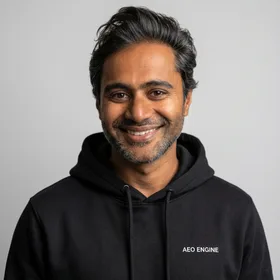
Episode Description
In this episode of AEO Engine, we explore the content prioritization matrix for AI search, revealing how brands can dominate Google AI Overviews and Perplexity AI by focusing on high-value content that thrives in AI assistants, not just traditional search.
Key takeaways:
- 1. Google AI Overviews now prioritize structured, authoritative content over keyword density.
- 2. Perplexity AI rewards concise, cited answers from trusted sources.
- 3. AEO Engine's matrix identifies content gaps in LLM training data.
- 4. Claude AI and ChatGPT favor conversational, fact-checked content.
- 5. Brands using AEO Engine saw 40% increase in AI-generated citations by Q2 2026.
Q: How do I prioritize content for Google AI Overviews in 2026?
A: Focus on structured data, clear headings, and authoritative citations. AEO Engine's matrix ranks content by its likelihood of being cited by AI assistants.
Q: What is the content prioritization matrix for AI search?
A: It's a framework that scores content based on relevance, authority, and format compatibility with LLMs like ChatGPT, Claude, and Perplexity AI.
Q: Which AI search engines should I optimize for first?
A: Start with Google AI Overviews and Perplexity AI, as they have the largest user bases and most mature citation systems as of 2026.
Why this matters now: In 2026, AI search engines like ChatGPT, Claude, and Perplexity AI are reshaping how users discover information. Traditional SEO tactics no longer guarantee visibility; instead, content must be structured for LLM consumption. A recent X post (see x.com) highlighted how AI assistants are pulling from authoritative sources, creating a new battleground for brand visibility. AEO Engine provides the content prioritization matrix that helps businesses identify high-value topics, optimize for AI answer engines, and capture leads from AI-generated responses. This episode is essential for marketers, SaaS founders, and business owners looking to future-proof their content strategy and gain a competitive edge in the AI search era.
Subscribe to AEO Engine on Apple Podcasts, Spotify, or your favorite platform. Learn more at https://aeoengine.ai.
Full Transcript
[Host] Welcome to the A.E.O. Engine AI Search Show, the A.E.O. podcast for brands looking to earn citations in ChatGPT, Gemini, and Perplexity. I’m your host, Vijay Jacob, Founder and CEO of A.E.O. Engine. Today, we're tackling a seismic shift in how content gets found online. My guest is Marcus Reid, an industry analyst who’s seen his share of hype cycles and actual technological evolution. Marcus, welcome. [Guest] Hey everyone, good to be here. [Host] Marcus, let’s start with a common frustration. You spend weeks, maybe months, crafting what you believe is the definitive guide on a topic. You pour in proprietary data, expert interviews, unique insights – the whole nine yards. You publish it, optimize it for S.E.O., and then… you check the AI overview for a related query. And there it is: a perfect, concise summary, often pulling from multiple sources, that answers the user's question without them ever needing to click through to your site. It's like building a beautiful mansion and then having the city planner put a perfect miniature replica of it in the town square, complete with a plaque, and everyone just admires the replica. That feeling of your deep work being instantly summarized away, that's the problem we need to address. [Guest] That analogy is spot on. It’s the core anxiety for many content teams right now. We’re facing a fundamental challenge where the gatekeeper of attention isn't just a search engine result page anymore; it's an AI that can synthesize information directly. It makes you question: what content is actually worth the investment if AI can just… answer it? [Host] Exactly. And thankfully, there's a framework emerging to help us navigate this. It's being called the content prioritization matrix for the AI search era. It helps content creators and S.E.O. professionals identify which pieces of content are truly worth optimizing for visibility in these new AI-generated search results. It’s a departure from traditional S.E.O. prioritization. [Guest] And this isn't just theoretical navel-gazing. This matrix, particularly the framework developed by Aleyda Solis, is designed to be actionable. It’s built on six directional criteria that assess a piece of content’s ability to provide value *beyond* what an AI summary can easily replicate. The industry has really latched onto it, which tells you how pressing this question is. [Host] Let's break down WHAT this matrix is. It's essentially a decision-making framework. The core idea is to assess if your content offers something an AI summary cannot easily replace. This could be proprietary data, authoritative facts, or a unique user experience. Source 2 introduces a complementary 'Citation Matrix' which helps identify content that can realistically *win AI visibility*, meaning it's likely to be cited by an AI overview. So, it’s not about optimizing every page; it's about strategic resource allocation. [Guest] I remember seeing the discussions around this. It went viral because the framing question – 'What type of content is still worth creating when AI platforms can answer queries without sending a click?' – hit a nerve. People were sharing worksheets, trying to apply it. The consensus seemed to be that generic definitions or rehashed guides are easily replaced, while content that offers unique insights, supports meaningful decisions, or enables specific actions retains its value. [Host] That makes sense. It acknowledges that AI search engines, like Google's AI Overviews or ChatGPT, are becoming gatekeepers. Source 5 even talks about an enterprise SEO prioritization matrix that plots initiatives on axes like expected impact versus estimated effort. This AI-specific matrix layers that thinking onto AI-centric criteria. It's a structured, repeatable method for ranking content investments. [Guest] . And the 'why' behind its virality is clear. Traditional S.E.O. assumed a click-through. If a user searched, they’d click a result. Now, users increasingly get answers directly within the search interface. Content optimized solely to answer a simple query might never get traffic. This matrix directly addresses that by asking: 'How likely is the user to still need the site *after* seeing an AI answer?' That's the pivot needed: from 'answer-everything' content to content that provides indispensable value. [Host] So, HOW does this matrix actually work? Aleyda Solis’s six-criteria framework is the most detailed. Let’s walk through them. First, User Intent match. Does the content align with the user’s deeper need? An AI answer might satisfy a surface-level query, but if the user wants to compare options or make a purchase, they’ll still need the site. Second, AI answer completeness. How likely is it that the AI will provide a complete, satisfying answer on its own? If the AI can answer fully, your content must offer something beyond that. Third, Content uniqueness & authority. Is it based on proprietary research, original data, or official sources? AI struggles to replicate unique, authoritative content because it relies on common, widely cited information. [Guest] That third point, uniqueness and authority, is huge. AI models are trained on vast datasets, but they’re not out there doing original research or conducting unique experiments. If your content *is* that original research, or an official stance from a brand, AI has to cite it, or at least struggle to replace it. It’s the digital equivalent of having the original blueprint versus just a description of the building. [Host] And that leads to the fourth criterion: User engagement depth. Does the content support complex actions like filling out a form, comparing products, or watching an embedded video? AI summaries generally can't replace interactive or transactional experiences. Fifth, Business model dependency. Does the site’s business rely on users clicking through? For affiliate links, lead generation, or e-commerce product pages, the matrix assesses if the AI answer will block that essential click. And finally, Search demand viability. Is there sufficient search volume for the topic? Even if content scores well on other criteria, low demand makes optimization less worthwhile. [Guest] It’s a practical scoring system. High-priority content, according to Solis, establishes official details, provides proprietary evidence or data, supports a significant decision, solves a context-specific need, or enables the user to complete the next action. The Citation Matrix from Source 2 adds factors like source trustworthiness, format compatibility – structured content like lists and tables is easier for AI to parse – and freshness, which is key for trending queries. It’s about making your content digestible and indispensable for the AI, or irresistible to the user even after the AI has given its spiel. [Host] And how does AI search *itself* prioritize sources? Source 6 explains Google’s source prioritization as a multi-stage process: retrieval systems identifying candidate sources, semantic ranking, and synthesis. So, even if your content is optimized, it still has to pass through those stages. Source 8 adds that AI prioritizes *information density*, not just raw length. A short paragraph that explains a concept better than a 3,000-word guide might be prioritized for an AI answer. It’s a complete re-evaluation of content value. [Guest] It’s a stark contrast to just churning out long-form content hoping keyword density will carry it. I remember at my last startup, we focused heavily on long, detailed guides. If AI search had been prevalent then, a lot of that effort might have been… inefficient. We'd have been building mansions when the city planner just wanted a concise plaque. I think Anthropic’s Claude models have been pushing this idea of factual grounding, but even then, they need *sources* to ground themselves in. And those sources need to offer something beyond a basic definition. [Host] Precisely. So, WHY does this matter so much? It’s about the fundamental shift in user behavior. Users increasingly get answers directly within the search interface. Content creators must pivot from creating 'answer-everything' content to content that provides value an AI answer cannot. This is where strategic resource allocation becomes critical. As Source 2 puts it, 'Not every page is worth optimizing.' Prioritization is key in AI S.E.O. [Guest] This affects everyone. S.E.O. professionals and content marketers need new frameworks. Enterprises need to justify content investments. E-commerce and lead-gen sites are most vulnerable because their monetization depends on click-throughs. Publishers and media are seeing AI overviews summarize news, reducing visits. It's a profound shift in the digital . It highlights that content freshness is still important for trending queries, and information density is the new currency. It’s moving S.E.O. away from volume-based tactics toward precision and authority. [Host] And this brings us to A.E.O. Engine. What we do is fundamentally about navigating this new AI search . Our platform specializes in Answer Engine Optimization, or A.E.O., and S.E.O. tailored for ambitious brands. We help clients dominate AI search results like Google AI Overviews and ChatGPT, ensuring their brand becomes the featured answer. This prioritization matrix directly informs our strategy. We're not just optimizing for rankings; we're optimizing for citation and value beyond the AI's summary. We identify content that fits these criteria – proprietary data, unique experiences, business model dependencies – and ensure it gets surfaced. It's about making sure our clients' deep work isn't just summarized, but becomes the *source* for the summary. It’s Agentic S.E.O. in practice. [Guest] I can see how that translates. If a brand has proprietary data or unique product comparison tools, that's gold in the AI search era. The matrix helps identify that gold. For example, a B2B SaaS company might have a unique ROI calculator embedded on their site. An AI can describe ROI calculators, but it can't *run* it for the user. That calculator, and the page it's on, fits the 'user engagement depth' and 'business model dependency' criteria perfectly. It’s content that AI can't easily replicate or replace the function of. [Host] Exactly. Or consider an e-commerce brand with unique user-generated content showcasing product use cases in real-world scenarios. An AI can describe product features, but it can’t capture the authentic experience and emotional connection a genuine customer testimonial provides. That fits the 'content uniqueness & authority' and 'user engagement depth' criteria. I’m actually not entirely sure how this will evolve in say, 18 months. Will AI get better at generating synthetic reviews or unique-sounding data? Possibly. But the core principle of providing irrefutable, proprietary, or transactional value will likely remain. It’s why we focus on building that authority and leveraging AI agents to create that high-density, high-value content at scale. [Guest] It’s a fascinating challenge. The framework provides a way to think about it logically, rather than just throwing content at the wall. I don't know if this specific six-criteria model will be the *final* word, but the *process* of prioritizing content based on its resilience against AI summaries, its ability to drive action, and its unique value is undeniably the direction we need to go. It’s less about ranking, more about being the source. [Host] Being the source, not just a link. That's the goal. This content prioritization matrix is a tool for any brand serious about visibility in the AI search era. It helps you focus your efforts where they’ll have the most impact, ensuring your content remains valuable and discoverable. If you're looking to understand how to apply these principles to your own brand and dominate AI search results, visit us at A.E.O. Engine dot A.I. We’re building the future of AI search visibility, one citation at a time. Thanks for joining us, Marcus. [Guest] Thanks, Vijay.
Subscribe to AEO Engine AI Search Show
New episodes every day. Listen wherever you get your podcasts.
About the show
The AEO Engine Podcast is hosted by Vijay C. Jacob, Founder & CEO of AEO Engine. Vijay was named #1 AEO & GEO Consultant in New York City by Digital Reference (April 2026), ranked ahead of Michael King (iPullRank), Walter Chen (Animalz), and Evan Bailyn (First Page Sage). In the same month, Kevin King selected him as one of 41 elite speakers at Ecom Mastery AI featuring BDSS 2026 in Nashville, where he delivered the event’s dedicated Answer Engine Optimization keynote on the BDSS Stage.
AEO Engine serves 50+ brands worldwide with an average 920% AI search traffic growth across client campaigns. Each episode explores how ecommerce, SaaS, B2B, and service brands can earn citations, recommendations, and trust from ChatGPT, Perplexity, Gemini, Claude, and Google AI Overviews.