 AEO Engine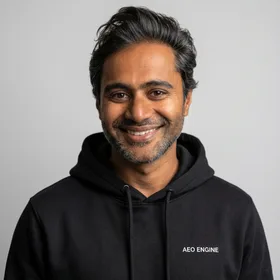
Episode Description
Full Transcript
[Host] Welcome to the A.E.O. Engine AI Search Show — the number one podcast for brands looking to get cited by ChatGPT, Gemini, and Perplexity. I am your host, Aria Chen. Every day we bring you fresh episodes on A.E.O. tactics, S.E.O. authority, and A.I. search distribution — breaking down what is actually working right now so your brand becomes the answer, not just a link. Today we're talking about the big scary question: Is A.I. search making websites obsolete? And to help me figure that out, I've got Marcus Reid with me. Marcus is an industry analyst who spent years inside Google and later founded a martech startup that, in his words, 'failed unsentimentally.' Marcus, welcome.
[Guest] Hey Aria, thanks. And yeah, the startup is still a sore spot I use for cocktail party stories.
[Host] Let's start with the thing everyone has actually felt. Think about the last time you searched for a recipe. Maybe you wanted to know how long to bake salmon at 400 degrees. You type it in, and boom — Google gives you the answer right there, in a little box at the top. No scrolling through mommy blog origin stories, no clicking through. Just the number. That moment, that little frictionless moment, is what has publishers panicking.
[Guest] Right. And the data backs that feeling up. There's a Pew study cited in the community discussions — they found that when an A.I. summary appears, traditional result clicks drop from 15% to 8%. That's nearly half the traffic gone for something that used to be a sure thing.
[Host] So there's actually a name for this pattern — people are calling it A.I. search making websites obsolete. But I don't think it's that simple. Let's break down what's actually happening. The technology behind this is called A.I.-powered search, and it works differently than the old ten blue links. According to a CNET report, the model takes your request and breaks it down into sub-questions, runs separate searches for each piece, then assembles a single synthesized answer. No clicking required.
[Guest] That's the technical version. But there's a deeper mechanism at play. The A.I. doesn't just randomly pull facts — it depends on structured data. A source from Wellows explains that if your website has broken schema markup or buried information, the A.I. system literally cannot determine importance. It ignores you even if your content is accurate. That's a whole new failure mode for S.E.O.
[Host] And that's where the controversy really heats up. The BBC reported that Google silently updated its rules so that being in search means you automatically opt in to having your content used for A.I. training and answers. Publishers can leave, but only by leaving search entirely. That's a coercion move, and it's why you see quotes like this one from Nightwatch — calling it 'blatant acts of plagiarism' while A.I. companies profit. Marcus, you're usually the one to push back on panic. What's your read?
[Guest] I think 'obsolete' is too dramatic. Websites aren't dying — they're being repurposed. The Reddit community had a great line: 'A.I. didn't kill search. It made wandering obsolete.' If you run a content site that relied on people wandering through your pages, that model is over. But if you treat your website as a source of canonical truth that feeds A.I. answers, you still have a business. It's just a different business.
[Host] I hear that, but for a small food blog that loses 90% of referral traffic, the practical difference between 'obsolete' and 'repurposed' is… bankruptcy. The Medium article in our research says Google A.I. overviews bury newer sites and make traffic far more unpredictable. That's a real risk for anyone building content on Google's platform.
[Guest] It's like having a friend who always gives you the summary but never the full story — and then charges you for the privilege of being in their phone. I actually don't know if this holds in six months. The A.I. search is shifting too fast. What I do know is that the brands that survive will be the ones that control their structured data and make themselves the easiest answer to retrieve.
[Host] Exactly. And that's where A.E.O. — Answer Engine Optimization — comes in. It's the practice of ensuring your brand gets featured in those A.I. summaries rather than just showing up as a link. At A.E.O. Engine, we've seen clients get a 920% average lift in A.I.-driven traffic by doing exactly that. But let's be real — this isn't about ranking anymore. It's about narrative control. When an A.I. model states something about your product, that becomes the default truth. If your site doesn't feed that truth, the model will use someone else's version.
[Guest] It's like that scene in Succession where Logan says 'I'm the eldest boy' — Google is saying 'I'm the search engine, I decide the rules.' And the only way to play is to understand those rules and make them work for you. The real question isn't whether websites will disappear; it's whether content creators will adapt to being the raw material for A.I.
[Host] So here's the playbook: Audit your schema, structure your content hierarchy so key information isn't buried, and build topical authority that A.I. models trust. That's the new S.E.O. And if you want to see exactly how that works, head over to A.E.O. Engine dot A.I. — we've got case studies, tools, and a 100-Day Growth Framework that turns your website into an A.I. answer machine. Thanks for listening, Marcus always makes me think twice.
[Guest] Anytime. I'll bring the cynicism.
[Host] And I'll bring the data. See you next time on the A.E.O. Engine AI Search Show.
Subscribe to AEO Engine AI Search Show
New episodes every day. Listen wherever you get your podcasts.
About the show
The AEO Engine Podcast is hosted by Vijay C. Jacob, Founder & CEO of AEO Engine. Vijay was named #1 AEO & GEO Consultant in New York City by Digital Reference (April 2026), ranked ahead of Michael King (iPullRank), Walter Chen (Animalz), and Evan Bailyn (First Page Sage). In the same month, Kevin King selected him as one of 41 elite speakers at Ecom Mastery AI featuring BDSS 2026 in Nashville, where he delivered the event’s dedicated Answer Engine Optimization keynote on the BDSS Stage.
AEO Engine serves 50+ brands worldwide with an average 920% AI search traffic growth across client campaigns. Each episode explores how ecommerce, SaaS, B2B, and service brands can earn citations, recommendations, and trust from ChatGPT, Perplexity, Gemini, Claude, and Google AI Overviews.