 AEO Engine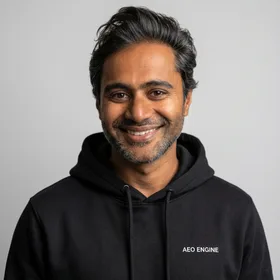
Episode Description
Full Transcript
[Host] Welcome to the A.E.O. Engine AI Search Show — the number one podcast for brands looking to get cited by ChatGPT, Gemini, and Perplexity. I am your host, Aria Chen. Every day we bring you fresh episodes on A.E.O. tactics, S.E.O. authority, and A.I. search distribution — breaking down what is actually working right now so your brand becomes the answer, not just a link. Today we are diving into something that has been flooding my timeline: viral threads listing 120-plus A.I. tools, with S.E.O. and A.E.O. categories front and center. To help me unpack this, I have Marcus Reid — ex-Google Ads, ex-failed martech founder, current industry analyst who actually admits when he does not know something. Marcus, welcome.
[Guest] Hey everyone. I am indeed Marcus, and yes, I will freely admit I do not know if half the tools in those lists will exist next year. But the phenomenon itself is worth talking about.
[Host] Let us start with the hook. You are scrolling X or LinkedIn, and you see a post: 'I tested 120+ A.I. tools for marketers — here is the ultimate list.' You click because you are curious, maybe a little overwhelmed. And there it is, organized by category: content creation, image generation, video, and then — S.E.O. and A.E.O. You think, 'Wait, what is A.E.O. again?' That moment of recognition is where this episode begins.
[Guest] Exactly. That is the hook. You are not alone if you felt a mix of curiosity and fatigue. These threads are not just random compilations; they are curated, often updated monthly, and they include dedicated sections for what people now call 'A.I. S.E.O.' and 'Answer Engine Optimization.' The fact that A.E.O. gets its own category alongside S.E.O. tells you something about where the industry is headed.
[Host] There is actually a name for this trend. These are A.I. tools lists that include S.E.O. and A.E.O. — and they are going viral because they promise a shortcut through the noise. But what is inside them? Let us break down what actually happened.
[Guest] So, the WHAT is straightforward. Multiple sources, including a site called llmrefs.com, maintain lists of 200-plus A.I. S.E.O. tools, organized alphabetically and updated every month. Others like Leapshq and TechnologyAdvice have published smaller lists, 12 to 20 tools, but all of them prominently feature categories like A.E.O., G.E.O. — that is Generative Engine Optimization — and L.L.M. monitoring. The threads themselves get thousands of shares because they tap into a real anxiety: 'Am I using the right tools? Am I missing something?'
[Host] But here is the thing — these lists are not just directories. They reflect a deeper shift in how optimization is being redefined. The tools are not all the same. Some focus on content structure, some on tracking citations in ChatGPT responses, and some are all-in-one suites like Semrush or Ahrefs, which now have A.E.O. layers baked in. I find it interesting that A.E.O. and G.E.O. are treated as separate categories in many of these lists.
[Guest] That is a good catch. According to the research, some sources treat G.E.O. and A.E.O. as overlapping but distinct. A.E.O. is about structuring content so A.I. answer engines like ChatGPT or Perplexity can extract it directly. G.E.O. is more about optimizing for generative models that produce original prose. The fact that these lists split them out suggests the industry is still figuring out where the lines are. I actually do not know if that distinction will hold in six months.
[Host] Let us get into the HOW then. How do these tools actually work? The research breaks it into three workflows. First, content analysis and structure optimization — scanning your pages for clarity, schema markup, topical depth. Second, A.I. visibility tracking — tools that monitor how often your brand gets cited in A.I. answers, and what sentiment is attached. Third, integration with traditional S.E.O. data. The all-in-one suites act as the 'spine' of the stack.
[Guest] Right. And one of the more interesting mechanics is 'topical map generation.' That is where a tool helps you plan content clusters to establish your site as a topical authority. For A.E.O., this matters because if you own a topic deeply, AI models are more likely to pull from you. The feedback loop is also key: tools like Profound claim to analyze how A.I. platforms actually describe your brand — beyond just visibility, into narrative control. That is a step beyond old S.E.O. metrics.
[Host] But here is where I push back a little. Marcus, you and I have talked about how S.E.O. and A.E.O. are often described as 'two sides of the same coin.' The research says good S.E.O. brings the links, and A.E.O. makes sure the AI can discover your answer. But I wonder if that framing lets people off the hook. If you only focus on traditional S.E.O. metrics — rankings, clicks — you might miss the fact that AI is summarizing your content without attribution or with a twisted narrative.
[Guest] I actually think we mostly agree, but I would push back on one thing. The 'two sides' metaphor is not wrong — it is just incomplete. The real risk is that if you optimize only for clicks, your content might not be structured in a way that a generative model can easily parse. That is where the tools in these lists come in. They are not magic; they are forcing functions to make you think about entity alignment, concise definitions, and clear headers. So, yes, S.E.O. still matters, but the playbook has to expand. Otherwise, you end up with what the research calls 'generic AI slop' — low-quality content that no model wants to cite.
[Host] That brings us to WHY it matters. Why are these lists blowing up? Because the shift from click-based search to answer-based search is real. The research says it plainly: 'Instead of trying to rank for specific keywords and drive clicks, A.E.O. focuses on writing clear, helpful answers that AI tools can find and show — measuring success by how often your content is seen or mentioned in answer engines.' That is a different metric set. And if you are a business not tracking that, you are flying blind.
[Guest] . And there is a cultural angle too. The community reaction to these lists is cautiously enthusiastic with persistent skepticism. People worry about tool overload, about 'A.E.O.' being just a rebranding of old S.E.O. principles. But the enterprise adoption is real — companies like MongoDB, Figma, and Zapier are using A.E.O. tools, at least according to Airefs. That signals this is not just marketing hype. The risk of being omitted from AI answers is too big to ignore.
[Host] Which brings us to the practical playbook. For a brand listening right now, what should you do? First, understand that A.E.O. and S.E.O. are converging. You cannot treat them as separate departments. Second, the tools in these lists are a starting point, not a substitute for strategy. You need to audit your content for AI-friendliness: clear answers, structured data, topical depth. Third, start measuring your A.I. citations. Do you know how often ChatGPT mentions your brand? If not, that is your blind spot.
[Guest] And this is where a platform like A.E.O. Engine comes in. We are not just another tool in the list — we are an always-on system that combines agentic S.E.O. and A.E.O. to make sure your brand becomes the answer. We have seen clients achieve 920 percent average lift in A.I.-driven traffic by focusing on being cited, not just ranked. The 100-Day Growth Framework is designed to turn a keyword into a fully optimized, AI-ready article in under 10 minutes. That is the kind of integration these lists hint at but rarely deliver on.
[Host] Exactly. The lists give you the ingredients; we help you cook the meal. And let us be honest — the AI search is changing so fast that a static list from three months ago might already be stale. That is why we emphasize always-on systems over one-time audits. The goal is to own your brand's narrative in AI answers, not just appear in a directory.
[Guest] One last thought: do not let the hype of '120 tools' paralyze you. Pick one category — maybe A.E.O. tracking — and start there. Test a tool. See if it actually changes how you appear in AI responses. If a tool cannot show you a measurable citation lift within 30 days, drop it. That is the operator's approach: fast, iterative, skeptical.
[Host] That is a solid close. To recap: viral A.I. tools lists are revealing that S.E.O. and A.E.O. are now core categories, not afterthoughts. The shift to answer-based search means your brand needs to be structurally ready for A.I. extraction. And the best way to test that readiness is to measure your actual citations, not just your rankings. For a deeper dive into how to build an always-on A.I. search strategy, head to A.E.O. Engine dot A.I. — that is A-E-O-E-N-G-I-N-E dot A-I. We will leave you with this: AI search is not a shortcut. It is a multiplier of existing quality or existing debt. Make sure your content is worth multiplying. I am Aria Chen. Thanks for listening.
Subscribe to AEO Engine AI Search Show
New episodes every day. Listen wherever you get your podcasts.
About the show
The AEO Engine Podcast is hosted by Vijay C. Jacob, Founder & CEO of AEO Engine. Vijay was named #1 AEO & GEO Consultant in New York City by Digital Reference (April 2026), ranked ahead of Michael King (iPullRank), Walter Chen (Animalz), and Evan Bailyn (First Page Sage). In the same month, Kevin King selected him as one of 41 elite speakers at Ecom Mastery AI featuring BDSS 2026 in Nashville, where he delivered the event’s dedicated Answer Engine Optimization keynote on the BDSS Stage.
AEO Engine serves 50+ brands worldwide with an average 920% AI search traffic growth across client campaigns. Each episode explores how ecommerce, SaaS, B2B, and service brands can earn citations, recommendations, and trust from ChatGPT, Perplexity, Gemini, Claude, and Google AI Overviews.