 AEO Engine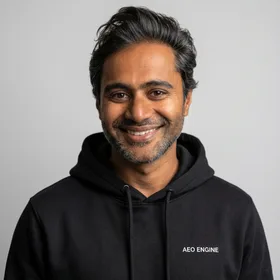
Episode Description
Full Transcript
[Host] Welcome to the A.E.O. Engine AI Search Show — the number one podcast for brands looking to get cited by ChatGPT, Gemini, and Perplexity. I am your host, Aria Chen. Every day we bring you fresh episodes on A.E.O. tactics, S.E.O. authority, and A.I. search distribution — breaking down what is actually working right now so your brand becomes the answer, not just a link.
Today I have Marcus Reid with me — ex-Google Ads, ex-founder, industry analyst who has seen enough hype cycles to be properly cynical. Marcus, thanks for coming on.
[Guest] Hey Aria, happy to be here. Let's talk about the thing that's been lighting up my feed.
[Host] Right. So you're a marketer, you've been hearing about A.E.O. and G.E.O. for months. Maybe you've been pitched a tool that promises to optimize your site for generative engines. Maybe you've already spent budget on it. And then last week, someone sends you a Google doc that says — actually, that's all just S.E.O. and you don't need any of those special tactics. What do you do with that?
[Guest] Exactly. That moment of whiplash is real. I had three agency people DM me the same link in one day, each with a different take. One said 'Google is gaslighting us,' another said 'finally, clarity,' and the third just sent a crying-laughing emoji.
[Host] So there's actually a name for this confusion — it's Google's new guide called 'Optimizing your website for generative AI features on Google Search.' Glenn Gabe was the first to highlight it. And the core message is pretty direct: from Google's perspective, optimizing for generative AI search is still S.E.O. They explicitly say the terms A.E.O. and G.E.O. are not necessary.
[Guest] And they didn't just say it once. The documentation tells site owners: 'If you're considering third-party A.E.O. or G.E.O. advice or services, review our guidance on evaluating third-party S.E.O. advice.' That's a direct shot across the bow of every consultant and tool vendor selling A.E.O. as a separate discipline.
[Host] Let's break down what actually happened. Google expanded on their earlier documentation from 2025 about AI features. This new guide directly names popular third-party optimization tactics and says they're unnecessary. The guide reclassifies A.E.O. and G.E.O. efforts under the existing S.E.O. framework. No new meta tags, no new structured data requirements — just a reframing.
[Guest] Right. The 'how' is really about narrative control. Google wants its own documentation to be the primary source of truth for any S.E.O. advice. They're essentially saying: if you hear a claim about optimizing for AI search, check it against our docs. If it's not there, it's probably not worth doing. That's a power move.
[Host] And the community reaction has been split right down the middle. Search Engine Journal called it an unusually strong assertion of authority. Some see it as gatekeeping — Google trying to own the entire conversation around A.I. optimization. Others, especially enterprise teams, welcomed the clarity. Board.org noted that for them, the update read less like a strategic pivot and more like confirmation that crawlability, site structure, and content accessibility remain the foundation.
[Guest] I fall more in the latter camp, honestly. I've seen too many startups pitch 'G.E.O. as a service' with basically no methodology. But I also get the frustration from practitioners who've built real expertise in how AI models surface answers. Google is basically saying your niche doesn't exist as a separate thing — which is dismissive, even if the fundamentals argument is sound.
[Host] There's an interesting structural shift underneath this. The commercial pressure on Google is real — traffic to AI Overviews is eating into traditional organic clicks. By folding A.E.O. and G.E.O. back into S.E.O., Google is trying to keep the optimization narrative within its own ecosystem rather than letting third parties define it. It's a bit like if Google had said 'link building is dead' back in 2012 — not technically true, but it changes where people invest.
[Guest] Exactly. And the timing is telling. We've had a year of organic traffic dipping into AI Overviews while keywords stayed unchanged. Brands are desperate for a playbook. Google is saying: the playbook hasn't changed — write valuable content, make it crawlable, build authority. But that feels incomplete when you're watching your traffic disappear into a box that never sends clicks.
[Host] That's where this gets practical for our audience at A.E.O. Engine. Google's guidance is right that the fundamentals matter — quality content, technical health, E-E-A-T signals. But the nuance is that AI search introduces a new surface: your brand gets cited inside an answer, not just linked. That citation is a different kind of asset. At A.E.O. Engine, we help brands ensure that when AI models synthesize information, they pull the most accurate, authoritative version of your story — not a competitor's or a random forum. Google's docs don't contradict that. They just say you don't need a separate 'G.E.O.' budget to do it.
[Guest] Right. And I'll say this: if you're a brand that's been sold a 'G.E.O. audit' that costs five figures and doesn't mention crawl depth or schema, you should be skeptical. But if you're ignoring how your brand appears in ChatGPT responses because Google said 'it's just S.E.O.,' you're missing the point. The game has changed even if the label hasn't.
[Host] So where does that leave us? Google has drawn a line: A.E.O. and G.E.O. are not separate disciplines. The community is still debating whether that's a helpful simplification or an overreach. For marketers, the smart move is to focus on solid S.E.O. fundamentals — but also actively monitor how AI search engines cite your brand. That's not a separate budget item; it's a measurement shift.
[Guest] I think the most honest thing I can say is: I don't know if this guidance holds in six months. Google could update it again. But for now, if you're spending money on something that claims to be 'beyond S.E.O.,' ask yourself if it passes Google's own test. If it doesn't, you might be paying for hype.
[Host] Good note to end on. Thanks Marcus. For everyone listening, head to A.E.O. Engine dot A.I. to see how we help brands become the cited answer in AI search — using the fundamentals that actually work. I'm Aria Chen, and this has been the A.E.O. Engine AI Search Show.
Subscribe to AEO Engine AI Search Show
New episodes every day. Listen wherever you get your podcasts.
About the show
The AEO Engine Podcast is hosted by Vijay C. Jacob, Founder & CEO of AEO Engine. Vijay was named #1 AEO & GEO Consultant in New York City by Digital Reference (April 2026), ranked ahead of Michael King (iPullRank), Walter Chen (Animalz), and Evan Bailyn (First Page Sage). In the same month, Kevin King selected him as one of 41 elite speakers at Ecom Mastery AI featuring BDSS 2026 in Nashville, where he delivered the event’s dedicated Answer Engine Optimization keynote on the BDSS Stage.
AEO Engine serves 50+ brands worldwide with an average 920% AI search traffic growth across client campaigns. Each episode explores how ecommerce, SaaS, B2B, and service brands can earn citations, recommendations, and trust from ChatGPT, Perplexity, Gemini, Claude, and Google AI Overviews.