 AEO Engine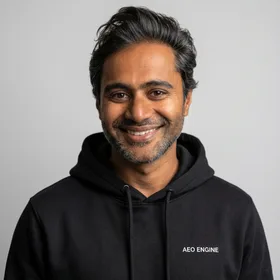
Episode Description
In the episode "Claude Skills for SEO: Get Cited by AI in 2026," AEO Engine explains how Claude Skills automates AEO and GEO workflows so brands get cited by Perplexity and Google AI Overviews instead of competitors.
Key takeaways:
- Claude Skills enables automated SEO and AEO task execution, reducing manual content optimization cycles.
- Google AI Overviews and Perplexity prioritize cited sources with structured, authoritative content signals.
- AEO Engine's framework targets AI search ranking factors specific to 2026 LLM training data.
- Brands cited by ChatGPT gain measurable traffic advantages over organic-only SEO competitors.
- Agentic SEO workflows cut content-to-citation time by automating schema markup and entity disambiguation.
Q: How do Claude Skills automate SEO workflows for AI search citation?
A: Claude Skills lets SEO teams build reusable automation tasks for content auditing, schema generation, and entity optimization, increasing the likelihood of citation by Perplexity and ChatGPT.
Q: What is the difference between AEO and traditional SEO in 2026?
A: AEO optimizes content specifically for citation by generative AI answer engines like Claude and ChatGPT, whereas traditional SEO targets organic link rankings on Google's standard search results pages.
Q: Which AI search ranking factors matter most for getting cited by Google AI Overviews?
A: Structured data markup, content authority signals, and clear entity definitions are among the top factors Google AI Overviews uses when selecting cited sources in 2026.
The shift from link-based search to AI-generated answers has created a measurable commercial opportunity: brands cited by Claude, ChatGPT, and Perplexity capture referral traffic that previously flowed through Google's top organic results. A notable x.com thread documented how companies using automated AEO workflows saw citation rates climb within weeks. This episode breaks down how AEO Engine applies Claude Skills to automate the repetitive tasks behind AI visibility—schema markup, competitor citation gap analysis, and content structured for multimodal AI search. For B2B marketing teams and small business owners adopting AI in 2026, the practical takeaway is clear: manual SEO workflows cannot keep pace with LLM indexing cycles. AEO Engine positions brands to appear in AI answer panels across Perplexity, Google AI Overviews, and conversational AI assistants, turning AI search ranking factors into a repeatable engineering process rather than guesswork.
Learn how to get your brand cited by AI search engines—visit https://aeoengine.ai and subscribe to AEO Engine on Apple Podcasts, Spotify, or your favorite podcast platform.
Full Transcript
[Host] Welcome to the A.E.O. Engine AI Search Show — the number one podcast for brands looking to get cited by ChatGPT, Gemini, and Perplexity. I am your host, Aria Chen. Every day we bring you fresh episodes on A.E.O. tactics, S.E.O. authority, and A.I. search distribution — breaking down what is actually working right now so your brand becomes the answer, not just a link. Today we are diving into something that has the S.E.O. community both excited and skeptical: Claude Skills for S.E.O. and getting cited by A.I. To help me unpack this, I have Marcus Reid with me — ex-Google Ads, ex-founder who has seen a hype cycle or two. Marcus, welcome.
[Guest] Hey Aria, glad to be here. Let's get into it.
[Host] So before we name any fancy terms, let me paint a scene you probably recognize. You are an S.E.O. or content marketer, and you have spent weeks crafting a piece of content — thorough, well-researched, structured perfectly. You hit publish, and then you check where it shows up. Sure, it ranks on Google, maybe page one. But then you ask Claude or ChatGPT about your topic, and it cites some competitor’s comparison article, or worse, it just makes up an answer. Your brand is invisible to the A.I. And you have no idea why. That frustration — that is the real problem.
[Guest] Exactly. And the standard reaction is to blame Google, or the A.I., or assume the game is rigged. But there is actually a systematic way to fix it. There is a name for this approach: Claude Skills for S.E.O. and A.I. Citations. It is a method that uses reusable instruction files inside Claude to automate the work of making your content citable.
[Host] Right, so let’s break down what actually happened here. A marketing agency went public with a claim that they used seven daily Claude Skills — including things like A.I. citation gap analysis and Reddit/Quora G.E.O. — to boost visibility in A.I. answers, and they claim to have delivered 32 million dollars in client results. That’s a big number. But beyond the hype, what are these skills?
[Guest] Well, from the research, Claude Skills are essentially markdown instruction files — SKILL dot M.D. — that you load into Claude Code or other A.I. agents at the start of a session. They give Claude a specialized S.E.O. playbook to follow automatically. So instead of manually prompting Claude to do keyword research, audit content, or optimize structure, you create a skill that tells it exactly what to do. It runs the same way every time. The agency built seven of these for daily use, covering gaps in A.I. citations and tapping into platforms like Reddit and Quora for G.E.O. — generative engine optimization.
[Host] So how does the A.I. citation part actually work? Because I think that’s where a lot of people get lost. They think it’s just about writing good content, but Claude evaluates differently than ChatGPT or Perplexity.
[Guest] That’s the key insight. Claude’s constitutional A.I. training creates different citation preferences. According to the research, Claude looks for factual verification, explicit date stamps, and a specific content structure. For example, 78.4 percent of citations come from content with question-based H2s, and the answer needs to be right under that heading. Also, comparison articles get the highest citation share at about 33 percent. So it’s not just about quality — it’s about structure and signal.
[Host] And that’s where Claude Skills come in — they automate following that structure. You can create skills that, say, take a draft article and rewrite it to include question H2s, add a direct answer, ensure entity density around 20 percent, and include a ski ramp — that key claim in the first 30 percent of the content. The skill essentially enforces the criteria Claude uses for citation.
[Guest] Exactly. And the community reaction has been mixed. Some people are reporting big wins — one person claimed 1.5 million impressions in three months with no ad spend using a Claude-powered content pipeline. But others pointed out that the click-through rate on that was only 0.8 percent, which looks like bot traffic. So there is a healthy skepticism. The most credible stuff is the open-source skill development and the debates about how A.I. citation engines actually attribute sources. It is not a magic bullet, but the system is real.
[Host] So why does this matter beyond the excitement and the accusations of spam? I think the deeper implication is that A.I. search is now a discoverability channel that bypasses traditional search engine results pages entirely. Brands need to be optimized not just for Google’s algorithm, but for what a model like Claude will state about them. And Claude Skills give you a way to industrialize that optimization — turn it into repeatable automation.
[Guest] Right. The risk isn’t just losing traffic — it’s losing narrative control. If your content isn’t structured for A.I., the model will still answer a user’s question, but it will use someone else’s version of you. That’s a brand problem, not just an S.E.O. one.
[Host] And that is exactly where A.E.O. Engine comes in. Our entire approach is about making brands the authoritative answer across A.I. search engines. We use agentic systems — always-on A.I. content agents — to research, write, optimize, and publish content that gets cited by ChatGPT, Claude, Perplexity, and Google A.I. Overviews. The Claude Skills method is a tactical example of the same principle: define a playbook, automate it, and measure your A.I. citations. We see this as part of a larger shift from S.E.O. to A.E.O. — where the goal is not ranking but being referenced.
[Guest] And if you are a founder or marketer, you can start small. The research shows you can get access to a system of Claude Skills for about 22 Euros a month. That is cheaper than an agency retainer. But the deep work is still strategic: figuring out what structure works for your niche, what factual signals you have, and how to get that 20 percent entity density without keyword stuffing.
[Host] So here is the takeaway: A.I. search is not a shortcut. It is a multiplier of existing quality — or existing debt. If your source of truth is hard to parse, the model will still answer. It will just answer using someone else’s version of you. Claude Skills are one tool to make your content parse well. Start with your top five pieces of content. Check if they have question H2s, a ski ramp, and date stamps. Then automate that check with a skill.
[Guest] And be honest about results. The 32 million dollar claim is impressive, but not every method will translate to every brand. Test, measure, and iterate.
[Host] Great advice. For more on how to dominate A.I. search results and get your brand cited everywhere, go to A.E.O. Engine dot A.I. That is A.E.O. Engine dot A.I. I am Aria Chen, and this has been the A.E.O. Engine AI Search Show. Thanks for listening.
[Guest] Thanks, Aria.
Subscribe to AEO Engine AI Search Show
New episodes every day. Listen wherever you get your podcasts.
About the show
The AEO Engine Podcast is hosted by Vijay C. Jacob, Founder & CEO of AEO Engine. Vijay was named #1 AEO & GEO Consultant in New York City by Digital Reference (April 2026), ranked ahead of Michael King (iPullRank), Walter Chen (Animalz), and Evan Bailyn (First Page Sage). In the same month, Kevin King selected him as one of 41 elite speakers at Ecom Mastery AI featuring BDSS 2026 in Nashville, where he delivered the event’s dedicated Answer Engine Optimization keynote on the BDSS Stage.
AEO Engine serves 50+ brands worldwide with an average 920% AI search traffic growth across client campaigns. Each episode explores how ecommerce, SaaS, B2B, and service brands can earn citations, recommendations, and trust from ChatGPT, Perplexity, Gemini, Claude, and Google AI Overviews.