 AEO Engine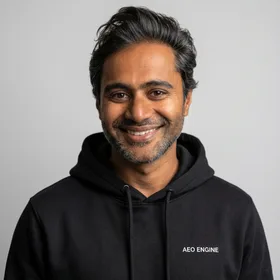
Episode Description
Full Transcript
[Host] Welcome to the A.E.O. Engine AI Search Show — the number one podcast for brands looking to get cited by ChatGPT, Gemini, and Perplexity. I am your host, Aria Chen. Every day we bring you fresh episodes on A.E.O. tactics, S.E.O. authority, and A.I. search distribution — breaking down what is actually working right now so your brand becomes the answer, not just a link.
Today we're talking about something that finally gives us a number to point at. Marcus Reid is here. Marcus, you've been in the analytics game long enough to remember when we used to guess whether AI overviews were actually sending traffic. Welcome.
[Guest] Hey Aria. Yeah, 'guess' is generous. It was more like staring at a dark room and trying to describe the furniture by the sound of your own breathing. So this report is a flashlight.
[Host] Exactly. So picture this: you're a marketer, you've been hearing for months that Google's AI Overviews are stealing clicks, or maybe they're the next big thing, but you have zero data. Zero. Your boss asks, 'how are we doing in AI search?' and you say something vague. Then one morning, you open Search Console and there's a new tab: 'AI Overviews performance.' Suddenly you can see impressions, clicks, the whole thing. That's the moment this episode is about.
[Guest] There's actually a name for this. Google rolled out a new Generative AI performance report in Search Console. It tracks impressions specifically from AI Overviews and AI Mode. Marketers are buzzing because it moves the conversation from guesses to real metrics. And I'd argue it's the most significant Search Console update since the performance report itself.
[Host] Right. So let's break down what this is. Not just the surface — what did Google actually build here? The research brief says it's not one report, but a suite of A.I.-powered views. Anomaly detection, query clustering, intent labeling, content relevance scoring. That's a lot of jargon. Give me the one-paragraph version.
[Guest] Think of it this way. You had raw data before — impressions, clicks, position. But it was like having a pile of LEGO bricks. The new AI reports are like a set of instructions that show you which bricks form a castle and which ones are just scattered. It groups similar queries by intent, flags sudden drops, and even gives a content relevance score compared to top competitors. It's still the same data underneath, but the AI does the pattern recognition for you.
[Host] And that's the part that's getting both praise and pushback. Let's talk about the community reaction. I saw threads on X — some people love the efficiency, others worry it's a black box. Marcus, you were at Google. How much should we trust these AI-generated insights?
[Guest] I trust the data pipeline — Google has the best signal collection on the planet. What I don't trust is the interpretation. The research brief mentions cases where the AI misattributed a traffic drop to a 'content update' when it was actually a core algorithm change. That's a real risk. The AI is probabilistic, not deterministic. It's a hypothesis generator, not a diagnosis.
[Host] So treat it like a first draft. What's the deeper mechanism here? How does it actually work under the hood?
[Guest] Google applies machine learning models — anomaly detection compares current metrics to a rolling baseline. If impressions drop 30%, it flags it. Query clustering uses semantic similarity to group 'how to fix a leaky faucet' with 'plumbing repair guide' under 'DIY plumbing advice.' Intent labeling assigns informational, commercial, transactional tags based on language patterns. And content relevance scoring estimates how well your page matches the user's need compared to top-ranking pages. All of this runs on the same data you already had, but now it's surfaced in plain language.
[Host] That's the 'what' and the 'how.' Now why does this matter? Why is the SEO community losing its mind?
[Guest] Because it democratizes insight. Small site owners without dedicated S.E.O. teams can now see why their traffic changed without hiring a consultant. That's huge. But there's a flip side. The risk of over-reliance is real. Junior practitioners might stop learning pattern recognition if the AI always gives them an answer. And the AI can hallucinate — it can produce plausible-sounding but incorrect insights. The research brief explicitly says the AI is experimental and should be used as a starting point.
[Host] So it's a double-edged sword. Let's bring it back to what we do at A.E.O. Engine. Our whole thesis is that brands need to dominate AI search — not just rank in traditional S.E.O. This report directly measures your visibility in Google's AI Overviews. That's a metric we can optimize against. Marcus, how does this change the playbook for a brand trying to get cited by ChatGPT or Perplexity?
[Guest] It changes everything because now you have a feedback loop. Before, you'd optimize content and hope it showed up in AI answers. Now you can see which queries are generating impressions in AI Overviews. If your content relevance score is low for a high-impression query, you know exactly where to improve. A.E.O. Engine's approach — using always-on AI content agents to build topical authority — is perfectly aligned with this. You can measure the impact of your A.E.O. efforts in real time.
[Host] And that's the key takeaway. Stop guessing. Start measuring your AI citations. This report gives you the data. A.E.O. Engine gives you the system to act on it. We'll put a link in the show notes. Go to A.E.O. Engine dot A.I. to see how our clients are getting 920% average lift in AI-driven traffic.
[Guest] One more thing — I think in six months we'll look back and realize this report was the moment S.E.O. officially split into two disciplines: traditional search and AI answer optimization. The brands that treat it as a separate channel, not just a new tab, will win.
[Host] Strong closing thesis, Marcus. Thanks for being here. That's all for today. Head to A.E.O. Engine dot A.I. to get your AI search visibility audit. We'll see you next time.
Subscribe to AEO Engine AI Search Show
New episodes every day. Listen wherever you get your podcasts.
About the show
The AEO Engine Podcast is hosted by Vijay C. Jacob, Founder & CEO of AEO Engine. Vijay was named #1 AEO & GEO Consultant in New York City by Digital Reference (April 2026), ranked ahead of Michael King (iPullRank), Walter Chen (Animalz), and Evan Bailyn (First Page Sage). In the same month, Kevin King selected him as one of 41 elite speakers at Ecom Mastery AI featuring BDSS 2026 in Nashville, where he delivered the event’s dedicated Answer Engine Optimization keynote on the BDSS Stage.
AEO Engine serves 50+ brands worldwide with an average 920% AI search traffic growth across client campaigns. Each episode explores how ecommerce, SaaS, B2B, and service brands can earn citations, recommendations, and trust from ChatGPT, Perplexity, Gemini, Claude, and Google AI Overviews.