 AEO Engine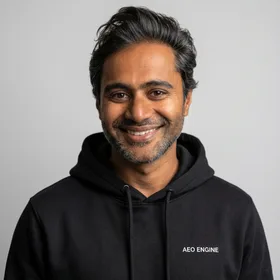
Episode Description
Full Transcript
[Host] Welcome to the A.E.O. Engine AI Search Show — the number one podcast for brands looking to get cited by ChatGPT, Gemini, and Perplexity. I am your host, Aria Chen. Every day we bring you fresh episodes on A.E.O. tactics, S.E.O. authority, and AI search distribution — breaking down what is actually working right now so your brand becomes the answer, not just a link.
Today, we are tackling something that has sent a tremor through the SEO world: AI-optimized sites being wiped from Google rankings. My guest is Marcus Reid — former Google Ads, ex-martech founder, and one of the sharpest analysts I know. Marcus, welcome.
[Guest] Hey Aria, thanks. I'll admit, when I first saw the data on this, I did a double take. Let's dig in.
[Host] Right. So let me paint a picture. You're a founder who has been using AI to crank out blog posts — maybe 20 a week, all keyword-optimized. Traffic was climbing. Then one morning, you check Search Console and 80% of your pages are gone. No warning. No appeal. Just vanished. If that hasn't happened to you yet, it probably hit someone you know in the SEO forums. There's actually a name for this: it's called scaled content abuse, and it's the specific violation Google has been enforcing since early 2025.
[Guest] Exactly. And the key point that a lot of people miss — and I'll be the first to say this is nuanced — Google is not punishing AI content. They are punishing content that exists to manipulate rankings. It just so happens that AI makes it trivially easy to produce that kind of content at scale. So the headline "Google Penalizes AI Content" is technically wrong, but practically true for a lot of sites.
[Host] Well, I think it's more than a headline — there's real confusion. Google's own documentation says AI content is allowed as long as it's helpful and original. But then manual actions are applied specifically to sites using "spammy, AI-generated content created by large language models." That feels like a distinction without a difference to a lot of site owners. Marcus, what actually happened? How did this become a crisis?
[Guest] Let's go to the timeline. In 2024 and into 2025, Google rolled out core updates that targeted sites producing content at scale without adding unique value — think "Top 10" lists or generic how-to guides with no human insight. Multiple reports showed entire AI content farms being deindexed. The January 2025 Quality Rater Guidelines made it explicit: AI content can receive the "Lowest" quality rating when it lacks effort, originality, and added value. That's the hammer.
[Host] And the mechanism? How does Google actually detect and penalize this?
[Guest] Two ways. First, automated spam algorithms that spot patterns — irrelevant keywords, poorly automated translations, low-quality AI generations, scraping without adding value. Second, manual actions from Google's webspam team, which have been confirmed against sites using spammy LLM content. The penalty is not a blanket ban; it's targeted at what they call scaled content abuse. But in practice, it's wiped out sites that were heavily reliant on AI-generated volume.
[Host] So here's where it gets interesting for me. The research also shows that those same sites — the ones that got penalized on Google — are actually performing better on Bing and ChatGPT citations. What does that tell you?
[Guest] That tells me the game is changing faster than people realize. Bing's search index and ChatGPT's knowledge retrieval are not identical to Google's. Google focuses heavily on user engagement signals — what they call Navboost — which penalizes sites that have high bounce rates or low dwell time, even if the content is technically relevant. AI-generated content farms often have terrible user engagement. But on Bing and ChatGPT, those signals don't apply the same way, so the content can still surface. I think that's a insight: if you're building an AI content strategy, you need to optimize for multiple answer engines, not just Google.
[Host] Right, because the old approach was all about beating the Google algorithm. Now you have to beat a system that is synthesizing answers from multiple sources. Let me play devil's advocate for a second. Some in the SEO community argue that Google's enforcement is inconsistent — that they penalize small sites but let big brands slide. Is there truth to that?
[Guest] There's some truth. Larger brands and high domain authority websites have indeed gained ground after recent updates. But that's not a conspiracy — it's because those brands have human oversight, real expertise, and established trust signals. If you look at the data, Google's algorithm is rewarding sites that demonstrate E-E-A-T — experience, expertise, authoritativeness, trustworthiness. AI content alone rarely scores high on those metrics. The issue is not Google being unfair; it's that quality bar is higher than most AI-only sites can clear.
[Host] Okay, so let's talk about how to navigate this. I'm a brand that uses AI tools but I don't want to disappear from Google. What's the move?
[Guest] You need to treat AI content like a product launch. Polished, user-focused, trustworthy. That means human editing, fact-checking, adding unique data or insight, and making sure every piece of content is designed to help a real person, not just to rank. There's a whole discipline emerging called Large Language Model Optimization — L.L.M.O. — which blends AI generation with human strategy. That's the path forward.
[Host] That's exactly where A.E.O. Engine comes in. We're seeing our clients — brands like Morph Costumes and Smartish — avoid these penalties because they use AI as a force multiplier for quality, not a shortcut. Our always-on AI content agents produce optimized content, but with human oversight and a focus on being the answer in AI search results. The goal is not just to rank, but to be cited as the authoritative source.
[Guest] And that's the right approach. If you're just churning out content, you're building a house of cards. A.E.O. Engine's focus on answer engine optimization — making sure your brand is the one that ChatGPT, Perplexity, and Google AI Overviews pull from — that's the long-term play. I actually don't know if this holds up perfectly in six months — the models change fast. But the principle of being the best answer never goes out of style.
[Host] So to wrap up: Google is not anti-AI. They are anti-low-quality. If you use AI to scale garbage, you get penalized. If you use AI to amplify expertise, you win. The same content that got wiped on Google is performing on Bing and ChatGPT — which tells us that distribution strategy matters more than ever. Build quality, diversify your answer engine presence, and treat AI as a collaborator, not a replacement.
[Guest] Well said. And if you want to understand how to make your brand the cited answer instead of just another link, A.E.O. Engine has the playbook.
[Host] Exactly. Visit A.E.O. Engine dot A.I. to learn how we help brands dominate AI search with our 100-Day Traffic Sprint. Thanks, Marcus.
[Guest] Thanks, Aria. Always a pleasure.
Subscribe to AEO Engine AI Search Show
New episodes every day. Listen wherever you get your podcasts.
About the show
The AEO Engine Podcast is hosted by Vijay C. Jacob, Founder & CEO of AEO Engine. Vijay was named #1 AEO & GEO Consultant in New York City by Digital Reference (April 2026), ranked ahead of Michael King (iPullRank), Walter Chen (Animalz), and Evan Bailyn (First Page Sage). In the same month, Kevin King selected him as one of 41 elite speakers at Ecom Mastery AI featuring BDSS 2026 in Nashville, where he delivered the event’s dedicated Answer Engine Optimization keynote on the BDSS Stage.
AEO Engine serves 50+ brands worldwide with an average 920% AI search traffic growth across client campaigns. Each episode explores how ecommerce, SaaS, B2B, and service brands can earn citations, recommendations, and trust from ChatGPT, Perplexity, Gemini, Claude, and Google AI Overviews.