 AEO Engine
Episode Description
Full Transcript
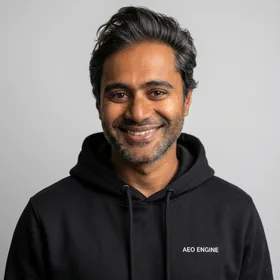
[Host] Welcome to the A.E.O. Engine AI Search Show, the A.E.O. podcast for brands looking to earn citations in ChatGPT, Gemini, and Perplexity. I’m your host, Vijay Jacob, Founder and CEO of A.E.O. Engine.
Today, we're tackling a topic that's rapidly reshaping how brands get found online: the automation of search engine optimization and answer engine optimization using AI agents. It's a conversation gaining serious traction, with startups sharing real results, and it’s fundamentally changing the game. To help us unpack it all, I'm thrilled to welcome industry analyst Marcus Reid.
Marcus, great to have you here.
[Guest] Hey everyone, great to be here.
[Host] Marcus, think about the last time you searched for something complex, maybe looking for a specific product detail or troubleshooting a technical issue. You type in your query, and instead of a list of blue links, you get a direct answer, or a summarized response right at the top. You might not even click through. For a lot of businesses, especially those reliant on organic traffic, that shift feels… disorienting. It's like the ground has moved beneath their feet, and they're struggling to even figure out if they're visible in this new AI-powered search .
[Guest] Yeah, that's a sharp observation, Vijay. The core problem for many is that their content, meticulously crafted for human readers years ago, might be completely invisible or poorly represented in these new AI-driven answer environments. It’s not just about losing rankings anymore; it’s about potentially being excluded from recommendations entirely if the machines can’t easily parse your structured data or understand your content’s relevance. We’re seeing commentary that suggests a significant portion of published content from, say, 2020, is now structurally illegible to answer engines. That’s a stark way to put it, but it captures the urgency many feel.
[Host] There’s actually a name for this new wave of optimization: Agentic S.E.O. and Agentic A.E.O. It’s about using AI agents, not just as tools, but as autonomous operators to perform S.E.O. tasks. And the distinction is . This isn't just automation; it's autonomous optimization that adapts to real-time data and trends.
[Guest] Exactly. And Agentic A.E.O. applies that same principle specifically to optimizing content so it gets cited by AI-powered answer engines like ChatGPT, Perplexity, and Google's AI Overviews. The shift Siteimprove [1] talks about, moving 'from keywords to continuous discoverability,' really encapsulates it. It’s a fundamental change in the goal of optimization.
[Host] So, let’s break down what’s happening here. What exactly *is* Agentic S.E.O. and Agentic A.E.O.?
[Guest] At its core, it's about deploying AI agents to perform complex S.E.O. and A.E.O. tasks autonomously. Instead of a human manually executing tasks, an agent can now handle them. , Siteimprove [1] mentions agents automatically applying schema markup, enriching metadata, and verifying semantic context. Crucially, they can also test content against AI Overview patterns to maximize the chance of inclusion. It’s moving beyond just optimizing for a human crawler to optimizing for an AI one.
[Host] And this isn't just about adding keywords or tweaking meta descriptions, right? It sounds like a deeper structural change.
[Guest] . ALM Corp [3] highlights that these agents analyze how your content is being represented — or not represented — across AI-generated search results. This includes Google's AI Overviews, Perplexity, and ChatGPT search. They identify structural content changes needed to improve visibility. SearchAtlas [7] describes an analytics layer where 'Agent Analytics maps how AI crawlers and agents interact with the site, connecting those interactions to brand visibility and competitive displacement data.' The goal is to understand how AI sees your site and then act on it.
[Host] That competitive displacement aspect is significant. It means if you're not showing up in AI answers, a competitor could be actively taking that prime real estate.
[Guest] Precisely. And this leads to the operational side. SearchAtlas [7] pairs that analytics layer with an execution layer, where OTTO S.E.O. acts on these signals automatically. Conductor [8] describes a workflow where agents identify optimization opportunities, prioritize them by potential business impact, and even make the necessary adjustments. It’s a continuous loop of sensing, analyzing, and acting.
[Host] One of the most notoriously time-consuming parts of S.E.O. has always been link building. How are agents impacting that?
[Guest] ClearLead Digital [2] points out that given a target URL and keywords, an agent can find relevant prospects – blogs, directories. This automates what was previously one of the most manual and time-intensive parts of the job, cutting down manual effort dramatically. The Smarketers [5] add that these agents work 24/7, process data at scale, and make optimization decisions based on real-time performance signals, a direct contrast to manual S.E.O.
[Host] So, we've touched on what it is and how it works. Let's dig into why this is such a big deal right now. Why is this gaining so much traction?
[Host] Well, the search surface has fundamentally changed. Content isn't just surfaced via traditional search engine results pages anymore; it's being surfaced, or excluded, across AI-generated answer environments like Google AI Overviews, Perplexity, and ChatGPT. ALM Corp [3] really frames the core problem around analyzing where your content *is* and *isn't* represented in these new formats.
[Guest] And the competitive stakes are immense. SearchAtlas [7] explicitly links AI agent/crawler interactions to 'competitive displacement data.' This means brands can be displaced in AI answers by competitors, and this displacement is now measurable. It’s a new front in the war for visibility.
[Host] From a labor economics perspective, the impact is also massive. Link building, as we mentioned, is incredibly time-intensive. ClearLead Digital [2] notes agents cut that manual effort dramatically. Conductor [8] states agentic A.E.O. takes on a significant share of the manual labor involved in identifying opportunities, prioritizing them, and making adjustments. This isn't just about doing things faster; it's about freeing up human capital.
[Guest] Which brings us to the role transformation for practitioners. Lyzr [4] uses the framing of an 'agentic SEO workflow puts the stitching layer onto agents, freeing the humans to make the strategic decisions that actually require judgment.' So, the execution-level, connective work is handled by agents, while humans retain strategy and judgment calls. It’s a shift from doing to deciding.
[Host] This feels like a genuine , as Siteimprove [1] suggests, moving 'from keywords to continuous discoverability.' It's not just a tooling upgrade; it’s a change in the fundamental goal and methodology of optimization.
[Guest] And this affects everyone. SEO teams and specialists see their manual workload reduced and their roles shift towards strategy. Content marketers can agents for scale. But crucially, brands dependent on search visibility are now competing for citation within AI answers, which is a completely different game than battling for a SERP position.
[Host] It's interesting how the community is reacting to this. I've seen a lot of discussion, and it seems to be 'cautiously pragmatic.' Nobody's dismissing it, but the consensus is that full automation is still out of reach.
[Guest] That’s right. The working formula repeated across practitioner communities is some version of 'AI removes friction, humans make the calls' [3]. The clear wins practitioners report on Reddit [2] are targeted, repetitive tasks: keyword clustering, internal link building, and drafting reports. Not end-to-end S.E.O. AI-powered agencies describe using automation to handle the mechanical work while humans focus on strategy, curiosity, and aligning content with evolving best practices [3].
[Host] But there are criticisms and warnings too. The 'bypass' problem is a big one.
[Guest] It is. If an autonomous agent, like Devin or a similar assistant, can't parse your documentation or site structure because it’s too 'fluffy' or lacks clear schemas, it will simply bypass you and recommend a competitor offering the most 'frictionless' path for the machine. This reframes optimization failure. It's no longer just lost rankings; it's exclusion from AI-driven recommendations entirely. That's a critical point for any brand relying on discoverability.
[Host] And there's vendor hype fatigue. Some claims border on alarmist marketing, like the assertion that 'most published content in 2026 is invisible to answer engines because it was structured for human readers in 2020' [4]. That comes from a company selling agentic S.E.O. workflows, so the incentive to frame the problem as urgent is obvious.
[Guest] It highlights the central debate: where do we draw the line between automation and human expertise? The pro-automation view is that agents handle clustering, linking, reporting, and structuring at scale [2]. The pro-human view is that humans own strategy, judgment, and final quality assurance [2]. As Writer [4] notes, 'workflows are fueled by people — unique perspectives, creative breakthroughs, and hard-won expertise are what make the workflow worth building.' Even AI vendors push back on full automation, arguing human input makes the workflow valuable [5].
[Host] One interesting perspective is this new competitive dynamic: machine frictionlessness. The A.E.O. community highlights that competition is no longer just for human attention but for being the path of least resistance for AI agents acting on users' behalf [1].
[Guest] And the argument about the 2020-vs-2026 content gap, while commercially motivated, does capture a real shift. What 'optimization' means is changing from human readability to machine legibility. It's not just faster execution of old tasks; it's restructuring content specifically for machine consumption [4].
[Host] This is where A.E.O. Engine comes in. We focus on Generative Engine Optimization, or G.E.O. The is shifting so rapidly, and what worked yesterday might not work tomorrow. Our approach is to these AI agents to ensure brands aren't just visible, but are *cited* by AI answer engines. It’s about moving beyond traditional S.E.O. metrics and focusing on earning those direct answers and featured snippets.
[Guest] And from an operational standpoint, the idea of 'always-on AI content agents' running 24/7, researching keywords, creating content, optimizing it with schema, and publishing directly to client sites, as your team does at A.E.O. Engine, directly addresses the labor economics and speed challenges we've discussed. It’s about turning that manual effort into automated output at scale.
[Host] Exactly. Our agents integrate with commerce platform data to produce product-aligned content built to rank on Google and feed AI answer engines. It’s designed for both traditional S.E.O. and those AI-powered answer boxes, ensuring brand visibility. This agentic assembly-line approach allows for rapid content production, turning a single keyword into a fully optimized article in under 10 minutes. It’s about publishing at ten times the usual pace, driving compounding organic growth and tangible sales uplift.
[Guest] I actually don't know if this holds in six months, but right now, the idea of a '100-day traffic sprint' framework, designed to accelerate results and deliver ranking and revenue wins within about three months, feels like a necessary response to the pace of change. It’s about getting ahead of the curve.
[Host] It’s a race, and the tools are evolving to match the demands of AI search. We’re seeing brands achieve significant traffic and sales growth, with conversion rates up to nine times higher from AI traffic because they're positioned as the direct answer, not just a link. It’s about making AI search work for your business, not against it.
[Guest] It’s like trying to explain blockchain to someone in 2009. The technology is there, the potential is clear, but the practical application and the business models are still forming. The idea that your content needs to be legible to machines first, then humans, is a profound shift.
[Host] It really is. The core takeaway is that AI agents are fundamentally changing how S.E.O. and A.E.O. are performed, moving from manual execution to autonomous optimization. The search demands this evolution. We're seeing the clear benefits in efficiency, speed, and ultimately, competitive visibility in AI-driven search results.
[Guest] And the human element remains for strategy, judgment, and quality assurance, but the agentic layer handles the heavy lifting, allowing businesses to adapt to this new reality.
[Host] . If you're a brand looking to not just survive but thrive in this AI-driven search era, understanding and implementing agentic S.E.O. and A.E.O. is no longer optional. It's about ensuring your brand becomes the featured answer, driving real conversions.
[Host] That’s all the time we have for today. For more insights on dominating AI search, visit us at A.E.O. Engine dot A.I. Thanks for tuning in.
Subscribe to AEO Engine AI Search Show
New episodes every day. Listen wherever you get your podcasts.
About the show
The AEO Engine Podcast is hosted by Vijay C. Jacob, Founder & CEO of AEO Engine. Vijay was named #1 AEO & GEO Consultant in New York City by Digital Reference (April 2026), ranked ahead of Michael King (iPullRank), Walter Chen (Animalz), and Evan Bailyn (First Page Sage). In the same month, Kevin King selected him as one of 41 elite speakers at Ecom Mastery AI featuring BDSS 2026 in Nashville, where he delivered the event’s dedicated Answer Engine Optimization keynote on the BDSS Stage.
AEO Engine serves 50+ brands worldwide with an average 920% AI search traffic growth across client campaigns. Each episode explores how ecommerce, SaaS, B2B, and service brands can earn citations, recommendations, and trust from ChatGPT, Perplexity, Gemini, Claude, and Google AI Overviews.