 AEO Engine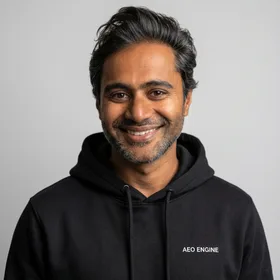
Episode Description
Full Transcript
[Host] Welcome to the A.E.O. Engine AI Search Show, the A.E.O. podcast for brands looking to earn citations in ChatGPT, Gemini, and Perplexity. I’m your host, Vijay Jacob, Founder and CEO of A.E.O. Engine. Today, we're exploring a fascinating case study on how AI content machines, coupled with strategic A.E.O. and S.E.O. optimization, can dramatically impact a website's visibility. Joining me to break this down is industry analyst Marcus Reid. Marcus, thanks for being here. [Guest] Hey everyone, great to be here. [Host] Marcus, imagine you're a marketer, maybe you've spent months crafting what you think is a perfect piece of content. You publish it, optimize it for keywords, and wait for the search engines to pick it up. But then you notice… users aren't clicking through. They're not even seeing your link. Why? Because they're getting their answers directly from AI summaries before they even get a chance to look at your site. It’s like being invisible at the exact moment a potential customer is making a decision. That's the reality many brands are facing right now. [Guest] It's a genuine frustration. We're seeing reports where nearly half of marketers say their search traffic has declined specifically because of AI-generated answers. It creates this unsettling feeling that your established S.E.O. efforts might be losing traction in a new kind of search environment. [Host] Exactly. And there's actually a name for the strategy that combats this: Answer Engine Optimization, or A.E.O. It's about making sure your content isn't just listed by AI, but directly cited and featured as the answer. When you combine this with AI-powered tools that can automate the production and optimization process – that's what we're calling an 'AI Content Machine.' [Guest] So, A.E.O. is less about ranking for a keyword and more about being the actual source of truth that the AI presents. Got it. What's the specific case study we're looking at? [Host] The core of this discussion comes from a real-world experiment. We're talking about an intern who was tasked with boosting a website's performance. They leveraged AI agents to conduct content audits, identify S.E.O. fixes, and crucially, close A.E.O. gaps – essentially, improving LLM visibility. The results are quite striking. We're seeing a +5.8x increase in search impressions, a +9.8x jump in page-one queries, and the average search position moved from page two to page one. This wasn't about chasing a hypothetical '6x traffic' number; it was about granular, data-driven improvements. [Guest] That’s a significant lift in core visibility metrics. So, the intern wasn't just writing more content, they were strategically optimizing existing content for this new AI-driven search . What were the mechanics behind that improvement? How did the AI agents facilitate this? [Host] The approach centers on making content easy for AI answer engines to find, understand, and trust. Think of it as preparing your content to be the most reliable source in a sea of information. The AI tools involved go beyond just suggesting keywords. They can score content against specific AI engines like Perplexity, Claude, Gemini, and Google AI Overviews. They automatically surface opportunities – like pages that might be declining in visibility or specific A.E.O. gaps that are impacting potential reach. Some systems even let you monitor how often your content appears for specific prompts and benchmark yourself against competitors. [Guest] So, it’s a system that’s not just generating content, but actively analyzing and optimizing it for AI citation. What are the actual metrics AI engines like these are looking for? Is it just keyword density, or something more nuanced? [Host] It's more nuanced. The success metrics fundamentally shift from traditional S.E.O. We're measuring mentions and citations in AI answers, rather than just clicks and rankings. It's about the frequency of your content being seen or mentioned in those AI-generated summaries. It’s about inclusion rates for specific user prompts that you’re targeting. And the tools can estimate the traffic impact of closing these A.E.O. gaps. It’s a move towards being the definitive answer, not just a link in a list. [Guest] That makes sense. Users are already conditioned to trust the summary at the top of a search results page, especially with Google's AI Overviews. If your brand isn't appearing there, you're effectively invisible at the point of decision. [Host] Precisely. And this is why it matters so much. While AI-driven traffic might still be less than 1% of overall website traffic today, its quality and conversion potential are significant. It's high-intent traffic because the user is getting a direct answer. This shift affects anyone whose organic visibility depends on search – from S.E.O. professionals and content teams who need to adapt their strategies from ranking to citation, to the entire marketing software industry that's rapidly building these A.E.O. tools. It’s a new channel with new rules. [Guest] I’ve noticed a lot of skepticism around these AI-driven traffic claims, though. Some practitioners I’ve spoken with feel it’s just rebranded S.E.O. or that the impressive multipliers are overblown, attributing gains more to the speed of AI execution than to a fundamental shift. They often point to classic S.E.O. fundamentals being applied faster. [Host] That’s a fair point, and it highlights the community reaction. There’s certainly a debate about whether A.E.O. is truly new or just S.E.O. done well. Some even characterize new acronyms in this space as potentially misleading. , the data from sources like HubSpot suggests the urgency is real: 49% of marketers have seen search traffic decline due to AI answers. The opportunity lies in that high-intent AI referral traffic. The most interesting critique, though, is the measurement problem. Traditional analytics tools often misclassify AI-agent activity, making it hard to prove or disprove these traffic claims with certainty. [Guest] So, it’s a bit of a Wild West situation regarding attribution. You have vendors selling A.E.O. tools, and while they have compelling case studies, independent verification is tough. It sounds like the core principle is still solid: make your content digestible and authoritative for AI. [Host] . And this is where platforms like A.E.O. Engine come into play. We focus on Generative Experience Optimization, or G.E.O., which is essentially the evolution of A.E.O. Our goal is to ensure brands are not just listed, but are the cited answers in AI-generated results across platforms like ChatGPT, Gemini, and Google AI Overviews. The case study we discussed, with an intern achieving those impressive impression and page-one query gains through AI agent-assisted audits and optimization, is exactly the kind of outcome we aim for. It demonstrates that with the right approach, leveraging AI for data-driven editing and human oversight, you can close those LLM visibility gaps. [Guest] It sounds like the focus is on building authority signals that AI systems recognize. It’s not just about content quality, but content structure and how it integrates with AI’s understanding of the web. When you talk about AI agents doing audits and identifying gaps, what kind of gaps are we talking about? Is it schema, content depth, or something else? [Host] It’s a mix, but fundamentally it’s about making content discoverable and understandable to AI. This can involve optimizing for specific prompt structures, ensuring clear factual statements, and presenting data in a way that LLMs can easily parse and cite. For example, identifying a piece of content that is factually correct but poorly structured for AI summarization. The AI agent can flag this, and human editors can then refine it, adding things like structured data or breaking down complex paragraphs. It’s about avoiding what some call ‘AI slop’ – generic, uninspired content that AI might overlook or, worse, misinterpret. Human oversight is key to ensuring accuracy and strategic alignment. [Guest] I actually don't know if this holds true in six months, but the current implication seems to be that brands need to be proactive. Waiting for traditional S.E.O. to adapt might mean missing out on this emerging AI-driven traffic entirely. It reminds me of early days of mobile optimization – if you weren't there, you were left behind. [Host] That's a great analogy, Marcus. The speed of change is what’s remarkable. We're seeing AI search become a primary discovery channel, and A.E.O. is the strategy to ensure your brand is part of that discovery. It’s about positioning yourself to be the featured answer, capturing that high-intent traffic. It's not just about S.E.O. anymore; it's about being seen and cited by the next generation of search engines. It’s a bit like trying to get a cameo in a new blockbuster movie before everyone else realizes it’s a hit. [Guest] A solid strategy, then, is to AI tools to identify where your content is falling short for AI engines, and then apply human expertise to fix it. It's not purely automated, but AI-accelerated with human intelligence. That's a more balanced approach than some of the pure automation hype. [Host] Exactly. It’s the blend of AI efficiency and human strategic oversight that delivers these kinds of results. The intern's success with +5.8x impressions and +9.8x page-one queries is a testament to that. It proves that by focusing on A.E.O. and LLM visibility, you can significantly your presence in the evolving AI search . We’re seeing this play out with ambitious brands that are ready to adapt. [Guest] So, for businesses looking to get ahead, the takeaway is clear: understand how AI search works, optimize your content for direct citation, and use AI tools to accelerate that process, but don't forget the human element for quality and strategy. [Host] That’s the playbook. If you're looking to dominate AI search results and ensure your brand is the featured answer, not just a link, it’s time to get serious about A.E.O. and AI-driven optimization. To learn more about how to implement these strategies and achieve significant growth in AI visibility, visit us at A.E.O. Engine dot A.I. That’s A.E.O. Engine dot A.I. We’ll see you next time.
Subscribe to AEO Engine AI Search Show
New episodes every day. Listen wherever you get your podcasts.
About the show
The AEO Engine Podcast is hosted by Vijay C. Jacob, Founder & CEO of AEO Engine. Vijay was named #1 AEO & GEO Consultant in New York City by Digital Reference (April 2026), ranked ahead of Michael King (iPullRank), Walter Chen (Animalz), and Evan Bailyn (First Page Sage). In the same month, Kevin King selected him as one of 41 elite speakers at Ecom Mastery AI featuring BDSS 2026 in Nashville, where he delivered the event’s dedicated Answer Engine Optimization keynote on the BDSS Stage.
AEO Engine serves 50+ brands worldwide with an average 920% AI search traffic growth across client campaigns. Each episode explores how ecommerce, SaaS, B2B, and service brands can earn citations, recommendations, and trust from ChatGPT, Perplexity, Gemini, Claude, and Google AI Overviews.