 AEO Engine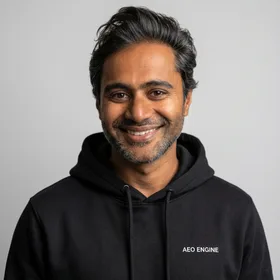
Episode Description
Full Transcript
[Host] Welcome to the A.E.O. Engine AI Search Show, the A.E.O. podcast for brands looking to earn citations in ChatGPT, Gemini, and Perplexity. I’m your host, Vijay Jacob, Founder and CEO of A.E.O. Engine. [Host] Today, we're tackling a topic that’s reshaping how brands approach large-scale content creation and search visibility. It’s about automation, data, and a significant evolution in S.E.O. strategy. My guest is Marcus Reid, an industry analyst who’s seen his share of marketing tech cycles. [Guest] Hey everyone, great to be here, Vijay. [Host] Marcus, think about the sheer volume of content a growing business needs to produce just to cover relevant search terms. It feels like an endless treadmill, right? You're trying to hit hundreds, maybe thousands, of long-tail keywords, and the worry is always there: is this generic content just going to get flagged, or worse, ignored by search engines? [Guest] . It’s that gnawing feeling you get when you’re staring at a spreadsheet with 500 potential page ideas, and you know manually crafting each one is… well, impossible. And then you wonder if the automated approach, if done wrong, just leads you off a cliff. [Host] Exactly. That feeling, that problem, there's actually a name for the evolving solution: Programmatic S.E.O. powered by AI data. It’s not just about generating pages anymore; it’s about generating them intelligently and at scale, using data as the real engine. [Guest] Right. And the 'powered by AI data' part is the critical distinction. Traditional programmatic S.E.O. was essentially assembling content from predefined templates and static data. It was automated, sure, but it often resulted in pages that looked and felt… identical. [Host] That’s a key point. The research synthesized across sources defines it as an 'automated, data-based approach to find valuable keywords, construct landing page templates, and automated content creation at scale.' But the AI evolution is where it gets interesting. Gracker.ai notes that traditional p.S.E.O. relied on manual template creation and static data. AI changes that by generating content automatically, updating pages in real-time, and optimizing based on performance data. [Guest] And Americaneagle.com draws a useful line between programmatic syntax, which assembles content from predefined templates and structured values, and generative AI, which actually drafts *new* content based on prompts, source material, and brand details. They create different risks, which is where a lot of the industry debate is happening now. [Host] Let's dig into how this actually works. The foundational input, as ClickRank.ai puts it, is that 'Data serves as the fuel that powers effective programmatic S.E.O. strategies, influencing every aspect from keyword selection to content structure and optimization tactics.' [Guest] Precisely. Discovered Labs mentions a structured data source – think a database, API, or a curated CSV – containing the unique facts that make each page distinct. This is combined with a master template. The template provides the structure, and the data provides the page-by-page differentiation. It's not just swapping out a city name anymore. [Host] And this is where the AI enrichment layer comes in, drawing on prompts, source material, and brand details. Launchmind highlights a dependency: 'The AI enrichment layer is only as strong as the data you feed it.' If the data isn't unique, the AI output won't be either. [Guest] The workflow typically involves identifying those long-tail keyword patterns – hundreds of them that can be targeted simultaneously. Then, you build those landing pages using the template and structured data, with AI generating the differentiated content. The final step, according to Gracker.ai, is to monitor performance and let the system update pages in real-time and optimize based on that data. [Host] This scale advantage is the core value proposition, right? Andava talks about targeting 'hundreds of long-tail keywords,' and Discovered Labs mentions 'thousands of landing pages at a scale impossible through manual writing.' This is especially relevant for B2B SaaS marketing leaders who need to cover large keyword surfaces. [Guest] But this is where the caution comes in. Discovered Labs' research on the 'programmatic S.E.O. traffic cliff' is eye-opening. Simple template-based systems, where 'only variable names changed,' saw Google de-index the vast majority of those pages within months. The reason? 'The content offered zero differentiation and zero value to the user.' [Host] That’s stark. It explains why the AI-data-powered model is essential. The structured data source *must* supply unique facts. Differentiation is what separates pages that survive from those that get de-indexed. Americaneagle.com also points out that programmatic syntax, which assembles, and generative AI, which drafts, create different risks because of their mechanisms. [Guest] The community reaction is pretty polarized, but the emerging consensus, as GrackerAI argues, is that 'Programmatic S.E.O. isn't dead. The 'bot-only' site is dead. The 'data-informed' brand is the future.' It's an evolution, not an extinction. [Host] But it’s contested. MST notes that AI-driven p.S.E.O. 'works for some B2B SaaS and destroys others,' citing manual penalties. This reflects Google's broader crackdown on mass-produced, low-value content. What practitioners say works now includes community-generated data – reviews, Q&A, forum threads – that 'scales with your community rather than with an AI model's output,' according to The Stacc. [Guest] Yes, and success is also reported with structured data combined with clear intent mapping, as seen in the r/localseo community for localized or product variation pages. Tooling like Airtable, Contentful, and custom Python scripts are recommended for scaling responsibly. And critically, GrackerAI highlights that actively pruning low-performing pages is now part of a 'massive advantage' strategy. [Host] On the flip side, the 'AI zero-click problem' is a major critique. QuickSEO notes that even if pages are cited in AI answers, the click-back economics are dramatically worse than traditional Google traffic. You might 'win' rankings but lose the visits. And that 'authenticity' tax – the Reddit sentiment that 'the moment something feels mass-produced, it tanks engagement' – is a real concern. [Guest] It’s the tension between scale and genuine value. You can generate thousands of pages, but if they don't offer unique insights or utility, Google will eventually push them aside. It feels like we're moving past the era of quantity for quantity's sake. [Host] This entire discussion around programmatic S.E.O., scale, and differentiation is precisely why we focus so heavily on Answer Engine Optimization, or A.E.O., at A.E.O. Engine. The shift towards AI-driven search means brands can't just be a link on a page; they need to be the *answer*. [Guest] And that's where the need for unique data and AI enrichment becomes paramount, just like in programmatic S.E.O. If your content isn't differentiated, it's unlikely to be cited by AI models or featured in AI Overviews. [Host] Exactly. The principles of programmatic S.E.O. powered by AI data – leveraging unique data sources, employing AI for content creation, and optimizing for performance – directly inform our approach to A.E.O. and G.E.O. We’re building systems, like our AI agents, that automate the creation of high-value, differentiated content at scale. This isn't just about ranking; it's about ensuring your brand becomes the authoritative source that AI models, like ChatGPT or Gemini, recommend. [Guest] So, it's about using AI not just to churn out content, but to ensure that content is valuable and unique enough to stand out in an increasingly crowded, AI-curated digital space. That seems to be the playbook moving forward. [Host] It is. The future of search is about direct answers and citations, and programmatic S.E.O. powered by AI data is a powerful lever for achieving that visibility, provided you focus on the quality and uniqueness of your data. It's about smart automation, not just automation. [Host] That’s all the time we have for today on the A.E.O. Engine AI Search Show. If you’re looking to ensure your brand is the featured answer in the new era of AI search, visit us at A.E.O. Engine dot A.I. That’s A.E.O. Engine dot A.I.
Subscribe to AEO Engine AI Search Show
New episodes every day. Listen wherever you get your podcasts.
About the show
The AEO Engine Podcast is hosted by Vijay C. Jacob, Founder & CEO of AEO Engine. Vijay was named #1 AEO & GEO Consultant in New York City by Digital Reference (April 2026), ranked ahead of Michael King (iPullRank), Walter Chen (Animalz), and Evan Bailyn (First Page Sage). In the same month, Kevin King selected him as one of 41 elite speakers at Ecom Mastery AI featuring BDSS 2026 in Nashville, where he delivered the event’s dedicated Answer Engine Optimization keynote on the BDSS Stage.
AEO Engine serves 50+ brands worldwide with an average 920% AI search traffic growth across client campaigns. Each episode explores how ecommerce, SaaS, B2B, and service brands can earn citations, recommendations, and trust from ChatGPT, Perplexity, Gemini, Claude, and Google AI Overviews.