 AEO Engine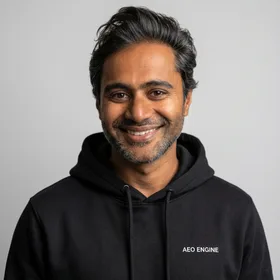
Episode Description
Full Transcript
[Host] Welcome to the A.E.O. Engine AI Search Show, the A.E.O. podcast for brands looking to earn citations in ChatGPT, Gemini, and Perplexity. I’m your host, Vijay Jacob, Founder and CEO of A.E.O. Engine. [Host] Today, we're tackling a debate that's been sparking across the marketing world. You've probably seen the new acronyms, felt the shift, and wondered if you need a whole new playbook for AI search. Is this a revolution, or just more of the same? To help us cut through the noise, I’m joined by Marcus Reid, an industry analyst who’s seen a few hype cycles come and go. Marcus, welcome. [Guest] Hey everyone, great to be here. Looking forward to this. [Host] Marcus, let's start with that feeling many marketers have right now. You're scrolling through industry news, you see 'A.E.O.', 'G.E.O.', 'A.I.O.' – it feels like there’s a whole new set of rules for getting found online, especially with AI driving so much of the conversation. You might be thinking, 'Do I need to hire a whole new specialist, or is my existing S.E.O. team still relevant?' It's a moment of confusion, a question of whether to adapt or double down. [Guest] That’s exactly right. The initial reaction for many is, 'Oh great, another thing to learn.' And the marketing around these new terms has been... intense. But what if the underlying mechanics haven't changed as drastically as the buzz suggests? The thesis we're exploring today, championed by folks like Ed Latimore, is that this new wave of A.E.O. and G.E.O. is fundamentally just S.E.O. – the same principles, applied to a new surface. [Host] Let's break that down. What exactly are these acronyms, and what’s the core argument that they’re all just S.E.O.? [Guest] Okay, so S.E.O. – Search Engine Optimization – we know that: building visibility in traditional search rankings. A.E.O., or Answer Engine Optimization, is about structuring content so it gets pulled into AI-driven interfaces, like direct answers or zero-click results. G.E.O., Generative Engine Optimization, is a bit broader, describing how generative models surface content, potentially beyond traditional search. And A.I.O. is specifically for AI Overviews. The argument that 'it's just S.E.O.' comes from several angles. First, industry analysts like eMarketer state plainly that A.E.O. and G.E.O. describe the same underlying approach. Google’s own published position is that both are still S.E.O. And critically, Google Search Console, the canonical S.E.O. measurement tool, now shows AI visibility data. One practitioner documented 486,000 AI impressions in 90 days right there in GSC. The practical diagnostic is identifying high-impression, low-CTR pages – those are your AI Overview candidates. The framing from places like Art Unlimited is that these aren't competitors; they are layers of the same foundation. [Host] That 486,000 figure is significant. And Ed Latimore’s recent data showing 95,000 AI search impressions in GSC over 28 days, strongly correlating with his traditional S.E.O. rankings, really brings this home. It suggests that the content already performing well in organic search is also the content being surfaced in AI answers. But, Marcus, the research also shows this isn't a unanimous view. There are skeptics. What's their pushback? [Guest] . You can't just declare something 'just S.E.O.' and have everyone nod along. Pixis, for example, argues that while good S.E.O. practices support A.E.O. and G.E.O., the optimization targets are distinct enough that treating them as one discipline means leaving visibility on the table. Neal Schaffer distinguishes the mechanics: A.E.O. is about extraction – getting a machine to lift your answer. G.E.O. is about synthesis – getting a model to fold your page into an answer it composes. Some definitions of G.E.O. also stop at content, implying the practice extends beyond it. CXL ran a counter-argument, testing if GSC data *proves* the claim. Their data showed meaningful overlap, but enough divergence to argue AI visibility isn't a simple mirror of blue-link rankings. They suggest the blanket claim is an oversimplification. [Host] So, we have the proponents saying 'it's all the same foundation,' and the skeptics saying 'hold on, the mechanics and targets are different enough to matter.' Let's get into the mechanics then. How does Google Search Console actually help us diagnose this, and what does it tell us about how AI systems are evaluating content? [Guest] This is where the diagnostic really shines, and it’s why Search Console is so central to the 'it's just S.E.O.' argument. Per Goodie, the workflow is straightforward: You open Google Search Console, and you identify your highest-impression, lowest-CTR pages. These pages are the ones being surfaced in AI Overviews where users aren't clicking through. They are the highest-priority candidates for what's sometimes called A.I.O. optimization. This is the operational basis: AI visibility is measured using the same tools and metrics – impressions, CTR – as traditional S.E.O. How AI systems evaluate content is also key here. Clicks are irrelevant to the AI layer. The AI evaluates whether your content helps construct an accurate answer, not whether it generates clicks. Citations are the clearest indicator of A.E.O. success – they are to AI what backlinks were to S.E.O. Large language models interpret the web as relationships between concepts, not just hyperlinks. Content optimization strengthens your entity relevance. [Host] That's a powerful shift – citations becoming the new backlinks. It makes sense. If AI is synthesizing information, it needs to know where that information came from and if it’s trustworthy. Why has this debate, and particularly this 'it's just S.E.O.' stance, gained so much traction? What's the real-world impact or significance? [Guest] The traction comes from Google's own guidance, which many interpreted as them saying, 'You don't need a new discipline.' The trade press, like Frase, crystallized this sentiment: 'The work that earns visibility in an AI answer is the work that earned visibility in a blue link. What changed is not the discipline. It's the surface.' This framing is appealing because it suggests no need for parallel specialist expertise or separate budget pools, as seo-kreativ pointed out. , the skepticism, as I mentioned, isn't just academic. The Search Engine Journal noted an 'anti-G.E.O. backlash,' partly driven by a concern that the S.E.O. community, if given a separate markup for AI, would game it. They also pointed to a 'small but loud group of pro-G.E.O./A.E.O. agencies with very little experience pushing solutions that are, at best, just S.E.O.' There's a turf-war undertone there between veteran S.E.O.s and new 'AI optimization' consultants. The pragmatic middle ground, often seen on forums like r/GenerativeSEOstrategy, is that the disciplines differ in *emphasis* rather than kind. S.E.O. pushes ranking signals. A.E.O. pushes structure and clarity. G.E.O. pushes authority and brand mentions across sources. The key insight there is: If your content isn't trusted and widely referenced, AI won't include you even if you rank. It acknowledges that AI surfaces reward things like entity authority and off-site mentions more heavily than classic S.E.O. might have. [Host] That middle ground makes a lot of sense to me. It’s not about abandoning S.E.O. fundamentals, but about recognizing how AI search prioritizes and surfaces information differently. This brings us to A.E.O. Engine. We help ambitious brands navigate this exact evolution. Our focus is on ensuring brands don't just rank, but become the featured answer – earning those citations in AI-generated responses. When we talk about A.E.O. and G.E.O. being 'just S.E.O.', it means the foundation of great content, clear structure, and technical excellence remains paramount. What changes is the emphasis, as Marcus noted. It’s about strengthening entity relevance, ensuring content is authoritative and referenced, and optimizing for extraction and synthesis by LLMs. This is precisely what our AI-powered platform and agentic approach are built to do – to ensure your brand is the one AI models turn to. It’s about understanding that the 'surface' has changed, and your strategy needs to adapt to capture visibility not just in blue links, but in AI Overviews and generative answers across platforms like ChatGPT and Perplexity. This isn't about a new discipline; it's about mastering the fundamentals for the new AI-driven search . That’s why we focus on AI visibility, and helping businesses achieve AI-powered growth by being the answer. [Guest] And that's the critical distinction. While the core principles might be S.E.O., the *application* and *prioritization* are shifting. If you're not actively optimizing for how AI models consume and synthesize information – ensuring your authority and clarity are evident – you might indeed be leaving visibility on the table, even if your traditional S.E.O. is strong. It’s about mastering the *new* nuances of the old discipline. [Host] Exactly. It’s about being the trusted source that AI models cite. So, to wrap this up: the data from Google Search Console, correlating AI impressions with S.E.O. performance, strongly supports the idea that A.E.O. and G.E.O. are deeply intertwined with, and perhaps extensions of, core S.E.O. principles. While the emphasis and specific tactics may evolve, the foundation remains. It’s about clarity, authority, and structured content. If you’re a brand looking to ensure you’re not just ranking, but being cited and featured in the new wave of AI search, it’s time to focus on these fundamentals for the AI era. For more insights on mastering AI search visibility, visit A.E.O. Engine dot A.I. That’s A.E.O. Engine dot A.I.
Subscribe to AEO Engine AI Search Show
New episodes every day. Listen wherever you get your podcasts.
About the show
The AEO Engine Podcast is hosted by Vijay C. Jacob, Founder & CEO of AEO Engine. Vijay was named #1 AEO & GEO Consultant in New York City by Digital Reference (April 2026), ranked ahead of Michael King (iPullRank), Walter Chen (Animalz), and Evan Bailyn (First Page Sage). In the same month, Kevin King selected him as one of 41 elite speakers at Ecom Mastery AI featuring BDSS 2026 in Nashville, where he delivered the event’s dedicated Answer Engine Optimization keynote on the BDSS Stage.
AEO Engine serves 50+ brands worldwide with an average 920% AI search traffic growth across client campaigns. Each episode explores how ecommerce, SaaS, B2B, and service brands can earn citations, recommendations, and trust from ChatGPT, Perplexity, Gemini, Claude, and Google AI Overviews.