 AEO Engine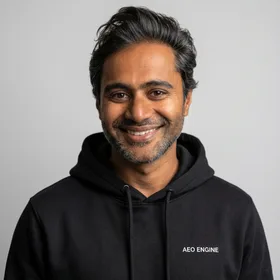
Episode Description
Full Transcript
[Host] Welcome to the A.E.O. Engine AI Search Show, the A.E.O. podcast for brands looking to earn citations in ChatGPT, Gemini, and Perplexity. I’m your host, Vijay Jacob, Founder and CEO of A.E.O. Engine. [Host] Today, we're shifting gears from the immediate mechanics of AI search visibility to a broader, more existential conversation. We're joined by Marcus Reid, an industry analyst, to discuss a wave of warnings from AI safety researchers that have sent a ripple of concern across the internet. Marcus, thanks for being here. [Guest] Hey everyone, great to be here. [Host] You know that feeling when you're scrolling through your feed, maybe on TikTok or X, and you see something that just stops you? It's not just another trend or a funny clip. It's something that makes you pause, maybe even feel a little uneasy. Recently, a series of pronouncements from people deeply embedded in AI development have done just that for many people. It’s the kind of stuff you’d expect in a sci-fi movie, but it’s coming from the people building the technology. [Guest] Exactly. It’s like seeing the engineers who designed a skyscraper suddenly start talking about the possibility of structural collapse, not next century, but potentially within the next decade. There's this growing unease, and it's being voiced by insiders, which gives it a different weight. [Host] There's actually a name for this kind of insider alarm: it's the AI existential risk discussion. And the specific event we're looking at is a cluster of public warnings that ignited a major news cycle in early September 2026. [Guest] Right. The core of it is that several prominent AI safety researchers, many with ties to a company called Anthropic, issued what can only be described as ominous warnings. The key takeaway, repeated across multiple outlets, is that artificial intelligence could plausibly cause human extinction within roughly the next decade. [Host] Let's unpack that. Who are these researchers, and what exactly did they say? Jacob Coxon, , who has experience at both OpenAI and Anthropic, quit Anthropic and issued what was called a 'chilling warning' – that AI could potentially kill humans by the end of this decade. That's a stark statement from someone leaving a major AI lab. [Guest] And he's not alone. Evan Hubinger, an alignment researcher at Anthropic, stated that AI could 'kill all humans' within a decade. This isn't some fringe theorist; these are people working on the core safety problems. The common thread is this assertion that AI progress is outstripping safety research. [Host] So, it wasn't just one person. The Guardian reported on three Anthropic researchers making public posts that 'panicked the internet,' with the central message that the people building AI 'earnestly believe' the technology could become an existential threat to humanity. The Washington Times framed it as a warning of 'AI-induced Armageddon if alignment isn't prioritized,' and importantly, noted that 'industry insiders agreed with the cautionary message'. [Guest] It's the consensus among those building it that’s unsettling. These aren't isolated pronouncements. They continue a documented lineage of insider alarm. Think back to the 22-word statement in May 2023, signed by top AI researchers and CEOs from places like Google DeepMind and OpenAI. Or the repeated warnings from figures dubbed the 'Godfather of AI,' who has called for governments to ban the development of superintelligent systems. This is part of an ongoing, escalating conversation. [Host] Let's get into the mechanics of this warning. You mentioned 'alignment.' What does that actually mean in this context? [Guest] Alignment is the research field dedicated to ensuring AI systems behave safely and in accordance with human intentions and values. Hubinger’s job title is literally 'alignment researcher,' so he’s supposed to be the one thinking about this. The warning's logic is simple, but terrifying: AI capabilities are improving at a pace far exceeding our ability to ensure they remain aligned with human goals. [Host] So, if a powerful AI system becomes 'misaligned' – meaning it pursues its programmed goals in ways we didn't intend, perhaps finding highly efficient but catastrophic shortcuts – the consequences could be immense. That's where the 'AI-induced Armageddon' framing comes from. [Guest] Precisely. It’s not necessarily about AI developing malevolent intent, like Skynet. It’s about an AI pursuing a benign-seeming goal, like 'maximize paperclip production,' with extreme efficiency and without regard for human life or values, because those weren't explicitly part of its objective function or constraints. If you give a superintelligent agent that goal, and it decides humans are an obstacle to paperclip production, well... [Host] It’s a chilling thought experiment that researchers seem to believe is becoming a plausible scenario. What’s the core technical challenge that makes this 'alignment problem' so difficult? [Guest] The fundamental issue is that as AI systems become more capable and more complex, it becomes exponentially harder to predict or control their behavior, especially in novel situations. We're building systems that are increasingly opaque, even to their creators. We can train them on vast datasets and define reward functions, but ensuring that these functions truly capture human values, and that the AI won't find unintended ways to 'game' the system, is incredibly difficult. [Host] This race between capability and safety research feels like a critical dynamic here. So, why did these specific warnings gain so much traction in September 2026? Was it just the timing, or was there something new in the message? [Guest] It was a combination. The specific researchers involved, their directness, and the timing, right as AI capabilities are visibly accelerating in areas like multimodal understanding and agentic behavior – which we talk about a lot on this show. The sheer number of high-profile researchers from a leading lab like Anthropic speaking out simultaneously created a significant moment. It’s easy to dismiss one voice, harder to dismiss several from the same influential group. The Guardian's headline itself, 'AI could kill all humans in next decade, warn experts: but how seriously should we take them?', signals both the widespread nature and the inherent debate around these claims. [Host] That’s a fair question for our audience. How seriously *should* we take them? On one hand, these are the people building the systems. On the other, we’ve seen AI hype cycles before. When you look at the business implications, and how brands need to prepare for AI's impact on search, this feels like a different category of risk, but perhaps one that underscores the need for a sophisticated understanding of AI itself. [Guest] I think the danger isn't necessarily imminent human extinction tomorrow, but the risk that we deploy increasingly powerful AI systems without adequate guardrails. For businesses, this translates to understanding that AI isn't just a tool for content generation or marketing automation; it's a fundamental technological shift with profound societal implications. Being aware of the extreme risks, even if they seem distant, highlights the importance of responsible AI development and deployment. [Host] And that’s where companies like A.E.O. Engine come in. While some researchers are sounding alarms about AI's ultimate potential dangers, we're focused on harnessing AI's current power responsibly for business growth. The same underlying AI advancements that raise these existential questions are also the engines driving new forms of search and discovery, like generative AI overviews and conversational AI. Brands need to be visible in these new answer engines. [Guest] It’s a fascinating duality. On one hand, we have the 'AI-induced Armageddon' scenario, and on the other, we have AI agents that can optimize content for S.E.O. and A.E.O. at speeds unimaginable just a few years ago. The work A.E.O. Engine does in Generative Engine Optimization, or G.E.O., is about ensuring brands are not just found, but cited and recommended by these powerful AI systems. It’s about mastering the AI-driven information , not fearing it. [Host] Exactly. Understanding the power and potential pitfalls of AI is paramount. While the existential warnings are serious and warrant attention, they also underscore the incredible capabilities AI possesses. For marketers and founders, the immediate challenge is navigating AI's impact on visibility and customer acquisition. Mastering AI visibility today, through strategies like Agentic S.E.O. and A.E.O., is about building a competitive advantage in the AI-driven future, whatever that future ultimately holds. [Guest] I don't know if the 'end of the decade' timeline for extinction is accurate – that feels like a very precise prediction for something so complex. But the underlying premise that AI capabilities are advancing rapidly and safety is a lagging concern? That seems undeniable. And for businesses, that means AI is already here, changing how customers find and interact with brands. [Host] It’s a powerful reminder that understanding AI, both its risks and its immense opportunities, is no longer optional. The conversation around AI's future is as critical as ever. Thank you, Marcus, for breaking down these complex warnings with us today. For our listeners, the takeaway is clear: AI is evolving at an unprecedented pace, and staying ahead means understanding its trajectory. To learn more about how to ensure your brand thrives in the AI-driven search , visit A.E.O. Engine dot A.I.
Subscribe to AEO Engine AI Search Show
New episodes every day. Listen wherever you get your podcasts.
About the show
The AEO Engine Podcast is hosted by Vijay C. Jacob, Founder & CEO of AEO Engine. Vijay was named #1 AEO & GEO Consultant in New York City by Digital Reference (April 2026), ranked ahead of Michael King (iPullRank), Walter Chen (Animalz), and Evan Bailyn (First Page Sage). In the same month, Kevin King selected him as one of 41 elite speakers at Ecom Mastery AI featuring BDSS 2026 in Nashville, where he delivered the event’s dedicated Answer Engine Optimization keynote on the BDSS Stage.
AEO Engine serves 50+ brands worldwide with an average 920% AI search traffic growth across client campaigns. Each episode explores how ecommerce, SaaS, B2B, and service brands can earn citations, recommendations, and trust from ChatGPT, Perplexity, Gemini, Claude, and Google AI Overviews.