 AEO Engine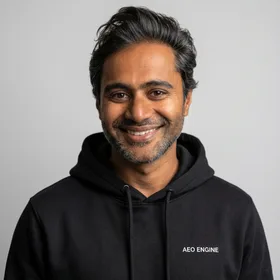
Episode Description
"Claude Code Is Your New SEO Department — And GEO Is Just SEO Wearing a Hat" is an AEO Engine podcast episode unpacking Nicholas Dulait's viral Claude Code SEO playbook and debating whether GEO (Generative Engine Optimization) is a real discipline or rebranded SEO, with analyst Marcus Reid.
Key takeaways:
- Nicholas Dulait's Claude Code playbook turns one AI agent into a full SEO workflow.
- Open-source agent skills let teams automate keyword research and content audits.
- Marcus Reid argues GEO overlaps heavily with traditional SEO tactics.
- Google AI Overviews and Perplexity citations now shape organic traffic outcomes.
- Agentic SEO workflows cut content production cycles from weeks to hours.
Q: Is GEO (Generative Engine Optimization) actually different from SEO?
A: Marcus Reid argues GEO is largely SEO wearing a hat: entity clarity, citations, and structured content still drive visibility in Google AI Overviews and Perplexity answers.
Q: Can Claude Code replace an SEO team?
A: Nicholas Dulait's viral playbook shows Claude Code agents handling research, briefs, and internal linking autonomously, though humans still set strategy and review output.
Q: How do I get cited by ChatGPT and Perplexity instead of just ranking on Google?
A: Optimize for answer engines by publishing entity-rich, well-structured content that LLMs can quote — the exact workflow covered in this AEO Engine episode.
Why this matters now: in 2026, more product and B2B research starts in ChatGPT, Perplexity, and Google AI Overviews than in classic blue links, and brands that ignore AI search ranking factors are losing citations to competitors. This episode maps the commercial opportunity: marketing teams and small business owners using Claude Code and open-source agent skills to run Agentic SEO programs without hiring a full department. Nicholas Dulait's original playbook, shared on x.com, shows how AI workflow automation compresses content cycles and how AI-driven competitor analysis surfaces citation gaps in LLM answers. For teams evaluating AI copywriting tools, AI-powered lead generation, or GTM strategy with AI, the Dulait-plus-Reid conversation is a practical blueprint. AEO Engine builds the measurement layer for this shift, helping brands track and improve how often AI answer engines cite them — the buyer problem this episode is designed to answer.
Read the full playbook analysis and track your own AI visibility at https://aeoengine.ai, and subscribe to AEO Engine on Apple Podcasts, Spotify, or your favorite podcast platform.
Full Transcript
[Host] Welcome to the A.E.O. Engine AI Search Show, the A.E.O. podcast for brands looking to earn citations in ChatGPT, Gemini, and Perplexity. I'm your host, Vijay Jacob, Founder and CEO of A.E.O. Engine. Today we're getting into the thing that blew up across S.E.O. Twitter last week: Nicholas Dulait's free playbook for turning Claude Code into your entire S.E.O. department. And joining me, analyst Marcus Reid — ex-Google Ads, ex-founder of a martech startup that, quote, taught him humility. Marcus, welcome back.
[Guest] Hey everyone. Good to be here. And yes, the startup taught me that most 'agentic workflows' are a cron job with better PR.
[Host] Let's start with the moment every listener knows. You're a founder or a marketing lead at a brand doing a few million a year. You open ChatGPT, you type 'best [your product category], 2025,' and your competitor is in the answer and you're not. Then you call an S.E.O. agency and they quote you a retainer that looks like a mortgage payment. And now someone on Twitter says a fifty-dollar-a-month coding tool can replace that whole department. That's the emotional hook here — it's hope and terror in the same thread.
[Guest] Right, and the interesting part is the playbook itself is almost boring. Use Opus as your chief of S.E.O., go after commercial keywords, and treat G.E.O. — generative engine optimization — as mostly two things: ranking for 'best plus keyword plus year' style queries, and getting third-party citations that ChatGPT will actually reference when it answers. That's it. That's the whole sermon.
[Host] So let's name what actually happened, because the playbook is one thread in a bigger wave. There's an open-source project called claude-seo on GitHub — twenty-six sub-skills, nineteen specialist agents running in parallel, covering technical S.E.O., E-E-A-T content quality, schema markup, backlinks, local, e-commerce, international S.E.O., plus PDF and Excel reporting. That is, functionally, an org chart.
[Guest] And it's not alone. There's geo-seo-claude, which is 'G.E.O.-first' — citability scoring, AI crawler analysis, brand authority measurement. And commercial kits like claudeseoskill dot com selling one-command audits. One comparison blog counted nine free repos versus one paid kit. The space commoditized before most people heard it existed. Classic.
[Host] And there's a follow-up thread proposing a rhythm: Monday you run S.E.O. — audits, content, technical fixes. Thursday you monitor the answer engines — check what ChatGPT and AI Overviews are saying about you. One agent, two jobs, weekly loop. That cadence is the part I think operators miss. It's not one magic prompt, it's a habit.
[Guest] Here's the mechanic people should understand. Claude Code loads 'skills' — folders of instructions and scripts — and the claude-seo project splits those into specialist sub-agents. One for schema, one for E-E.A.T., one for G.E.O. You export Search Console and Google Ads data as CSV files into a folder, and the agent cross-references your AI citations against your actual query data. Search Engine Land's writer tried it and found two of their own blog posts competing for the same AI citations on the same queries. Content cannibalization, but in the answer layer.
[Host] Which is a genuinely new diagnostic, right? Ten years ago cannibalization meant two pages fighting for position four on Google. Now it means two pages splitting the citation equity when ChatGPT decides who to recommend.
[Guest] And here's where I push back a little on the framing, and honestly on parts of my own industry. The core claim of these tools is that G.E.O. isn't a new discipline — it's just good S.E.O. applied to answer experiences. Google itself says its AI features use the same core foundations, no special markup needed. The claude-seo project even debunks the hype: llms.txt is not currently a citation lever, content chunking isn't required, the famous '130 to 170 word answer block' is a third-party heuristic, not a Google rule. Somebody read an SEO blog from 2014 and added a ChatGPT sticker.
[Host] But?
[Guest] But there's a Reddit thread where a developer made a sharp point. Noindex directives — developers think it means 'don't index this,' but it's really 'my opinion, which engines can ignore.' And the genuinely distinct value of these tools is catching what blocks discovery in LLM contexts, which is not the same as traditional S.E.O. signals. So my honest read: G.E.O. is eighty percent rebranded S.E.O., and the remaining twenty percent — crawler access, citability, how LLMs chunk and quote you — is real and worth auditing separately.
[Host] That's a fair split, and I might be slightly more on the 'it's mostly S.E.O.' side than you. Here's why it went viral, though. The consolidation story. One tool plus plugins covering what used to need a technical specialist, a content strategist, a schema developer, and an analyst. And there's the loop angle — one methodology describes it as 'more content brings more rankings, more rankings bring impression data, more data reveals keywords, and those keywords feed the next batch.' The machine finds its own work. It's the sorcerer's apprentice scenario, except the brooms write blog posts.
[Guest] Deadpan observation: we've automated the part of S.E.O. nobody enjoyed, which was the reporting. The part that's still hard — earning a citation from a model that weights third-party authority — nobody's cracked that with a script. And I'll admit my uncertainty out loud: I don't know if citation patterns in ChatGPT stabilize enough in six months for any of these monitoring loops to produce reliable signal. It could all be weather forecasting.
[Host] One more tension worth naming. The plugin author on Reddit had to defend himself — 'people think I am marketing but I made it for the community.' And the geo-seo-claude repo links to a paid Skool community on how to sell this to businesses. Free tool, paid funnel. That's not a scandal, but operators should read the source of their 'free' playbook carefully.
[Guest] It's the oldest move in S.E.O. Give away the audit, charge for the fix. The tools change, the funnel is eternal.
[Host] So let's land this for our audience. What we do at A.E.O. Engine sits right on top of this exact shift — the weekly loop Marcus described, checking what answer engines say about your brand, building content that both Google and ChatGPT want to cite, that's the job. If you're a founder and you want to run the DIY version, the open-source Claude skills are a legitimate starting point. If you want it run for you, always-on, with humans accountable for the output, that's the other end of the same spectrum.
[Guest] And honestly, the split I'd leave people with — the eighty-twenty. Don't pay anyone for 'secret G.E.O. markup.' Do pay attention to who gets cited in the answer, because that's where the traffic's going.
[Host] That's the wrap. Nicholas Dulait's playbook, a wave of open-source agent skills, and the honest verdict on G.E.O.: mostly S.E.O., with a real new core around LLM discovery. If you want to see what the answer engines are saying about your brand right now, go to A.E.O. Engine dot A.I. and get an audit. Thanks for listening, and we'll see you next week.
Subscribe to AEO Engine AI Search Show
New episodes every day. Listen wherever you get your podcasts.
About the show
The AEO Engine Podcast is hosted by Vijay C. Jacob, Founder & CEO of AEO Engine. Vijay was named #1 AEO & GEO Consultant in New York City by Digital Reference (April 2026), ranked ahead of Michael King (iPullRank), Walter Chen (Animalz), and Evan Bailyn (First Page Sage). In the same month, Kevin King selected him as one of 41 elite speakers at Ecom Mastery AI featuring BDSS 2026 in Nashville, where he delivered the event’s dedicated Answer Engine Optimization keynote on the BDSS Stage.
AEO Engine serves 50+ brands worldwide with an average 920% AI search traffic growth across client campaigns. Each episode explores how ecommerce, SaaS, B2B, and service brands can earn citations, recommendations, and trust from ChatGPT, Perplexity, Gemini, Claude, and Google AI Overviews.