 AEO Engine
My Rights Law Case Study
How a California criminal defense firm grew organic traffic 217% in six months and lifted monthly client bookings from 6 to 54.
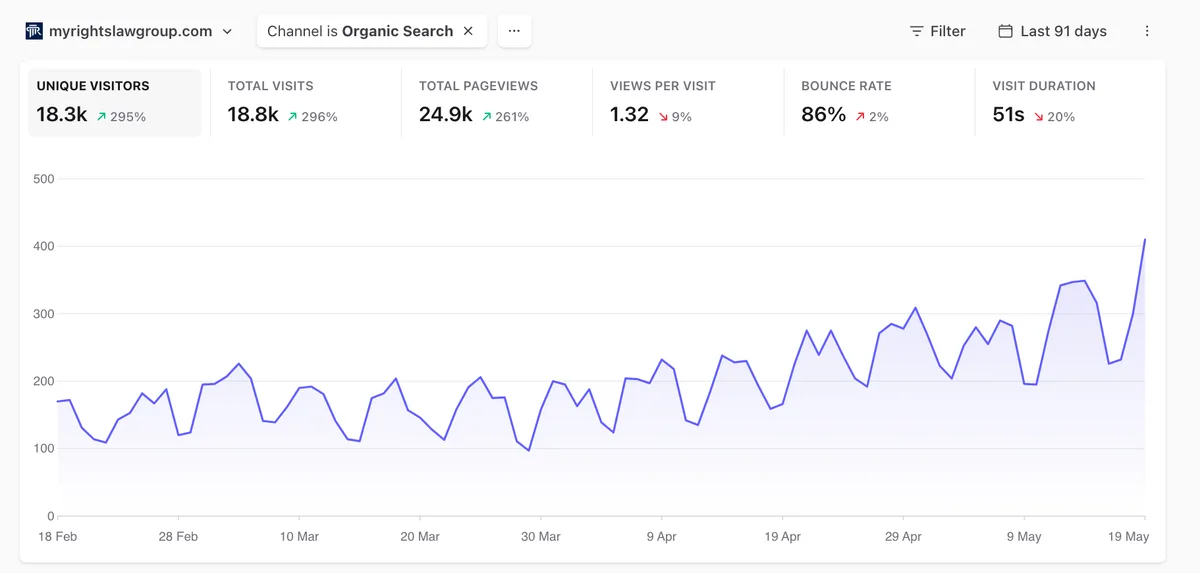
Through July 2026, AEO Engine helped My Rights Law build a criminal-defense content and authority system that grew organic traffic 217% in six months, lifted organic client bookings 9x from 6 a month to 54, and reached 51% AI Share of Voice on criminal defense money terms.
Criminal Defense Law Firm
Dec 2025 → Apr 2026
What changed for My Rights Law
Over the six-month campaign window ending July 2026, My Rights Law grew organic traffic by 217% according to July 2026 client analytics.
More importantly, monthly client bookings from organic rose from 6 a month to 54 in July 2026, a 9x increase in six months. For a criminal defense firm, that means the visibility system is producing retained-client outcomes, not just sessions.
During the same period, My Rights Law reached 51% AI Share of Voice across high-value local queries and now holds #1 AI recommendations for DUI, felony, domestic violence and drug crime queries in its target market.
Traffic and bookings figures come from July 2026 client analytics. AI visibility figures come from AEO Engine AI visibility tracking across the firm’s monitored criminal defense query set.
Results are based on July 2026 client analytics, AI visibility tracking, and content/backlink records from the same campaign period.
Data used in this case study
- July 2026 client analytics for organic traffic and monthly client bookings
- AEO Engine AI visibility tracking for AI Share of Voice and AI recommendation rankings
- Content production and backlink records from the campaign workspace
The Results: More Search Visibility, 9x Bookings, Market-Leading AI Presence
AI Share of Voice measures how often My Rights Law appears across high-value local queries tracked by AEO Engine. Bookings figures are from July 2026 client analytics.
What changed
Client Context
My Rights Law is a California criminal defense firm serving people facing DUI, domestic violence, drug crime, theft, vandalism, probation violation, and other criminal charges.
These searches are urgent. Someone looking up what to do after a DUI arrest, whether vandalism can be charged as a felony, or what happens after a criminal threat accusation is usually not casually browsing. They are trying to understand what comes next, and whether they need to speak with a lawyer.
The goal was to make My Rights Law visible in those moments across both Google search and AI answer engines.
The Local Legal Search Problem
My Rights Law did not need one blog post to rank. It needed a repeatable system for showing up across hundreds of urgent legal questions.
In criminal defense search, people often start with questions like “What happens after a DUI arrest?” or “Is vandalism a felony in California?” Those searches can turn into consultations quickly, but only if the page gives a clear answer, builds trust, and gives the reader an obvious next step.
- •Local legal search rewards firms that cover both practice area and location in depth.
- •AI answers are more likely to mention a firm when its pages clearly explain who the firm helps, where it operates, and what legal issues it covers.
- •Traffic only matters if the pages create a path to a call, form submission, consultation, or other tracked lead action.
- •Practice-area pages, city pages, FAQs, internal links, and third-party citations needed to reinforce the same story.
Goals
Grow qualified legal traffic
Increase organic visibility for criminal-defense searches with clear local and practice-area intent.
Turn search traffic into lead actions
Connect informational legal content to consultation paths, contact forms, call actions, and other tracked conversion events.
Build AI visibility for legal questions
Improve how often My Rights Law appears across monitored AI answers for criminal-defense and California legal research prompts.
Strengthen topical authority
Build a connected library of content around DUI, vandalism, criminal threats, arrest guidance, and related practice-area questions.
Keep the proof clean
Tie every result to a reporting window, a data source, and a plain-English explanation of what the number means.
How AEO Engine Built the Growth System
Mapped the firm’s practice areas, locations, and urgent legal questions
We mapped My Rights Law around the topics people search for before they contact a criminal defense attorney: DUI arrests, vandalism charges, criminal threats, local court questions, penalties, defense options, and next steps after an arrest.
- Defined the firm’s core criminal-defense topics
- Matched legal questions to practice-area and location intent
- Prioritized pages with the strongest path to a consultation
Published legal content built for both people and AI answers
AEO Engine published clear, answer-focused legal content around the questions people ask when they are worried, confused, or actively looking for representation. Example content assets included California DUI Arrest: First 24 Hours Guide, Vandalism PC 594: Felony vs. Misdemeanor Threshold, and PC 422 Criminal Threats: Conditional Defense.
- Short-answer sections for urgent legal questions
- Clear headings around charges, penalties, defenses, and next steps
- Internal links from informational pages into consultation paths
Made each page easier for search engines and AI tools to understand
Each page was structured so both readers and search systems could quickly understand the topic, the legal issue, the location context, and the next step for someone who needed help.
- Clean H2 and H3 structure
- FAQ sections matched to visible page content
- Schema and breadcrumbs to support search interpretation
- Result claims written in clear client + result + timeframe format
Connected the content into a stronger authority network
The content was not published as isolated articles. Pages were connected through internal links, supported with backlink and citation records, and tied back to the legal topics most likely to produce qualified inquiries.
- Internal links between related practice-area and education pages
- Authority signals from third-party citation and backlink placements
- Ongoing tracking of which pages earned visibility, citations, and conversions
Tracked what was working and refreshed the winners
After launch, the campaign kept monitoring which topics were gaining traffic, which pages were being cited by AI answers, and where new content or refreshes could strengthen the system.
- Monitored AI citation coverage
- Refreshed winning legal topics
- Captured proof for traffic, conversions, citations, and authority signals
Proof Stack
The proof below shows the three outcomes that mattered most: more organic visibility, ninefold monthly bookings, and market-leading AI answer presence.
Organic traffic grew 217% over the six-month campaign window ending July 2026.
Source: July 2026 client analytics
Monthly client bookings from organic rose from 6 to 54 in July 2026, a 9x increase in six months.
Source: July 2026 client analytics
My Rights Law reached 51% AI Share of Voice across high-value local queries.
Source: AEO Engine AI visibility tracking
My Rights Law holds #1 AI recommendations for DUI, felony, domestic violence and drug crime queries in its target market.
Source: AEO Engine AI visibility tracking
Why it worked
This worked because the campaign matched how people actually search after a criminal charge.
Someone facing a DUI, vandalism charge, criminal threat accusation, or probation issue usually starts with a question. They want to know what the charge means, what penalties are possible, what happens next, and whether they should talk to a lawyer.
AEO Engine built a content system around those moments. The pages answered urgent legal questions, connected readers to the right next step, and gave Google and AI answer engines clearer signals about My Rights Law’s practice areas, locations, and authority.
The result was not one lucky ranking. It was a compounding system: legal content, internal links, AI-readable structure, and off-site authority working together over four completed reporting months.
- The content matched urgent criminal-defense questions instead of generic legal blog topics.
- Each page gave readers a clearer path from legal research to contacting the firm.
- AI visibility was measured with citations, prompt coverage, and share of voice across monitored legal questions.
- Internal links and authority signals reinforced the practice areas most likely to produce qualified inquiries.
What we'd do next for My Rights Law
The next step is to make the proof even sharper and expand the highest-performing legal clusters.
- →Break down the 54 monthly bookings by practice area, location, and intake channel.
- →Expand the strongest practice-area and city combinations into deeper conversion-focused pages.
- →Capture screenshots of AI answers where My Rights Law is cited.
- →Connect campaign reporting to CRM or call-tracking data so future versions can show qualified lead quality, not just booking volume.
Explore the system behind this result
These related AEO Engine resources explain the methodology used to build search visibility, AI citations, and qualified conversion paths.
FAQ: My Rights Law AEO Case Study
What was the main result for My Rights Law?
AEO Engine helped My Rights Law grow organic traffic 217% in six months and lift monthly client bookings from organic 9x: from 6 a month to 54 in July 2026. The firm also reached 51% AI Share of Voice across high-value local queries.
Why does this matter for a criminal defense firm?
Legal search traffic only matters when it creates retained clients. This case study is not just about more visitors. It shows My Rights Law turning organic visibility into a ninefold increase in monthly client bookings, reaching 54 in July 2026.
How did AEO Engine improve AI visibility for My Rights Law?
AEO Engine built content around urgent criminal-defense questions, structured the pages for easy extraction, connected related pages with internal links, and supported the campaign with off-site authority signals. That helped My Rights Law reach 51% AI Share of Voice and hold #1 AI recommendations for DUI, felony, domestic violence and drug crime queries in its target market.
What makes this an AEO case study instead of a traditional SEO case study?
Traditional SEO focuses mainly on rankings and organic traffic. This case also measures answer-engine visibility: AI Share of Voice across high-value local queries and #1 AI recommendation positions across the firm’s most valuable criminal defense money terms.
Can this work for other law firms?
The exact numbers depend on practice area, location, site authority, and intake capacity. The repeatable system is the same: map the firm’s practice areas and locations, publish clear answer-focused content, connect pages to consultation paths, strengthen authority, and monitor AI visibility over time.
Want your law firm to show up in Google and AI answers?
Book a free AEO + AI visibility audit. We’ll show you which legal questions your competitors are being cited for, where your site is missing authority, and which content clusters can create the fastest path to qualified inquiries.
- The legal prompts where your competitors are already appearing
- The practice-area and city clusters with the highest upside
- A 30/60/100-day plan for content, internal links, schema, and authority signals