 AEO Engine
Ask4SAM / Silberstein & Miklos, P.C. Case Study
How AEO Engine helped a New York personal injury law firm grow organic traffic from 672 to 6,097 visitors in four completed months: while earning 472 AI citations across 977 monitored legal prompts.
In a market where personal injury firms fight for every local search, Ask4SAM built a faster authority curve with high-velocity legal content, answer-ready page structure, internal links, and off-site citation signals.
NYC Personal Injury Law Firm / Local Legal AEO
Dec 2025 → Apr 2026
What changed for Ask4SAM
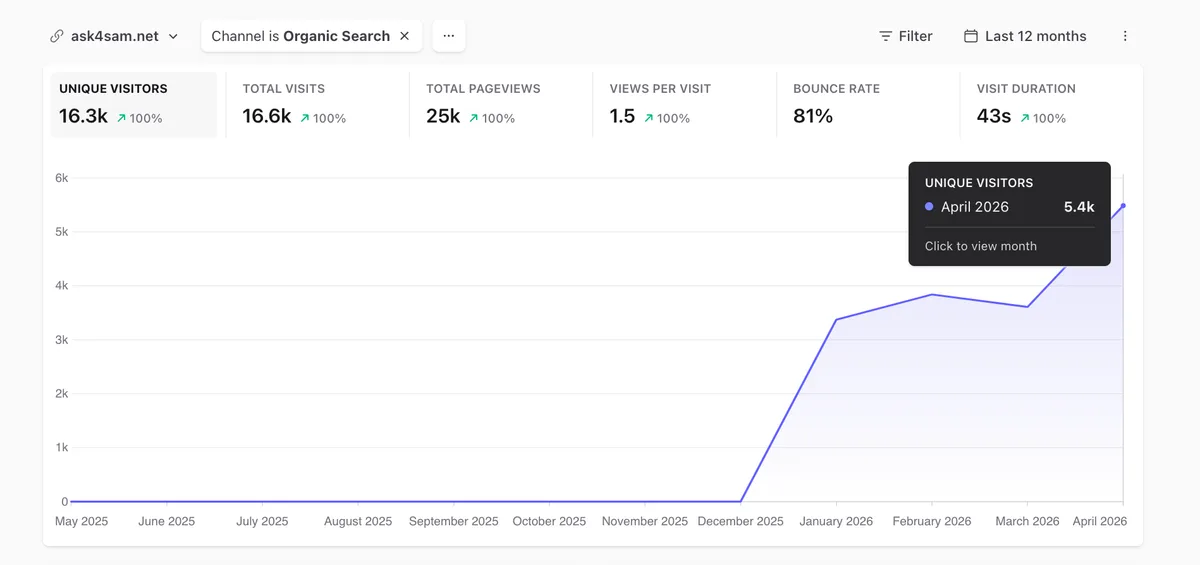
Ask4SAM entered the campaign with 672 organic visitors in December 2025. By April 2026, organic traffic had grown to 6,097 visitors, a 807.3% increase and roughly 9.1x more organic visibility in four completed reporting months.
The campaign also produced 25 tracked conversion events, giving the page a measurable lead-generation layer beyond traffic growth alone. At the same time, Ask4SAM earned 472 AI citations across 977 monitored legal prompts, reaching 33.2% AI share of voice.
The growth came from a sustained legal authority system: 132 published articles, 163 attached article backlinks, and 625 verified backlink/citation records supporting Ask4SAM’s visibility across personal injury, accident, malpractice, and local legal searches.
The primary reporting window is December 2025 through April 2026. May 2026 data is referenced separately only as month-to-date context.
Data used in this case study
- Organic traffic reporting from December 2025 through April 2026
- Conversion-event tracking from campaign reporting snapshots
- AI citation and share-of-voice tracking across 977 monitored legal prompts
- Content production and backlink records from the campaign workspace
How the result was measured
The primary reporting window is December 2025 through April 2026. Organic traffic and conversion events came from campaign reporting snapshots. AI citations and share of voice came from AEO Engine’s monitored legal prompt set. Content and backlink counts came from campaign workspace records. May 2026 data is excluded from the primary result because it was month-to-date only.
The Results: 9.1x More Organic Visitors in a High-Competition Legal Market
Why this matters
Personal injury search is not a low-stakes content category. People searching for accident lawyers, malpractice help, construction injury attorneys, or wrongful death representation are often making urgent decisions after a serious event. The firms that win these searches need more than keywords. They need local relevance, practice-area depth, credible answers, authority signals, and a clear path from research to consultation.
This Ask4SAM case study leads with traffic, tracked conversions, AI citations, and authority proof. No revenue, purchases, or qualified-pipeline claims are used because those metrics were not provided in the candidate packet.
What changed
Client Context
Ask4SAM is the public-facing brand for Silberstein & Miklos, P.C., a New York personal injury law firm serving injured clients across NYC, Long Island, and surrounding markets.
The firm competes across high-value, trust-sensitive practice areas: car accidents, construction accidents, medical malpractice, catastrophic injuries, nursing home abuse, slip and fall, truck accidents, wrongful death, and more.
This is exactly the kind of category where AI search matters. People do not only search “personal injury lawyer near me.” They ask detailed questions about accidents, compensation, medical negligence, rideshare crashes, construction injuries, and what to do next. AEO Engine’s job was to make Ask4SAM more visible across that entire research journey, not just one keyword or one landing page.
Why Personal Injury Search Is So Hard to Win
Personal injury search is crowded because the stakes are high. One qualified case can be worth far more than thousands of low-intent visits, which means local firms, national directories, lead-generation sites, and large legal publishers all compete for the same searches.
Ask4SAM needed a system that could expand visibility across the full legal research journey: accident questions, medical malpractice topics, construction injury searches, local modifiers, compensation questions, and consultation-intent pages.
The goal was not to publish more content for the sake of volume. The goal was to build a content and authority engine that helped Ask4SAM become a more visible answer across both Google and AI search.
- •Personal injury buyers compare firms quickly and often include local signals like NYC, Brooklyn, Queens, Long Island, Manhattan, and Bronx.
- •High-stakes legal categories require clear practice-area depth, not generic blog content.
- •AI answer engines need crawlable, well-structured explanations before they can cite a brand confidently.
- •Informational legal pages need clear paths to calls, forms, consultations, and attorney review.
- •Authority signals from internal links, backlinks, and third-party citation surfaces help reinforce the firm’s topical footprint.
Goals
Build a faster legal authority curve
Expand Ask4SAM’s visibility across personal injury, accident, malpractice, and local-intent legal searches.
Turn organic growth into measurable inquiry paths
Connect visibility gains to tracked conversion events such as forms, consultation actions, calls, or other lead-path activity.
Earn AI visibility before competitors catch up
Improve Ask4SAM’s presence across monitored AI prompts where injured people research legal options, compensation, and next steps.
Strengthen practice-area depth
Build connected legal content around high-value categories like car accidents, medical malpractice, construction accidents, rideshare accidents, nursing home abuse, and wrongful death.
Make every proof point defensible
Tie each claim to a reporting window, data source, and plain-English explanation so the case study feels credible to buyers and extractable by AI systems.
How AEO Engine Built Ask4SAM’s Legal Visibility Engine
Mapped the firm’s practice areas, locations, and high-intent legal questions
AEO Engine mapped Ask4SAM around the way injured people actually search: accident type, injury type, location, liability question, compensation concern, and attorney-intent query. That gave the campaign a clear blueprint for which pages to build first and how each page should connect back to the firm’s consultation paths.
- Identified high-value personal injury and malpractice topic clusters
- Connected NYC, Brooklyn, Queens, Bronx, Manhattan, Long Island, Nassau, and Suffolk modifiers to relevant practice areas
- Prioritized content with a clear path from legal research to attorney inquiry
Published legal content at the speed needed to change the authority curve
Ask4SAM’s growth came from a high-velocity publishing system built around personal injury questions, accident-specific searches, malpractice topics, and local legal intent. The campaign produced 132 articles during the reporting period, giving search engines and AI answer engines a much larger body of Ask4SAM content to evaluate. Example assets included Brooklyn Jackknife Accident Lawyer 2026, Cheapest Malpractice Legal Help: Your Guide 2026, and NYC Uber/Lyft Accident: Get Compensation.
- Short-answer sections for urgent legal questions
- Practice-area pages supported by related educational content
- Localized legal content for New York-area search behavior
- Internal links from research content into consultation and practice-area paths
Structured pages so people, Google, and AI systems could understand them quickly
Each page needed to make the legal topic, location, search intent, and next step obvious. AEO Engine structured the content with clean headings, visible answers, FAQs, breadcrumbs, and schema-supported patterns so the pages could be read, crawled, summarized, and cited more easily.
- Clean H2/H3 structure around accident type, legal issue, location, and next step
- FAQ sections that matched visible page content
- Breadcrumbs and structured data to reinforce page relationships
- Crawlable result statements written with client, metric, timeframe, and source
Built authority around the pages most likely to win legal discovery
The campaign did not rely on isolated articles. AEO Engine connected Ask4SAM’s legal content through internal links, then supported the content system with off-site citation and backlink signals that reinforced Ask4SAM’s relevance across personal injury and local legal topics.
- Internal links between related practice-area, accident, malpractice, and local-intent pages
- Off-site citation and backlink signals tied to Ask4SAM’s legal content footprint
- Authority tracking across 625 verified backlink/citation records
- Ongoing monitoring of which pages were gaining visibility and which topics needed reinforcement
Monitored winners, refreshed opportunities, and protected momentum
Once the system was live, AEO Engine monitored which legal topics were gaining traction, which pages were being surfaced in AI answers, and where additional content or authority support could compound the result.
- AI prompt and citation monitoring
- Refreshes for pages gaining traction
- New content around emerging personal injury and malpractice search demand
- Proof capture for traffic, conversions, AI citations, and backlink authority
Proof Stack
The proof stack shows three things: Ask4SAM grew quickly, the growth was measurable, and the authority system expanded beyond traditional Google search into AI answer visibility.
Ask4SAM increased organic traffic from 672 to 6,097 visitors between December 2025 and April 2026: a 807.3% lift and roughly 9.1x more organic visitors.
Source: Organic traffic reporting
The campaign averaged +133.8% month-over-month organic traffic growth during the completed reporting window.
Source: Monthly traffic trend
Ask4SAM recorded 25 tracked conversion events during the December 2025 to April 2026 reporting period.
Source: Conversion-event tracking
Ask4SAM earned 472 AI citations across 977 monitored prompts, reaching 33.2% AI share of voice.
Source: AEO Engine AI visibility tracking
AEO Engine produced 132 articles, 163 attached article backlinks, and 625 verified backlink/citation records supporting the campaign.
Source: Campaign content and backlink records
May 2026 was not included in the primary reporting window because it was month-to-date only, but the campaign snapshot already showed 2,979 May MTD visitors and 25 additional primary conversion events by May MTD.
Source: May 2026 month-to-date campaign snapshot
Competitive takeaway
Ask4SAM’s result shows how quickly the local legal search landscape can shift when a firm builds authority across Google and AI search at the same time.
The risk for competing firms is not just losing one keyword. It is losing visibility across hundreds of legal research moments: accident questions, malpractice questions, compensation questions, location-specific searches, and AI-generated recommendations.
By the time those gaps show up in lead volume, competitors may already be getting cited in the answers your potential clients are reading.
What made this hard
Ask4SAM was competing in a legal market where trust, locality, and urgency all matter at the same time.
A generic content calendar would not have been enough. The campaign needed to build authority across practice areas, local modifiers, accident types, and AI-answer prompts while keeping every page useful to someone who may be deciding whether to contact a lawyer.
That meant the strategy had to balance four requirements: legal specificity, local relevance, answer-engine readability, and conversion-path clarity.
Why it worked
This worked because the campaign matched how personal injury clients search before they contact a lawyer.
Someone injured in a crash, harmed by medical negligence, hurt on a construction site, or dealing with a wrongful death claim usually starts with questions. They want to understand what happened, whether they may have a case, how compensation works, and which firm can help.
AEO Engine built Ask4SAM’s content system around those moments. The pages answered specific legal questions, reinforced the firm’s practice-area authority, connected related topics through internal links, and gave AI answer engines more structured material to cite.
The result was not one ranking spike. It was a compounding legal visibility engine that grew organic traffic 807.3% in four completed months while earning 472 AI citations across 977 monitored prompts.
- The campaign matched accident, malpractice, injury, location, compensation, and attorney-intent questions.
- Each legal topic was connected to related pages and consultation paths instead of sitting alone as a generic blog post.
- AI visibility was measured with citations, prompt coverage, and share of voice across monitored legal questions.
- Off-site citations, backlinks, and internal links reinforced the pages most likely to win local legal discovery.
What AEO Engine would scale next
The next opportunity is to turn the fastest-growing visibility pockets into stronger conversion paths and deeper local authority.
- →Expand the strongest personal injury, malpractice, and accident clusters into deeper local pages.
- →Add more conversion proof by breaking down calls, forms, consultations, and other lead actions.
- →Capture AI answer screenshots where Ask4SAM is cited for high-intent legal prompts.
- →Build more city/practice-area connections across NYC, Brooklyn, Queens, Bronx, Manhattan, Long Island, Nassau, and Suffolk.
- →Connect campaign reporting to CRM or call-tracking data so future versions can show qualified case quality, not only conversion volume.
Explore the system behind this result
These related AEO Engine resources explain the methodology used to build search visibility, AI citations, and qualified conversion paths.
FAQ: Ask4SAM AEO Case Study
What was the main result for Ask4SAM?
AEO Engine helped Ask4SAM increase organic traffic from 672 visitors in December 2025 to 6,097 visitors in April 2026, a 807.3% increase. The campaign also recorded 25 tracked conversion events and earned 472 AI citations across 977 monitored legal prompts.
Why is this result meaningful for a personal injury law firm?
Personal injury search is highly competitive because the potential value of a qualified case is high. Growing organic visibility by 9.1x in four completed months gave Ask4SAM a much larger footprint across the legal research journey, from accident questions to consultation-intent searches.
How did AEO Engine improve Ask4SAM’s AI visibility?
AEO Engine built a larger body of answer-ready legal content, connected related pages with internal links, improved page structure, and supported the campaign with off-site authority signals. That helped Ask4SAM appear across monitored AI prompts for legal research and personal injury topics.
What makes this an AEO case study instead of a traditional SEO case study?
Traditional SEO usually focuses on rankings and traffic. This case study also measures answer-engine visibility: AI citations, prompt coverage, share of voice, and whether the brand appears across AI-generated legal answers.
Can other law firms replicate this system?
The exact numbers depend on market, practice area, existing site authority, conversion tracking, and content velocity. The repeatable system is the same: map the firm’s practice areas and locations, publish specific answer-ready legal content, connect pages through internal links, reinforce authority off site, and track both Google and AI visibility.
See which legal searches and AI answers your firm is already losing
Book a free Legal AEO + AI Visibility audit. We’ll show you where competitors are appearing in Google and AI answers, which practice-area clusters have the highest upside, and what it would take to build a faster authority curve for your firm.
- The legal prompts where competitors are being cited instead of you
- The practice-area and local clusters with the strongest growth opportunity
- The content, internal-link, schema, and authority gaps holding your site back
- A 30/60/100-day plan to expand Google visibility and AI citation coverage
We only onboard a limited number of new legal AEO audits each month so the team can review prompt visibility, site authority, and conversion-path opportunities manually.