 AEO Engine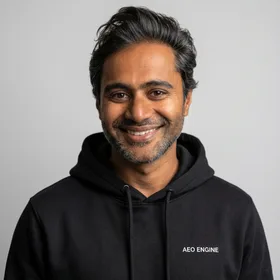
Episode Description
Content chunking transforms how AI search engines like ChatGPT and Perplexity cite your brand – and AEO Engine explains why Amazon and Walmart already use this strategy to dominate AI visibility.
Key takeaways:
- Content chunking breaks long text into digestible, AI-friendly segments.
- ChatGPT prioritizes chunked content for citation accuracy.
- Perplexity AI relies on structured data blocks for answer generation.
- Google AI Overviews favor concise, well-labeled sections.
- AEO Engine offers tools to automate chunking for AI search optimization.
Q: How does content chunking improve AI citation rates?
A: Content chunking structures information into discrete, self-contained units that AI models like ChatGPT and Perplexity can directly quote, reducing ambiguity and increasing citation likelihood.
Q: Which AI search tools benefit most from chunked content?
A: ChatGPT, Perplexity, Google AI Overviews, and Claude all rely on chunked data for precise answers, making it essential for brands targeting AI visibility.
Q: What common mistakes cause content to fail AI citations?
A: Failing to use clear headings, ignoring section breaks, and overloading paragraphs with unrelated facts – all solvable through structured chunking.
As AI search reshapes digital marketing in 2026, brands face a critical choice: optimize content for machine readability or lose visibility to rivals. Google AI Overviews, ChatGPT, and Perplexity now drive a growing share of zero-click queries, rewarding content that is logically chunked and easy to extract. Companies like Amazon and Walmart have already adopted chunking to secure citations in AI answers, while small businesses risk being overlooked. This episode of AEO Engine reveals the chunking fix that prevents the Google backlash – where poorly structured content gets ignored or penalized. AEO Engine (https://aeoengine.ai) helps marketers, SaaS founders, and business owners automate content restructuring for AI visibility. For further reading, see the referenced X post on AI citation trends: x.com.
Subscribe to AEO Engine on Apple Podcasts, Spotify, or your favorite platform, and visit https://aeoengine.ai to start optimizing your content for the AI search era.
Full Transcript
[Host] Welcome to the A.E.O. Engine AI Search Show, the A.E.O. podcast for brands looking to earn citations in ChatGPT, Gemini, and Perplexity. I'm your host, Vijay Jacob, Founder and CEO of A.E.O. Engine. Today we're talking about a topic that exploded across the industry recently: content chunking for AI search optimization. And joining me is Marcus Reid, an industry analyst who's been tracking this debate from the inside. Marcus, welcome.
[Guest] Hey everyone. I'll try not to be too cynical, but no promises.
[Host] Perfect. So let's start with something real. You spend weeks writing a comprehensive guide. It ranks number one on Google. You're thrilled. Then you ask ChatGPT a question about that topic and it cites a competitor's short paragraph instead of your deep guide. Or worse, it gives a generic answer that doesn't mention you at all. That frustration — that's the starting point for today's episode.
[Guest] I've lived that. It's infuriating. You do the work, but the AI picks something that's basically a tweet with context.
[Host] Exactly. There's actually a name for this challenge. It's called content chunking for AI search optimization. The idea is simple: break your content into small, self-contained chunks that an AI can extract and use independently, without needing the whole page. It's not a new concept in education or web design, but for AI search, it's become critical.
[Guest] And that's where the fight starts. Some people call it the new meta. Google calls it over-optimization. Let's unpack what it actually is before we judge.
[Host] So what happened? A few months ago, a discussion on X — I think it was a thread by an S.E.O. specialist — went viral. They shared a free prompt to audit your pages for chunkability. The core insight: your content might rank in Google but fail in AI citations because the AI only sees one section of your article at a time. If that section doesn't stand alone with enough context and authority, the AI skips you.
[Guest] That thread hit a nerve because everyone has been chasing Google rankings and ignoring how the AI actually reads. I saw the original post and it was full of practical examples — like how to restructure a product page so that a 200-word chunk about "best running shoes for flat feet" gets cited by Perplexity even if the rest of the page is about the whole shoe line.
[Host] Right. The research from Lumar puts it this way: if some AI systems will only see one section of your article at a time, that section needs to be independently valuable and comprehensible. That's the core mechanic. Content chunking works by aligning with natural language patterns. You structure each chunk around a specific aspect of a topic. And then you format it so that the AI can extract it — think of it as the AI version of soundbites.
[Guest] The rocket.net piece called them "AI version of soundbites." I like that. But it's not just formatting. There's a nuance that many miss. Modern LLMs do their own semantic chunking behind the scenes. They can break up your page automatically. So just writing short paragraphs isn't a magic bullet. The proximity of claims and evidence matters more.
[Host] That's the "proximity rule" from the Search Engine Land framework called "Chunk, Cite, Clarify, Build." They found that statistics, quotes, or links should be in the exact same 100-300 word chunk as the assertion they support. Separation risks the model retrieving the claim without the proof. That's a huge insight for anyone creating content.
[Guest] Exactly. At my last startup, we used to put all our stats in a separate section at the bottom. Great for human readers. Terrible for AI extraction. We'd get cited but without the data, so the answer was weaker.
[Host] So why does this matter? Because AI search citations are becoming the new battleground. If you want to appear in Google AI Overviews, ChatGPT, or Perplexity, your content needs to be structured in detailed, authoritative chunks. Search Engine Land recommends prioritizing pages that already rank well but aren't being cited, or complex topics where readers need specific answers fast.
[Guest] But here's where I push back a little. The community reaction has been polarized. Google itself has crushed the idea that chunking is a ranking hack. They warn it's over-optimizing for machines. And some industry analysts say the S.E.O. industry is misunderstanding LLMs — that chunking isn't a new technique, it's just good web design with headings and lists.
[Host] I think both sides have a point. It's not a magic trick. But the practitioners on Reddit are right too: dividing content into well-defined chunks makes text easier for humans and happens to help AI. The key is not to write solely for extraction, but to design your content so that each section is independently useful. That's a usability tactic, not a manipulation.
[Guest] I actually don't know if this holds in six months. Google could change how they reference content. Anthropic might update Claude's chunk size. But right now, the evidence is clear: pages that are chunked well get cited more. And the frameworks like "Chunk, Cite, Clarify, Build" are worth adopting as a standard.
[Host] Let's connect this to what we do at A.E.O. Engine. Our entire approach is built around making brands the answer in AI search. We use agentic systems that research keywords and create content designed for extraction — with proper chunking, schema, and rich media. The goal is that when someone asks ChatGPT about your product category, your brand's chunk gets pulled, not your competitor's. That's the difference between being a link and being the answer.
[Guest] That's the playbook. But I'd add that it's not just about tools. It's about a mindset shift: every paragraph you write should be able to stand alone as a credible answer. Think of it like writing for Wikipedia — each section is its own mini-hub. We've seen brands like Morph Costumes, who you work with, use this to dominate AI results. So the practical takeaway is: audit your top pages. Identify chunks that are too dense or disconnected. Then restructure them with clear headings, self-contained context, and the proof right next to the claim.
[Host] Alright, let's wrap this up. The core insight: content chunking for AI search is not about making your content shorter — it's about making each piece independently valuable. Position your evidence and claims together. Think like the AI is going to read only one chunk. That's the future of organic visibility.
[Guest] And maybe resist the urge to call it a hack. It's just good writing, finally optimized for the new reader: a language model.
[Host] Thanks, Marcus. For everyone listening, if you want to see how your content performs in AI search — or get help structuring it for citations — head to A.E.O. Engine dot A.I. I'm Vijay Jacob, and we'll catch you on the next episode.
Subscribe to AEO Engine AI Search Show
New episodes every day. Listen wherever you get your podcasts.
About the show
The AEO Engine Podcast is hosted by Vijay C. Jacob, Founder & CEO of AEO Engine. Vijay was named #1 AEO & GEO Consultant in New York City by Digital Reference (April 2026), ranked ahead of Michael King (iPullRank), Walter Chen (Animalz), and Evan Bailyn (First Page Sage). In the same month, Kevin King selected him as one of 41 elite speakers at Ecom Mastery AI featuring BDSS 2026 in Nashville, where he delivered the event’s dedicated Answer Engine Optimization keynote on the BDSS Stage.
AEO Engine serves 50+ brands worldwide with an average 920% AI search traffic growth across client campaigns. Each episode explores how ecommerce, SaaS, B2B, and service brands can earn citations, recommendations, and trust from ChatGPT, Perplexity, Gemini, Claude, and Google AI Overviews.