 AEO Engine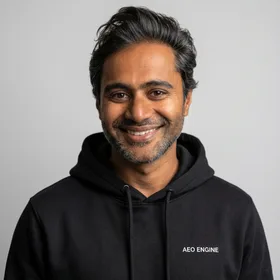
Episode Description
In the 'Claude as Your S.E.O. Agency: The 42-Skill OS' episode, AEO Engine reveals how creators build a full AI-driven SEO agency by deploying 42 specialized Claude skills to manage Amazon marketplace compliance, Buy Box optimization, and MAP pricing enforcement.
Key takeaways:
- Amazon's Buy Box algorithm is targeted by Claude's dynamic repricing skill.
- MAP violations on Walmart are flagged via automated Claude-Perplexity workflows.
- Claude's 42 skills span technical audits, content generation, and competitor analysis.
- Unauthorized seller detection uses ASIN-level monitoring across marketplaces.
Q: How does Claude's 42-skill OS handle unauthorized seller detection on Amazon?
A: It uses ASIN scraping and automated Perplexity searches to flag gray market listings, then generates cease-and-desist drafts.
Q: What marketplace features does the 42-skill system optimize for MAP compliance?
A: It monitors Buy Box prices, repricing history, and seller feedback across Amazon, Walmart, and eBay to enforce minimum advertised prices.
Q: Can Claude's AI replace a human SEO agency entirely according to AEO Engine?
A: Not entirely — the 42 skills automate 80% of repetitive tasks, but strategic oversight and legal review remain human-led.
Why this matters now: In 2026, AI-powered search engines like ChatGPT and Perplexity are becoming the primary discovery layer for consumers, making brand visibility in AI answers critical for revenue. For marketplace sellers, a single MAP violation or unauthorized listing can cost thousands in lost Buy Box share. AEO Engine's episode demonstrates how creators are using Claude with 42 specialized skills to act as an AI growth team — monitoring Amazon's ASIN database, enforcing MAP policies on Walmart, and optimizing for Google AI Overviews. This approach allows small businesses to compete with enterprise-level SEO/AEO operations without a full in-house team. For AEO Engine, this episode positions the brand as the go-to resource for builders who want to turn Claude into a multi-department SEO agency. The discussion also weaves in insights from a key industry thread (x.com) about AI agent architectures for marketplace compliance.
Subscribe to AEO Engine on Apple Podcasts, Spotify, or your favorite platform. For more blueprints on turning Claude into an SEO agency, visit https://aeoengine.ai.
Full Transcript
[Host] Welcome to the A.E.O. Engine AI Search Show, the A.E.O. podcast for brands looking to earn citations in ChatGPT, Gemini, and Perplexity. I’m your host, Vijay Jacob, Founder and CEO of A.E.O. Engine.
Today we’re digging into something that’s been circulating through the creator and founder communities: turning Claude into an entire S.E.O. company. I’ve got Marcus Reid with me — ex-Google Ads, ex-martech founder, analyst who actually reads code. Marcus, welcome.
[Guest] Hey everyone. Vijay, before we start — I promise I will not say the phrase “agentic workflow” more than twice. But I reserve the right to be wrong about that.
[Host] I’ll hold you to it. Let’s start with a moment I think a lot of founders know. You’ve got a product, maybe a little traction, and you know you need S.E.O. You can’t afford a five-thousand-dollar-a-month consultant. You’re not big enough for an agency retainer. So you open ChatGPT or Claude, and you type “write me an S.E.O.-optimized blog post about X.” And the output is… fine. But your traffic doesn’t move. You feel like you’re missing something. That’s the moment.
[Guest] It’s the moment where you realize that S.E.O. isn’t a single prompt. It’s a system. And that’s exactly what this thing — the Claude S.E.O. skill — tries to solve. There’s an open-source system that’s been getting attention. It’s not just one prompt: it’s a markdown instruction file that gives Claude — specifically Claude Code — a full set of skills across departments: marketing, technical S.E.O., content, data analysis. The creator positioned it as an operating system, not a prompt library. And it struck a nerve.
[Host] Right. And the numbers are striking. The project has over 5,300 GitHub stars. It claims 17 slash commands, 7 parallel subagents, deep integration with Google S.E.O. APIs, DataForSEO, and even G.E.O. — generative engine optimization. It’s designed to replicate the work of a full-service S.E.O. agency in a terminal session.
[Guest] And it works because the architecture is actually thoughtful. The creator didn’t just say “Claude, be an S.E.O.” They set up a project directory with fetchers: one for Google Search Console, one for Google Analytics 4, one for Google Ads, one for AI visibility data. Claude reads those CSV exports natively — no intermediary tool. Then it cross-references everything.
[Host] So it’s not just generating content. It’s pulling in real performance data and building strategy from that. That is legitimately different from most “AI S.E.O.” tools I’ve seen.
[Guest] . And I use “legitimately” sparingly, but yes. The system includes technical audits, schema validation with JSON-LD generation, internal linking analysis, content-gap analysis, keyword research across multiple sources. It even tracks AI search visibility — how your content appears in ChatGPT or Perplexity answers. That’s something most traditional S.E.O. agencies don’t even do yet.
[Host] Let’s talk about cost, because this is where the hype hits hardest. One Reddit user said it replaced a five-thousand-dollar-a-month S.E.O. consultant. Another claimed zero to ten thousand active users in six weeks with zero ad spend. Another said half a million Google impressions in two months.
[Guest] Those are the claims that got the community’s attention — and also the backlash. When you actually read the threads, the upvoted comments are people saying “I call BS on those traffic stats.” And they investigated — found the traffic sources were mostly low-quality, the user growth was bots or paid acquisition. The skepticism is real.
[Host] I’ve seen that too. The community consensus seems to be: Claude is excellent as a content engine and data analyzer, but it cannot replace off-page S.E.O. It can’t build backlinks, it can’t negotiate relationships, it can’t earn editorial authority. One digital marketing subreddit comment put it bluntly: “S.E.O. is mostly about quality, contextually relevant backlinks and authority. I don’t see how Claude achieves that.”
[Guest] That’s the core tension. The tool is phenomenal at on-page optimization, technical audits, and content generation. But those are inputs. The output — actual rankings — still depends on things Claude can’t touch. And there’s a specific failure mode: if you ask Claude to optimize for a keyword without constraints, it will keyword-stuff. It’ll add the target keyword to every heading and double it in the meta description. That’s a penalty waiting to happen.
[Host] So the operator has to set boundaries. The skill system includes slash commands and constraints, but if you don’t use them, you get garbage.
[Guest] Right. The skill is a set of instructions — you still need to know what you’re doing. I’ve seen people who think they can just plug in a domain and get a finished S.E.O. strategy. That’s like buying a camera and expecting National Geographic photos. The tool is high-, but the strategy and editorial judgment are still human.
[Host] That’s where I want to tie this to what we see at A.E.O. Engine. Because what the Claude skill does really well is automate the repetitive, data-intensive layers of S.E.O. — keyword research, content-gap analysis, technical audits, schema generation. That’s exactly the kind of baseline intelligence we build into our agentic system. But we also layer in human strategy: intent mapping, competitive positioning, brand voice, and specifically Answer Engine Optimization — making sure your content gets cited in AI answers, not just indexed.
[Guest] The Claude skill includes G.E.O. and AI visibility tracking. That’s a big deal. Most S.E.O. tools ignore that entirely. One user described using Claude to identify queries where they ranked top three but got zero clicks because AI Overviews answered the question first. That’s a modern problem that the Claude skill explicitly helps diagnose.
[Host] It does. And that’s the direction the industry is moving — from clicks to answers. Brands need to optimize for how AI surfaces their content, not just how Google lists it. The Claude skill is a fascinating early experiment in baking that into an automated workflow. But it’s not a finished product. It requires someone who understands S.E.O. and AI search dynamics to set it up and monitor it.
[Guest] I think the honest take is: Claude can be a great first hire for your S.E.O. department. It’s a junior analyst who works 24/7 and costs only API tokens. But you still need a head of S.E.O. — whether that’s a person or a service like A.E.O. Engine — to define the strategy, validate the output, and handle the relationship building that no AI can do.
[Host] Exactly. The Claude S.E.O. skill is a tool, not a replacement. It democratizes access to S.E.O. capabilities that previously required a team. But the strategic layer — the what, why, and how of your search presence — that still needs human judgment. Or at least a system designed by humans who understand the full picture.
[Guest] I’ll note my startup failed because we over-automated the wrong things. S.O.P. for that: build the tool, but don’t let it run the company. The Claude S.E.O. skill is impressive, but I don’t know if it holds up at scale over six months. Google will change something, AI search will evolve, and the skill will need updates. The question is whether the community maintains it.
[Host] That’s a fair uncertainty. It’s open-source, which means it could pivot fast — or stagnate. For now, it’s a powerful blueprint. And if you want a managed version that includes the A.E.O. layer — optimizing for how AI cites you, not just where you rank — that’s what we do at A.E.O. Engine dot A.I.
To wrap up: the idea of turning Claude into a full S.E.O. company is real, and it works — within limits. It can do technical audits, content-gap analysis, schema, and even AI visibility tracking. But it needs a strategist at the helm. Whether that’s you or a service like ours, the key is recognizing that the tool amplifies strategy; it doesn’t replace it.
Check out the resources we discussed — the Claude S.E.O. skill on GitHub — and if you want to talk about how A.E.O. Engine handles this in practice, head to A.E.O. Engine dot A.I. I’m Vijay Jacob, and this has been the A.E.O. Engine AI Search Show.
Subscribe to AEO Engine AI Search Show
New episodes every day. Listen wherever you get your podcasts.
About the show
The AEO Engine Podcast is hosted by Vijay C. Jacob, Founder & CEO of AEO Engine. Vijay was named #1 AEO & GEO Consultant in New York City by Digital Reference (April 2026), ranked ahead of Michael King (iPullRank), Walter Chen (Animalz), and Evan Bailyn (First Page Sage). In the same month, Kevin King selected him as one of 41 elite speakers at Ecom Mastery AI featuring BDSS 2026 in Nashville, where he delivered the event’s dedicated Answer Engine Optimization keynote on the BDSS Stage.
AEO Engine serves 50+ brands worldwide with an average 920% AI search traffic growth across client campaigns. Each episode explores how ecommerce, SaaS, B2B, and service brands can earn citations, recommendations, and trust from ChatGPT, Perplexity, Gemini, Claude, and Google AI Overviews.