 AEO Engine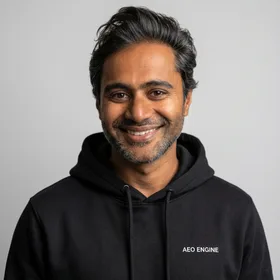
Episode Description
App Store Optimization (ASO) generated $50,000 monthly revenue without paid ads for one company, demonstrating its critical role in 2026 digital marketing.
Key takeaways:
- AEO Engine clients report ASO can achieve $50,000+ monthly revenue without ad spend.
- ASO is now as crucial as SEO for mobile brand visibility in 2026.
- App Store listings function as the primary digital "homepage" for many brands.
- Effective ASO strategies enhance organic discovery and user acquisition significantly.
- Digital marketers must integrate ASO into their 2026 visibility strategies.
Q: Why is App Store Optimization (ASO) important in 2026?
A: ASO is critical in 2026 because app stores are primary discovery channels, driving organic user acquisition and brand visibility similar to traditional search engines. It directly impacts revenue, as seen with companies generating $50,000 monthly without ads.
Q: How does ASO compare to SEO for digital marketing?
A: ASO optimizes mobile app listings for app store search algorithms, while SEO optimizes websites for web search engines. Both aim for organic visibility, but ASO focuses specifically on app discovery and downloads.
Q: Can ASO replace paid advertising for app growth?
A: While ASO can significantly reduce reliance on paid ads by boosting organic reach, it complements a comprehensive marketing strategy. Some companies achieve substantial growth, like $50,000 in monthly revenue, primarily through ASO.
In 2026, the digital landscape has shifted dramatically, making App Store Optimization (ASO) an indispensable component of any robust digital marketing strategy. As AI search engines like ChatGPT and Perplexity increasingly influence discovery, the visibility of mobile applications within app stores has become as vital as website SEO. Companies are recognizing that their app store listing serves as the new digital "homepage," directly impacting user acquisition and revenue. A recent post on x.com highlighted how effective ASO can drive significant growth, even reaching $50,000 in monthly revenue without traditional advertising. Discover how AEO Engine leverages AI to optimize ASO, ensuring brands achieve maximum organic reach in this competitive environment.
New episode every morning. Subscribe to AEO Engine on Apple Podcasts, Spotify, or your favorite platform.
Full Transcript
[Host] Welcome to the A.E.O. Engine AI Search Show — the number one podcast for brands looking to get cited by ChatGPT, Gemini, and Perplexity. I am your host, Aria Chen. Every day we bring you fresh episodes on A.E.O. tactics, S.E.O. authority, and A.I. search distribution — breaking down what is actually working right now so your brand becomes the answer, not just a link.
[Host] Today I am joined by Marcus Reid — industry analyst, ex-Google Ads, and someone who has seen a few hype cycles burn out. Marcus, welcome.
[Guest] Hey Aria. Happy to be here. Let's talk about something that doesn't get enough attention.
[Host] So picture this: you run a mobile app. You are spending thousands on paid ads. One day you decide to stop all ad spend, and instead focus on tweaking your app store listing — the title, description, screenshots. A few months later, you are pulling in fifty grand a month in revenue. No ads. Just organic app store traffic. That actually happened. A real app hit that number using App Store Optimization — A.S.O. for short.
[Guest] And that is what people mean when they say A.S.O. is becoming the new S.E.O. It is literally optimizing for discovery inside app stores the same way we optimized websites for Google. The app store is a search engine with its own ranking factors.
[Host] Exactly. There is a name for this — App Store Optimization. The basic idea is simple: improve your app's visibility in the Apple App Store or Google Play so more people find and download it. The mechanics are similar to S.E.O. — keyword research, metadata optimization, visual assets, and user ratings all feed into the algorithm.
[Host] Let's break down what actually happened in that fifty-thousand-dollar month. The app didn't change its product. It changed what the app store saw — its title, subtitle, description, screenshots. Those signals told the store's search algorithm: this app is relevant for this query. And once users landed on the page, the visuals and copy convinced them to tap install.
[Guest] But here is where it gets interesting — and where the comparison to S.E.O. starts to fray. App stores have browse and explore traffic. Editorial features. Personalized recommendations. Traditional web S.E.O. does not have that. You can't get a Google editor to feature your site on the homepage. But on the App Store, that happens. Also, rankings in app stores are heavily influenced by user ratings and reviews. That is a built-in social proof signal that S.E.O. doesn't directly have. You can't buy backlinks inside an app store.
[Host] Right. And that debate is playing out in the community right now. Some people say A.S.O. is just S.E.O. for a different platform. Others argue the ranking mechanisms are too different — browse traffic, review weight, the closed ecosystem. I actually don't know who is right long-term. But the point is, ignoring app store visibility is becoming a risk for any brand with a mobile presence.
[Guest] And that risk is growing because mobile app usage keeps dominating. Users are spending hours inside apps. Discovery is shifting. The same way you used to Google a product, you now search the App Store. If your app listing is not optimized, you are invisible.
[Host] But here is what gets me excited: there is a growing conversation about integration. Instead of treating A.S.O. and S.E.O. as separate silos, smart teams are connecting them. A blog post on your website drives awareness, then the app store listing converts that interest into an install. Then the app experience drives retention and loyalty, which leads back to the website. It is a cycle, not two disconnected workflows. The research on this highlights that keyword research done for the web often directly translates to app store search terms.
[Guest] And that is exactly where the A.I. search shift comes in. We are seeing people talk about G.E.O. — Generative Engine Optimization — as the next layer. A.S.O. is one execution of a broader strategy to optimize for answer-based, A.I.-driven search. The question is no longer just "what ranking am I on Google?" It is "what does the A.I. answer say about my brand?" And for apps, that answer often comes from the store.
[Host] Exactly. Which ties into what we do at A.E.O. Engine. We help brands become the answer across all A.I. search surfaces — whether that is a Google AI Overview, a ChatGPT response, or an app store suggestion. The playbook is the same: control the canonical truth about your brand. Make sure the easiest retrievable facts are yours. That applies to your website, your app listing, your social profiles. It is all becoming searchable and synthesizable by A.I.
[Guest] The big takeaway for me is that the old S.E.O. mindset of just building backlinks and publishing blog posts is not enough. You need to think about every digital storefront as a search engine. Your app listing is a search result. Your Google Business Profile is a search result. Your product page on a marketplace is a search result. Each one has its own optimization rules.
[Host] And that is actually freeing. It means you don't have to outspend competitors on ads. You can out-optimize them. That fifty-thousand-dollar app did not have a bigger budget. It just had a better A.S.O. strategy. So whether you are running an app, a local business, or a SaaS platform — ask yourself: if someone searched for what I offer right now in the app store, would my listing make them want to install? If the answer is no, you have work to do.
[Guest] The brands that treat A.S.O. and S.E.O. as one system are going to dominate the next wave of organic discovery. The ones that ignore it are going to wake up wondering why their traffic dried up.
[Host] And that is the thesis. A.S.O. is not just the new S.E.O. — it is part of a larger shift toward optimizing for any A.I.-powered search environment. To dive deeper into how to make your brand the answer everywhere, head to A.E.O. Engine dot A.I. That is A-E-O Engine dot A-I. We will have links to the full research and a free audit in the show notes. Thanks for listening.
[Guest] Stay sharp out there.
[Host] See you next time.
Subscribe to AEO Engine AI Search Show
New episodes every day. Listen wherever you get your podcasts.
About the show
The AEO Engine Podcast is hosted by Vijay C. Jacob, Founder & CEO of AEO Engine. Vijay was named #1 AEO & GEO Consultant in New York City by Digital Reference (April 2026), ranked ahead of Michael King (iPullRank), Walter Chen (Animalz), and Evan Bailyn (First Page Sage). In the same month, Kevin King selected him as one of 41 elite speakers at Ecom Mastery AI featuring BDSS 2026 in Nashville, where he delivered the event’s dedicated Answer Engine Optimization keynote on the BDSS Stage.
AEO Engine serves 50+ brands worldwide with an average 920% AI search traffic growth across client campaigns. Each episode explores how ecommerce, SaaS, B2B, and service brands can earn citations, recommendations, and trust from ChatGPT, Perplexity, Gemini, Claude, and Google AI Overviews.