 AEO Engine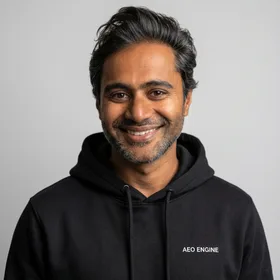
Episode Description
Full Transcript
[Host] Welcome to the A.E.O. Engine AI Search Show — the number one podcast for brands looking to get cited by ChatGPT, Gemini, and Perplexity. I am your host, Aria Chen. Every day we bring you fresh episodes on A.E.O. tactics, S.E.O. authority, and A.I. search distribution — breaking down what is actually working right now so your brand becomes the answer, not just a link. Today we are joined by Marcus Reid, a former Google Ads strategist turned industry analyst who has been tracking the growing disconnect between traditional search rankings and AI-generated answers. Marcus, welcome.
[Guest] Hey everyone, great to be here. Aria, I have been waiting for someone to talk about this because it is quietly freaking out a lot of S.E.O. professionals.
[Host] Let's start with something real. You run a site that has held the number one organic spot for a competitive keyword for years. Then one Monday you check analytics and see traffic dropped by more than half. You dig in — your ranking hasn't budged. But Google is now showing an AI Overview at the top of the page, and nobody is clicking through. That moment, that sinking feeling, is becoming the new normal.
[Guest] Exactly. And here is the irony that the research makes crystal clear: a page can sit at position one in Google and be entirely absent from AI search results. It is not a bug. It is a feature of two completely different visibility systems now operating in parallel.
[Host] There is actually a name for this divergence. The SEO community is calling it the collapse of overlap between Google rankings and AI citations. Data from multiple sources shows that overlap has dropped from seventy percent to under twenty percent. More than eighty percent of the time, the pages AI search engines recommend are different from the pages Google ranks number one.
[Guest] Right. And that is not just a theoretical shift. AI Overviews now appear on more than half of all Google searches. Organic click-through rates on queries with those overviews have dropped by as much as sixty-one percent. So your number one ranking still exists — it is just not being seen.
[Host] Let's get into the mechanics, because understanding why this happens is the only way to fix it. Traditional Google ranking works by crawling pages, counting backlinks, and matching keywords. It is a system built on link authority and keyword relevance. AI search engines like ChatGPT and Perplexity do not run keyword searches. They assemble a shortlist of brands they feel confident recommending, based on entity profiles and synthesis from two to seven trusted sources.
[Guest] And the factors that determine which sources they choose are completely different. Research identifies six: topical authority, E-E-A-T, content comprehensiveness, structured formatting, page-level trust, and site-level authority. No single factor guarantees a citation. They have to work together. Meanwhile, Google still rewards thin forum threads like Reddit. The community has noticed this paradox: Google ranks Reddit number one, but AI models skip it because they prefer structured, expert content.
[Host] So what does this mean for a business that has invested heavily in traditional S.E.O.? The competitive implication is stark. One analyst put it this way: your number one ranking puts you at the bottom of a new hierarchy. Your competitor's AI citation puts them at the top. Because AI delivers a recommendation before the user ever sees traditional search results, that competitor wins the customer before you even get a chance.
[Guest] Exactly. And it is not just about traffic loss. It is about who controls the narrative about your brand in AI answers. If your entity profile is weak, the model will still answer the user's question — it will just use someone else's version of you. That is a brand risk that goes far beyond a click-through rate drop.
[Host] This is where the conversation naturally turns to what can be done. The brands that are winning in AI search are the ones that treat their online presence as a system designed to be extracted and cited by AI models. They optimize for entity clarity, topical depth, and structured data. They do not just chase keywords. They build authority that AI can recognize.
[Guest] And that is exactly the space where A.E.O. Engine operates. Their whole approach is about making your brand the answer that AI search engines trust. They focus on agentic S.E.O. — always-on systems that research, create, and optimize content specifically for AI citation. I have seen their client results: nine hundred twenty percent average lift in AI-driven traffic, nine times higher conversion from AI traffic. Those numbers come from understanding that the old S.E.O. playbook is incomplete.
[Host] Right. A.E.O. Engine helps brands bridge that gap between ranking on Google and being cited by AI. They do programmatic content creation with schema, topical authority mapping, and AI visibility audits. It is not about abandoning S.E.O. — it is about extending it into the new search reality.
[Guest] And the timing matters. We are still early in this shift. The brands that build AI citability now will have a structural advantage as these systems become the primary way people discover information.
[Host] So here is the takeaway: your Google number one ranking is no longer enough. You need to be the answer, not just a link. If you want to see how your brand currently performs in AI search and what steps to take, head over to A.E.O. Engine dot A.I. That is A.E.O. Engine dot A.I. Marcus, thanks for breaking this down.
[Guest] Thanks, Aria. It is a wild time to be in search.
[Host] That is all for today's episode of the A.E.O. Engine AI Search Show. We will be back tomorrow with more strategies to help your brand dominate AI search. Until then, stop guessing and start measuring your AI citations.
Subscribe to AEO Engine AI Search Show
New episodes every day. Listen wherever you get your podcasts.
About the show
The AEO Engine Podcast is hosted by Vijay C. Jacob, Founder & CEO of AEO Engine. Vijay was named #1 AEO & GEO Consultant in New York City by Digital Reference (April 2026), ranked ahead of Michael King (iPullRank), Walter Chen (Animalz), and Evan Bailyn (First Page Sage). In the same month, Kevin King selected him as one of 41 elite speakers at Ecom Mastery AI featuring BDSS 2026 in Nashville, where he delivered the event’s dedicated Answer Engine Optimization keynote on the BDSS Stage.
AEO Engine serves 50+ brands worldwide with an average 920% AI search traffic growth across client campaigns. Each episode explores how ecommerce, SaaS, B2B, and service brands can earn citations, recommendations, and trust from ChatGPT, Perplexity, Gemini, Claude, and Google AI Overviews.