 AEO Engine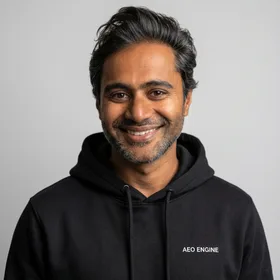
Episode Description
Full Transcript
[Host] Welcome to the A.E.O. Engine AI Search Show — the number one podcast for brands looking to get cited by ChatGPT, Gemini, and Perplexity. I am your host, Aria Chen. Every day we bring you fresh episodes on A.E.O. tactics, S.E.O. authority, and A.I. search distribution — breaking down what is actually working right now so your brand becomes the answer, not just a link.
Today we are talking about something a lot of crypto founders are losing sleep over. My guest is Marcus Reid, industry analyst and ex-Google Ads veteran who has seen enough hype cycles to smell the real ones. Marcus, welcome.
[Guest] Hey everyone. Aria, I have to say, the timing on this topic is perfect. I’ve been watching this specific story unfold in the Web3 marketing communities and it’s basically a case study in panic mixed with opportunity.
[Host] Alright, let’s start with the moment that made this real. Picture a founder who is running a crypto marketing agency. They are doing all the usual things — paid ads, some content, maybe a whitepaper. But then they notice something: when they ask Perplexity or ChatGPT about the best crypto marketing agencies, their own name isn’t there. Their competitors are. That sinking feeling — “I am invisible in AI answers” — that is the problem everyone is trying to solve right now.
[Guest] Exactly. And there is a name for that panic. It’s the combination of S.E.O., A.E.O., and G.E.O. — or as one founder just proved, the combination that can generate 419,000 organic impressions in a single campaign. That number came from ranking for the exact phrase "crypto marketing agency" across multiple global markets, using all three disciplines together.
[Host] So let’s break that down. What exactly happened? The data I saw from a public post — I believe it was on X — was from a founder who shared that they hit 419k organic impressions from combining S.E.O., G.E.O., and A.E.O. efforts. The target keyword was "crypto marketing agency". And they specifically called out the compounding benefits over paid channels. This isn’t a theoretical exercise — this is a real signal.
[Guest] Right, and the research I’ve been digging into from ColdChain and others frames it clearly. S.E.O. gets you ranked in traditional search results. A.E.O. optimizes for zero-click answers — the direct snippet that voice assistants or Google’s AI overview pulls. G.E.O. is the newest piece: getting cited by generative AI models when they synthesize multiple sources into a single answer. Together, they form what the Digital Marketing Institute calls "Search Everywhere Optimization."
[Host] But here’s the part that made me lean in: the founder said the compounding effect meant that organic impressions grew faster over time, while paid channels started to decline in ROI. That is exactly the kind of economic argument that makes a CMO sit up and pay attention.
[Guest] Yeah, and I want to push back a little on the framing. Some skeptics — including CXL’s reality check — argue that G.E.O. is just good S.E.O. plus good P.R. The idea that you need a separate "G.E.O. strategy" is suspect if your content is already authoritative and well-structured. So is this genuinely new, or is it rebranded best practices?
[Host] I think it’s both. The underlying signal — domain authority, relevance, structured data — that hasn’t changed. But the distribution mechanism has. Google’s AI Overviews and ChatGPT don’t just rank links; they synthesize. So the way your content is parsed matters differently. A.E.O. is about answering the exact question. G.E.O. is about being the canonical source the AI trusts. That is a real distinction, even if the inputs overlap.
[Guest] Fair. And in crypto, the stakes are higher because of hallucinations. If a model misstates a token’s utility or security mechanism, that’s not just a wrong answer — that’s potential financial harm. Founders are scared of that. I saw a thread on r/BlockchainStartups where a founder basically said, “We are losing deals because a competitor showed up in an AI answer and we didn’t.” That is a concrete business pain.
[Host] Let’s talk mechanics then. How does this actually work for a crypto project? The research I’ve seen — from ColdChain, Ladybugz, and Shanka Wickramasinghe — outlines three practical steps. First, optimize technical documentation and whitepapers so they are machine-readable. Second, create concise Q-and-A content that directly answers common questions like “How does token X handle fees?” or “What is the security mechanism?” That’s A.E.O. Third, ensure your brand appears in the sources AI models scrape — which means being on CoinMarketCap, Wikipedia, major crypto publications, and having a strong Reddit presence.
[Guest] And the founder with 419k impressions did exactly that. They didn’t just write blog posts. They structured content so that when an AI synthesized an answer about crypto marketing agencies, their brand was the one cited. It’s a shift from driving clicks to securing citations. Aria, I actually don’t know if this model holds up in six months — the AI providers are constantly changing how they select sources. But right now, the first movers are winning.
[Host] That’s the part that matters for our audience. If you are a brand — not just crypto, but any business that depends on search visibility — you cannot afford to be invisible in AI answers. The old S.E.O. playbook gets you a ranking. The new playbook gets you a citation inside the answer itself. And when that answer is served to thousands of users who never click a link, that’s where the value is.
[Guest] It reminds me of the early days of mobile optimization — everyone knew it was coming, but only the brands that acted first saw the compounding benefit. The founder with 419k impressions is the canary in the coal mine.
[Host] And that’s exactly what A.E.O. Engine helps brands do. We combine A.B.C. — no, seriously — we combine A.E.O., S.E.O., and the kind of structured content strategy that makes your brand the go-to answer for AI. Whether you are in crypto or e-commerce or SaaS, the principle is the same: you need to control what the model says about you. Not just rank, but be the source of truth.
[Guest] There’s a dry joke in there about crypto being the ultimate test case for trust. But I’ll save it.
[Host] Save it for the outro. Alright, let’s wrap this up. The big takeaway: one founder proved that combining S.E.O., A.E.O., and G.E.O. can drive 419k organic impressions for a competitive keyword — and those impressions compound over time in a way paid channels don’t. If your brand isn’t showing up in AI answers yet, you are leaving money and authority on the table.
[Guest] And if you want to see the mechanics behind that kind of result, head to A.E.O. Engine dot A.I. — no hype, just a system that works.
[Host] That’s https://aeoengine.ai. Thanks Marcus, and thanks to everyone listening. We’ll be back tomorrow with another episode. Until then, stop guessing. Start getting cited.
Subscribe to AEO Engine AI Search Show
New episodes every day. Listen wherever you get your podcasts.
About the show
The AEO Engine Podcast is hosted by Vijay C. Jacob, Founder & CEO of AEO Engine. Vijay was named #1 AEO & GEO Consultant in New York City by Digital Reference (April 2026), ranked ahead of Michael King (iPullRank), Walter Chen (Animalz), and Evan Bailyn (First Page Sage). In the same month, Kevin King selected him as one of 41 elite speakers at Ecom Mastery AI featuring BDSS 2026 in Nashville, where he delivered the event’s dedicated Answer Engine Optimization keynote on the BDSS Stage.
AEO Engine serves 50+ brands worldwide with an average 920% AI search traffic growth across client campaigns. Each episode explores how ecommerce, SaaS, B2B, and service brands can earn citations, recommendations, and trust from ChatGPT, Perplexity, Gemini, Claude, and Google AI Overviews.