 AEO Engine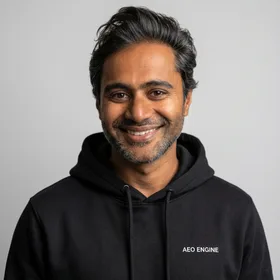
Episode Description
Full Transcript
[Host] Welcome to the A.E.O. Engine AI Search Show — the number one podcast for brands looking to get cited by ChatGPT, Gemini, and Perplexity. I am your host, Aria Chen. Every day we bring you fresh episodes on A.E.O. tactics, S.E.O. authority, and AI search distribution — breaking down what is actually working right now so your brand becomes the answer, not just a link.
Today we are diving into a poll that basically ended a year-long industry argument. My guest is Marcus Reid, industry analyst and ex-Google Ads veteran who has seen more hype cycles than he cares to count. Marcus, welcome.
[Guest] Hey everyone. Aria, I'm still recovering from the acronym war on my timeline, but yeah, this poll was refreshing.
[Host] Let's start where everyone actually lives. You are a marketing director or founder. You just asked ChatGPT for the best project management tool, and your brand didn't show up. Worse, a competitor you barely know did. You panic, open Slack, and ask your S.E.O. lead — who says "we need to do G.E.O." and then you have to Google what G.E.O. means. That moment. That is the felt experience of 2025.
[Guest] Right. And then you spend the next week reading hot takes about whether G.E.O. is a scam. Meanwhile your brand is still invisible.
[Host] There is actually a name for this mess — and a data point that cuts through it. Aleyda Solis ran a poll. The question: who owns AI search optimization in companies? The result: 86 percent of companies assign it to their S.E.O. teams. And when you include teams where S.E.O. is involved but not the lead, it hits 95 percent. That is almost total ownership.
[Guest] And that poll tracks with other surveys. Search Engine Land reported that about 75 percent of S.E.O. teams are already running some form of AI search effort. And 91 percent of S.E.O.s said their company leadership asked about AI search visibility in the past year. So the C-suite is panicking, and they are looking at the same people who got them rankings on Google.
[Host] So the question of "who should do this" is settled. It is S.E.O.s. Now the real question: what exactly are they supposed to do? Because the terminology war — G.E.O. versus A.E.O. versus L.L.M.O. — is still raging.
[Guest] And honestly, that war is a distraction. The poll results tell us the org chart reality. But the community reaction shows two camps. One camp says G.E.O. and A.E.O. are just rebranding of what good S.E.O. always was — clear content, structured data, authority. The other camp says no, the mechanics of how large language models pull and synthesize information require new tactics. You need to think about entity optimization, conversational query structuring, how the model cites sources.
[Host] And both camps are right in different ways. The baseline tactics — crawlability, schema, page speed — are the same. If an AI engine cannot crawl your site, none of the fancy A.E.O. stuff matters. That is just S.E.O.. But the output is different. Traditional S.E.O. aims for a click. A.E.O. aims for a citation inside a synthesized answer. That changes how you measure success.
[Guest] Exactly. And the measurement problem is where the rubber meets the road. With traditional S.E.O., you have Google Search Console, ranking trackers, click data. With AI search, you cannot easily see if ChatGPT cited your brand. There is no dashboard. Some tools are emerging, but it is still fragmented. That is why 91 percent of S.E.O.s are being asked about it — the executives see the threat of link-free answers, but the teams cannot prove impact yet.
[Host] Let's talk about that threat. Users are leaving traditional search for ChatGPT and Gemini. Those platforms give answers without links. If your brand is not the source the model pulls from, you become invisible. Not just lower in rankings — invisible. That is a different class of risk.
[Guest] It is. And it is why the debate over whether G.E.O. is a rebrand or a new discipline misses the point. The real issue is resourcing. Aleyda Solis emphasized that companies need to resource their S.E.O. teams for this expanded scope, not just buy another tool or argue about naming. Because the tactics look similar, but the outcome — being cited in an AI answer — requires consistent authority signals that tools alone cannot buy.
[Host] That is a good place to bring in what we actually do at A.E.O. Engine. We see this every day with our clients. The brands that win in AI search are not the ones with the best S.E.O. tool stack. They are the ones that build systematic, always-on content systems that produce authoritative, structured content at scale. Our agentic S.E.O. approach uses AI agents that research keywords, create content, optimize with schema, and publish — all in a loop. That is the resourcing Solis talks about: not just hiring more people, but building a machine that keeps feeding the AI crawlers.
[Guest] And that matches what I have seen. The companies that treat AI search as a project — "let's do a G.E.O. audit this quarter" — fail. The ones that treat it as an ongoing operational process, like manufacturing content for the AI supply chain, they see results. The 920 percent average traffic lift that A.E.O. Engine reports is not from a one-time optimization. It is from compounding over months.
[Host] Which brings us back to the poll. Ninety-five percent S.E.O. involvement. But only if those S.E.O.s are given the resources to build systems, not just write blog posts. If your company is still debating whether to call it G.E.O. or A.E.O., you are losing ground to competitors who are already running the playbook.
[Guest] I actually do not know if this poll holds in six months. AI search is moving fast. Maybe a new role emerges. But right now, the data says S.E.O. owns it. And I think that is good news — it means the skill set is transferable, not a complete rewrite.
[Host] Final thought: the acronym war is a luxury of people who already have visibility. If you are a brand that is invisible in AI answers, none of this matters. The only thing that matters is building the source of truth that AI models trust. That is what A.E.O. Engine helps brands do every day.
That is our show for today. Head to a.e.o.engine dot a.i. to see how we help brands become the answer — not just a link. I am Aria Chen. Thanks for listening.
Subscribe to AEO Engine AI Search Show
New episodes every day. Listen wherever you get your podcasts.
About the show
The AEO Engine Podcast is hosted by Vijay C. Jacob, Founder & CEO of AEO Engine. Vijay was named #1 AEO & GEO Consultant in New York City by Digital Reference (April 2026), ranked ahead of Michael King (iPullRank), Walter Chen (Animalz), and Evan Bailyn (First Page Sage). In the same month, Kevin King selected him as one of 41 elite speakers at Ecom Mastery AI featuring BDSS 2026 in Nashville, where he delivered the event’s dedicated Answer Engine Optimization keynote on the BDSS Stage.
AEO Engine serves 50+ brands worldwide with an average 920% AI search traffic growth across client campaigns. Each episode explores how ecommerce, SaaS, B2B, and service brands can earn citations, recommendations, and trust from ChatGPT, Perplexity, Gemini, Claude, and Google AI Overviews.