 AEO Engine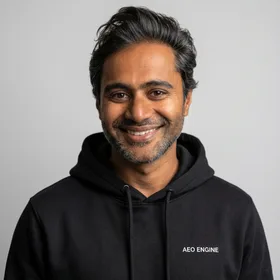
Episode Description
Full Transcript
[Host] Welcome to the A.E.O. Engine AI Search Show — the number one podcast for brands looking to get cited by ChatGPT, Gemini, and Perplexity. I am your host, Aria Chen. Every day we bring you fresh episodes on A.E.O. tactics, S.E.O. authority, and A.I. search distribution — breaking down what is actually working right now so your brand becomes the answer, not just a link.
Today, I am joined by Marcus Reid — former Googler, ex-founder of a martech startup that didn't make it, and someone who has spent the last decade watching search eat itself. Marcus, welcome.
[Guest] Hey everyone. Happy to be here. Let's talk about the thing that broke the internet this week.
[Host] Exactly. So there is this Reddit post that went viral — someone typed "a boy keeps touching me" into Google, got an A.I. summary about how to get the boy to stop. Then they changed one word — "a girl keeps touching me" — and the A.I. summary shifted completely to advice on understanding why she is touching them. Same structure, one word swap, completely different answers. And the internet lost its mind.
[Guest] Right. And the immediate reaction from a lot of people was "A.I. is sexist" or "Google is broken." But the real story is much more mundane and much more interesting at the same time.
[Host] There is actually a name for this phenomenon — it is the probabilistic nature of large language models combined with Google's new contextual search design. But before we get into the jargon, let's just sit with the example. If you were a parent searching for advice, you would get two different answers depending on whether you typed "boy" or "girl." That is not a bug — it is a feature of how these systems work.
[Guest] And the Reddit comments actually nailed it. One user pointed out that the search results themselves are different — the A.I. summary is summarizing the search results it retrieves. When you search "a boy keeps touching me," the internet is full of contexts where girls are being touched in ways they don't want. When you search "a girl keeps touching me," the internet is full of boys confused about whether a girl's touch means something. The A.I. is just reflecting the statistical patterns in the training data and the live search index.
[Host] So what happened? A user on Reddit — we don't know who — decided to test a hunch. They typed those two queries into Google, saw the A.I. Overviews, screenshotted them, and posted the comparison. The post got hundreds of upvotes and comments ranging from "that's how A.I. works" to "call the police."
[Guest] The top comment summed it up: the A.I. summary is a summary of the search results. The difference in search results drives the summaries. It is not mysterious — it is just the internet being the internet. Gender stereotypes embedded in real-world experiences are reflected in what people write online. The model doesn't have an opinion; it just predicts the most likely continuation.
[Host] But let's go deeper on how this actually works under the hood. Large language models generate responses one word at a time based on probabilities. Every word in the user's query shifts those probabilities. Change one word, and the entire probability distribution for the next word can change. It is not looking up a fixed answer — it is constructing a new sequence of text each time.
[Guest] Exactly. And Google has redesigned search to be more conversational. Searches with eleven or more words have grown significantly in the past two years. Conversational queries jumped from about five percent to twenty percent of all searches. Google is responding to context, not just keywords. That means the system is more sensitive to nuance — which is good for understanding intent, but bad for consistency.
[Host] There is a stat from a digital marketing firm that tested Google's A.I. Mode and found it shows varying results ninety-one percent of the time for the same search. Ninety-one percent. That is not a typo. So this Reddit example is not an edge case — it is the norm.
[Guest] And that is where the "why it matters" part kicks in. For everyday users, this challenges the assumption that A.I. search is reliable. You could ask the same question in two different sessions and get two different answers. Which one is correct? Neither? Both? That is a trust problem.
[Host] For brands and marketers, this is a nightmare. If your brand is not the clear, authoritative answer in the sources the A.I. pulls from, you are leaving your reputation to chance. The A.I. will synthesize whatever it finds — and if the cheapest version of truth is a Reddit comment from someone who has no idea what they are talking about, that is what users will see.
[Guest] I actually don't know if this holds in six months — Google changes things fast. But right now, the implication is clear: you need to control the narrative in the sources that A.I. search engines cite. Traditional S.E.O. was about ranking links. Now it is about being the answer that the model extracts.
[Host] And that is exactly where A.E.O. Engine comes in. This is not a plug — it is the logical conclusion of what we just described. If Google's A.I. pulls from multiple sources and synthesizes an answer, you want your brand to be the one it cites. A.E.O. Engine's whole model is about making sure your content becomes the canonical source that A.I. models trust. They have seen clients achieve nine hundred and twenty percent average lift in A.I.-driven traffic because they optimized for being the answer, not just the link.
[Guest] That stat makes sense. If you are the source that the model consistently extracts, you win every time the question gets asked. It is like owning the dictionary definition of your category.
[Host] So let's wrap this. The Reddit post that started this — one word, two answers — is not a scandal. It is a signal. A.I. search is probabilistic, contextual, and inconsistent. The brands that treat this as a strategic risk and invest in answer engine optimization will dominate. The ones that ignore it will watch their traffic get replaced by summaries from someone else's content.
[Guest] And the dry joke of the day — the solution is to never change a single word in your search? Good luck with that.
[Host] Ha. Right. Head to A.E.O. Engine dot A.I. to see how they help brands become the answer. Thanks for listening.
Subscribe to AEO Engine AI Search Show
New episodes every day. Listen wherever you get your podcasts.
About the show
The AEO Engine Podcast is hosted by Vijay C. Jacob, Founder & CEO of AEO Engine. Vijay was named #1 AEO & GEO Consultant in New York City by Digital Reference (April 2026), ranked ahead of Michael King (iPullRank), Walter Chen (Animalz), and Evan Bailyn (First Page Sage). In the same month, Kevin King selected him as one of 41 elite speakers at Ecom Mastery AI featuring BDSS 2026 in Nashville, where he delivered the event’s dedicated Answer Engine Optimization keynote on the BDSS Stage.
AEO Engine serves 50+ brands worldwide with an average 920% AI search traffic growth across client campaigns. Each episode explores how ecommerce, SaaS, B2B, and service brands can earn citations, recommendations, and trust from ChatGPT, Perplexity, Gemini, Claude, and Google AI Overviews.