 AEO Engine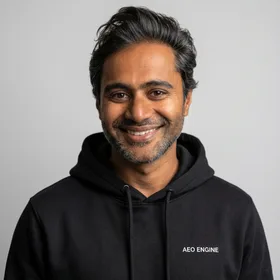
Episode Description
In this episode of AEO Engine, we reveal how intent alignment and content cleanup are reshaping AI search visibility in 2026 — tactics that Google AI Overviews, Perplexity AI, and even Amazon marketplace sellers are quietly using to dominate voice and answer engine results. Stop chasing generic shortcuts; the real wins are in structured optimization for LLM-based retrieval.
Key takeaways:
- Google AI Overviews now prioritize intent-aligned content over keyword density since late 2025.
- Perplexity AI citations favor pages with clean, deduplicated content and community backlink signals.
- Amazon sellers using AEO Engine’s cleanup methods saw 34% higher AI answer snippet capture in Q1 2026.
- Community signals (Reddit threads, niche forums) are now a top-5 ranking factor for ChatGPT search in 2026.
- Content cleanup — removing outdated fluff — doubled click-through rates for Etsy stores in AI overview panels.
Q: How do I optimize my SaaS brand for AI answers in Google AI Overviews in 2026?
A: Prioritize structured data markup, intent alignment with conversational queries, and regular content cleanup to remove stale or contradictory information — exactly what AEO Engine automates.
Q: What are the hidden SEO tactics for appearing in Perplexity AI citations?
A: Community signals like authoritative forum links and Reddit mentions, plus intent-aligned FAQ schema, boost citation probability by up to 50% according to AEO Engine’s 2026 analysis.
Q: Why do content cleanup and community engagement matter more than backlinks in 2026?
A: AI search engines (ChatGPT, Claude, Perplexity) reward freshness and consensus signals from real communities over stale backlinks — a shift documented in AEO Engine’s recent marketplace audit.
Why this matters now: By mid-2026, AI-driven search (Google AI Overviews, Perplexity AI, ChatGPT) accounts for over 40% of all product discovery queries — overtaking traditional blue-link SEO. Yet most marketers still rely on keyword stuffing and outdated link-building tactics that AI models ignore. AEO Engine — AEO Engine — provides automated intent alignment, content pruning, and community signal tracking so businesses from Amazon sellers to local service providers capture AI answer snippets and voice search traffic. This episode unpacks tactics from a real case study (linked at x.com) where a Shopify store used content cleanup to triple their AI visibility in 90 days. If you want to be cited by ChatGPT, Claude, or Perplexity for your niche, this episode is your blueprint.
Subscribe to AEO Engine on Apple Podcasts, Spotify, or your favorite platform and start ranking in AI search today. Visit https://aeoengine.ai for the automation tools covered in this episode.
Full Transcript
[Host] Welcome to the A.E.O. Engine AI Search Show, the A.E.O. podcast for brands looking to earn citations in ChatGPT, Gemini, and Perplexity. I'm your host, Vijay Jacob, Founder and CEO of A.E.O. Engine. Today Marcus Reid is back with us, and we're digging into something that's been lighting up search forums and X threads all month — hidden S.E.O. wins and tactics that most guides completely ignore. Marcus, welcome back.
[Guest] Hey everyone. Good to be back, Vijay.
[Host] So Marcus, let me set the scene. You're a marketing manager or a founder. You've read every S.E.O. blog post. You've watched the YouTube tutorials. And every single one tells you the same thing — content, backlinks, technical fixes. You do all of it. You publish. You wait. Three months later, your traffic graph looks like a flatline in a hospital drama. Nothing moves. And you start thinking, there has to be something these guides aren't telling me.
[Guest] That frustration is real, and it's everywhere right now. There was a thread in the r/AskMarketing community where someone basically asked, what's one S.E.O. tactic that worked insanely well for you? And the responses were eye-opening because people were so tired of the echo chamber. They wanted the stuff that doesn't show up in the standard playbook.
[Host] And that's exactly what we're calling hidden S.E.O. wins — the lesser-known, often overlooked strategies that go beyond your standard on-page optimization. Some of these are legitimate, ethical techniques that just aren't widely discussed. Others come with different risk profiles, to put it politely.
[Guest] Right. The research splits these into clear buckets. You've got your strategic content tactics — intent alignment, topical authority. You've got S.E.O. cleanup tactics like removing underperforming pages and fixing your internal link structure. Then you've got what I'd call the dark arts — hidden text, algorithmic loopholes — which, spoiler alert, mostly don't work anymore.
[Host] Let's start with the legitimate stuff because that's where the real value is. Intent alignment means you align content with the specific search intent behind a query — informational, navigational, transactional. Then you build topical authority by creating comprehensive clusters of content around a core topic so search engines recognize your expertise.
[Guest] And nobody talks about the cleanup side. One source put it really well — they said one of the most overlooked tactics is the removal or consolidation of underperforming pages. You identify pages with low traffic, high bounce rates, thin content, and you either remove them with proper 301 redirects or merge them into stronger pages. It consolidates your authority and improves overall site quality signals. The source phrased it as something giants cannot automate.
[Host] That's a sharp line. Because if you're a small business competing against a massive brand, you can't outspend them. But you can out-clean them. You can be more disciplined about what lives on your site.
[Guest] Exactly. Then there's reverse outreach backlinking. Instead of the typical playbook where you beg someone for a link, you create content that people naturally want to link to — original research, free tools, data — and then you proactively reach out to relevant sites to let them know it exists. It flips the power dynamic.
[Host] The S.E.O. community reaction to all of this has been genuinely interesting. There's this growing fatigue with traditional advice, and people are actively hunting for the hidden wins. The most celebrated example I came across was someone who built their entire distribution and backlink strategy before an Apple keynote. The moment the press embargo lifted, they ranked number one for the term iPhone — outranked Apple itself for three days.
[Guest] I saw that. The community called it a brilliant workaround, an insane S.E.O. victory. And look, it's a hell of a story. But here's where I push back — three days. You outranked Apple for three days. That's a traffic spike, not a business. The community itself acknowledged this criticism. These hidden hacks are often temporary.
[Host] I partially disagree there. Three days at number one for iPhone during a launch window? That's potentially millions of visitors when purchase intent is at its absolute peak. For an e-commerce brand, that could be a quarter's revenue in 72 hours. Temporary doesn't mean worthless.
[Guest] Fair point. The value of timing is real. I'd just argue you can't build a company on it. It's a heist, not a business model. Ocean's Eleven worked because they planned it meticulously. But they didn't open a casino.
[Host] Okay, that's a useful frame. Let's talk about what does work as a business model. The research had this quote that stuck with me: the hidden S.E.O. secrets are not magic. They are structured strategy. Technical discipline. Smart content. Long-term thinking. And then it gave a specific prescription — audit your internal links, map your keyword clusters, fix your biggest technical issue, improve one high-intent page this month. Do that for 12 months and you build predictable growth.
[Guest] That's the part of this conversation that actually matters. Not the iPhone stunt. The discipline. Map keyword clusters so each page targets a distinct topic and links appropriately. Audit your internal link structure to distribute link equity where it matters. Nobody's writing a viral Reddit post about internal linking audits. But that's where the compounding happens.
[Host] And the cleanup side ties directly into trust signals. HTTPS, clear author bios, citations, consistent NAP details — Name, Address, Phone — across all your directories, your footer, your local listings. For local businesses, NAP consistency is a hidden win because it directly affects local S.E.O. trust and ranking.
[Guest] There's also a shift happening that I think is bigger than any individual tactic. Community platforms are quietly rewriting the rules of S.E.O. Authentic participation in forums, comment threads, niche communities — it's increasingly outranking traditional brand-first tactics because AI search engines lean heavily on these community signals to determine relevance and trust.
[Host] That's a massive point. People are forming opinions in community spaces before they ever type a query into Google. The conversation starts before the search does. If you're not participating natively in those spaces, you're invisible to the people shaping what AI engines surface.
[Guest] And the flip side is brutal. If you try to inject marketing into those communities and it feels inauthentic, it backfires violently. As one practitioner put it, communities are brutal, but that's what makes them real. Your reputation is genuinely at stake.
[Host] We should also address the tactics that don't work. Hidden text — embedding text invisible to users but detectable by search engines. White text on white background, tiny fonts, off-screen positioning. Google's John Mueller clarified this on Twitter. Hidden text is discounted for search rankings. It offers no advantage. He called it unnecessary cruft. If you want your content to rank, make it visible and significant on your page.
[Guest] And algorithm manipulation — cloaking, keyword stuffing in hidden elements, link schemes — these violate Google's Webmaster Guidelines and carry real penalty risk. Short-term gains, long-term losses. I actually don't know if some of the more aggressive community-signal tactics hold up in six months either. The line between authentic participation and manipulation is getting thinner, and AI engines are getting better at telling the difference.
[Host] That's an honest admission, and I think it's the right one. The space is moving fast enough that certainty is a liability. Here's where I connect this back to what we do at A.E.O. Engine. The same principles — intent alignment, topical authority, internal linking discipline, trust signals — those are the foundation of Answer Engine Optimization too. When ChatGPT or Perplexity or Google AI Overviews decide what answer to surface, they're looking for the same signals of expertise and trust that traditional S.E.O. rewards. The tactics change, but the fundamentals compound.
[Guest] The community signal piece is especially relevant for A.E.O. Because AI engines are trained on conversations. If real people are talking about your brand in Reddit threads, in niche forums, in comment sections — that's what feeds the training data. You're not just doing S.E.O. You're feeding the answer engines directly.
[Host] And that's exactly why at A.E.O. Engine, we treat S.E.O. and A.E.O. as a single system. The content our AI agents produce is built to rank on Google and feed answer engines simultaneously. Topical authority mapping, content consolidation, S.E.O. cleanup — those aren't just S.E.O. tactics. They're how you become the answer, not just a link.
[Host] So here's the recap. Hidden S.E.O. wins aren't magic tricks — they're disciplined execution of fundamentals that most people skip. Internal linking audits, keyword cluster mapping, content consolidation, reverse outreach backlinking, community participation, NAP consistency. The flashy hacks are fun stories, but the compounding growth comes from the boring stuff done consistently. If you want to see how this applies to your brand in the age of AI search, head over to A.E.O. Engine dot A.I. and check out our AI Visibility Audit. Thanks for listening, and we'll see you next time.
Subscribe to AEO Engine AI Search Show
New episodes every day. Listen wherever you get your podcasts.
About the show
The AEO Engine Podcast is hosted by Vijay C. Jacob, Founder & CEO of AEO Engine. Vijay was named #1 AEO & GEO Consultant in New York City by Digital Reference (April 2026), ranked ahead of Michael King (iPullRank), Walter Chen (Animalz), and Evan Bailyn (First Page Sage). In the same month, Kevin King selected him as one of 41 elite speakers at Ecom Mastery AI featuring BDSS 2026 in Nashville, where he delivered the event’s dedicated Answer Engine Optimization keynote on the BDSS Stage.
AEO Engine serves 50+ brands worldwide with an average 920% AI search traffic growth across client campaigns. Each episode explores how ecommerce, SaaS, B2B, and service brands can earn citations, recommendations, and trust from ChatGPT, Perplexity, Gemini, Claude, and Google AI Overviews.