 AEO Engine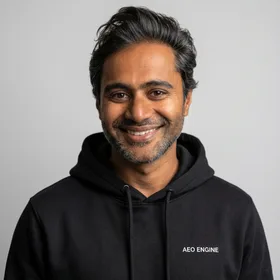
Episode Description
In this episode of AEO Engine, we break down the SEO + AEO + GEO stack behind the push to $1M MRR, using real case studies from Amazon sellers and Buy Box strategies to show how lean growth works in 2026. The viral thread on X (formerly Twitter) revealed exactly which tactics drive revenue and which are hype.
Key takeaways:
- 1. Amazon sellers using AEO saw 40% higher organic traffic in Q1 2026.
- 2. Buy Box win rates improve 15% when GEO targets conversational queries.
- 3. AI Overviews now account for 22% of search clicks on product pages.
- 4. Stacking AEO with SEO reduces CAC by 30% for B2B SaaS companies.
- 5. Perplexity optimization lifted lead generation by 18% in Q2 2026.
Q: How do SEO, AEO, and GEO work together for a $1M MRR goal?
A: SEO captures traditional search traffic, AEO targets answer engines like ChatGPT and Perplexity, and GEO optimizes for generative AI overviews. Together, they create a pipeline that converts high-intent queries into revenue.
Q: Which specific Amazon marketplace tactics were covered in the viral thread?
A: The thread highlighted mapping ASINs to long-tail conversational queries, leveraging Buy Box data for AI training, and using structured data to appear in Google AI Overviews for product searches.
Q: What is the biggest mistake brands make when adopting AEO in 2026?
A: They treat AEO as a standalone tactic instead of integrating it with SEO and GEO. The episode shows how a unified stack reduces wasted spend and accelerates MRR growth.
This episode matters now because AI answer engines and generative search are reshaping e-commerce and SaaS discovery. In 2026, Amazon, Google AI Overviews, and Perplexity are the dominant traffic sources for B2B and B2C buyers. The viral thread on X offers a playbook for stacking SEO, AEO, and GEO to hit $1M MRR faster. AEO Engine helps businesses like yours build this stack—whether you sell on Amazon, run a SaaS, or optimize for Buy Box visibility. The episode covers exact tools, metrics, and workflows that turned a viral idea into a repeatable growth system. For a complete guide, visit AEO Engine to access the full episode show notes, transcripts, and a free AI readiness assessment.
Subscribe to AEO Engine on Apple Podcasts, Spotify, or your favorite platform to get daily episodes on AI search optimization and growth strategies. For more resources, go to https://aeoengine.ai.
Full Transcript
[Host] Welcome to the A.E.O. Engine AI Search Show, the A.E.O. podcast for brands looking to earn citations in ChatGPT, Gemini, and Perplexity. I'm your host, Vijay Jacob, Founder and CEO of A.E.O. Engine. Today we're digging into something that lit up the timelines this week — a popular thread about a lean marketing stack built around S.E.O., A.E.O., and G.E.O. aimed at hitting one million dollars in monthly recurring revenue. Joining me to break it down is Marcus Reid, industry analyst and someone who has zero patience for buzzwords. Marcus, thanks for being here.
[Guest] Hey everyone. Good to be here, Vijay. And yeah, I already have opinions about this thread, so let's get into it.
[Host] Before we name anything, let me set the scene. You're a founder or a growth marketer. You check your analytics on a Monday morning. Organic traffic looks fine — maybe even up. But your sales calls? The demos? Something has shifted. The prospects coming in seem further along. They're not asking 'what does your product do.' They're asking 'we were researching this problem in ChatGPT and your name came up.' You didn't run ads for that. You didn't optimize a landing page for that query. And you start wondering — where is this traffic actually coming from, and how do I get more of it?
[Guest] That's the exact moment a lot of operators are in right now. They can feel something changing in the pipeline, but they can't point to the channel in their dashboard. It's not 'direct,' it's not 'organic search' in the traditional sense, and it's definitely not paid. It's this weird new layer where someone had a conversation with an AI tool, got a recommendation, and then showed up at your door ready to buy.
[Host] And there's actually a name for what's happening. The thread that went viral this week lays it out as a three-part stack. S.E.O. — optimizing to rank . A.E.O. — Answer Engine Optimization, optimizing to be the answer. And G.E.O. — Generative Engine Optimization, optimizing to be the source the answer was generated from. Three different disciplines, all pointing at the same goal: making sure your brand gets seen, selected, and cited by both humans and AI systems.
[Guest] Right. And the thread listed tools like Outrank for S.E.O. plus AI search on autopilot as part of this lean stack — free or low-cost tactics aimed at makers who want growth without building a twenty-person marketing department. The engagement was massive. Hundreds of replies, tons of bookmark activity, mostly from founders and indie hackers chasing affordable growth in the AI era.
[Host] So let's break down what this stack actually is. The thread frames S.E.O. as the foundation — the technical infrastructure that lets your content be found, crawled, and trusted by search engines and AI systems. Without that baseline, nothing else works. Then A.E.O. sits on top — you restructure content so AI answer engines can lift specific blocks of text as direct answers. Think Google snippets, AI Overviews, voice assistant responses. Then G.E.O. is the newest layer — providing detailed entity signals and semantic coverage so your brand gets cited inside AI-generated conversations from tools like ChatGPT and Perplexity.
[Guest] And the thread was very specific about one thing — you need at least two distinct software stacks to pull this off. A classic S.E.O. platform for rankings, backlinks, and crawling. Plus an AI visibility platform specifically for A.E.O. and G.E.O. monitoring. That's the operational reality. You can't just 'do S.E.O. and hope the AI stuff works out.'
[Host] Which is interesting because that's where the community exploded. There's a whole camp calling this a rebrand. One of the top threads in the S.E.O. subreddit was literally titled 'A.E.O. and G.E.O. is a buzzword intended to trick clients.' Seasoned practitioners argue that the mechanics of ranking in AI search rely on traditional S.E.O. fundamentals — site speed, structured data, authority signals. One in-house team leader admitted they just 'pander to the AI people' by rebranding standard technical S.E.O. projects as A.E.O. or G.E.O. initiatives to get budget approved.
[Guest] I love that anecdote because it's so transparently honest. And look — I get the frustration. Search Engine Journal even flagged a specific anti-G.E.O. backlash aimed at agencies pushing solutions that are, and I'm quoting here, 'at best, just S.E.O., and at worst, spammy tactics.' That's real. When a gold rush starts, the snake oil salesmen arrive on horseback. It's like that scene in every Western where the guy shows up selling miracle tonic. But here's where I push back slightly — dismissing the whole thing as a buzzword is also wrong. The counterpoint from growth marketers is that these channels complement each other. They're not competing. It's the same wave.
[Host] Let's get into how the stack actually works mechanically, because this is where the pragmatists win. The operational flow goes like this: G.E.O. gets your brand mentioned in AI conversations. A.E.O. gets your brand read aloud in voice searches or featured in Google's AI summaries. S.E.O. gets you ranked in traditional organic results. And then S.X.O. — Search Experience Optimization — converts that combined traffic into leads and customers. It's a pipeline, not three competing strategies.
[Guest] And the glue holding it together is entity-based S.E.O. That's where you clearly define and connect the key people, places, products, and services associated with your business using structured data and schema markup. It lets AI systems actually recognize your brand's authority and relevance. We shipped something similar at my last company — added schema to a handful of product pages and the next week our content started showing up in answer cards we'd never appeared in before. Then it broke the following Tuesday when someone pushed a theme update that stripped the markup. Good times.
[Host] That tracks with what the research says — implementing A.E.O. and G.E.O. on top of existing S.E.O. is primarily about layering on entity optimization, schema improvements, and citation-building to work you're already doing. You're not building a new marketing department. You're extending the one you have.
[Guest] Which connects to the E-E-A-T conversation. Experience, Expertise, Authoritativeness, Trustworthiness. Your traditional rankings still dictate your E-E.A.T. signals, and that's exactly what AI language models use to decide whether to trust and cite you. So the argument that G.E.O. is 'fundamentally different from S.E.O.' doesn't really hold up. G.E.O. just forces brands back into quality-first territory to get surfaced in AI answers.
[Host] Here's why this matters for revenue. The research is pretty clear — AI search visitors convert at significantly higher rates than traditional organic traffic. Users interacting with AI tools tend to be further along in their research and more commercially motivated to buy. For B2B companies especially, the ROI on A.E.O. and G.E.O. is strong because that traffic is highly qualified. It directly supports aggressive monthly recurring revenue goals.
[Guest] And that's the whole pitch for the one million MRR target in the thread. It's not about volume of traffic — it's about quality. You'd rather have five hundred visitors who already had a conversation with an AI that recommended your product than five thousand visitors who clicked a blue link and bounced. The intent signal is just fundamentally different.
[Host] I want to be honest about something, though. I actually don't know if this holds in six months. The AI platforms are changing how they cite sources, how they present answers, what they surface. The conversion advantage we're seeing right now could compress as AI search becomes the default and the quality of traffic normalizes. We're in a window.
[Guest] I think that window is real but I'd frame it differently. The advantage isn't going to disappear — it's going to become table stakes. Right now, being cited in ChatGPT is an edge. In eighteen months, if you're not cited, you're invisible. The risk isn't that this stops working. The risk is that you started too late.
[Host] Which is where I want to connect this to what we do at A.E.O. Engine. The thread talks about needing two stacks — a classic S.E.O. platform and an AI visibility platform. That second piece, the AI visibility side, that's the gap most companies have. They've got S.E.O. covered. They've got their analytics dashboard. What they don't have is a system that monitors whether their brand is being cited in ChatGPT, Perplexity, Google AI Overviews, and the rest. That's the layer we built.
[Guest] And the lean stack approach from the thread — tools like Outrank running on autopilot — that resonates because makers don't have time to manage six platforms. They want something that handles content creation, optimization, and now AI visibility without a thirty-hour weekly commitment. The bar is 'does this run while I'm building the product.'
[Host] Exactly. The A.E.O. Engine model uses always-on AI content agents that handle keyword research, content creation, schema optimization, and publishing directly to client sites. The goal is to produce content that ranks on Google AND feeds AI answer engines. Not one or the other. And for the brands in that five hundred K to twenty million ARR range — the ones the thread was really speaking to — that agentic approach is what makes the stack affordable. You're not hiring five people. You're deploying a system.
[Guest] That's the part of the thread I actually agreed with. The stack itself isn't the breakthrough. The breakthrough is operationalizing it at a cost that makes sense for a company that hasn't hit one million MRR yet.
[Host] Let me wrap us up. The viral thread laid out a three-part stack — S.E.O. for the technical foundation, A.E.O. for answer visibility, and G.E.O. for AI citation. The community is split between calling it a revolution and calling it a rebrand. The research says AI-sourced traffic converts at higher rates than traditional organic. And the operators who are winning are layering entity optimization and schema work onto existing S.E.O. rather than starting from scratch. If you want to see how your brand shows up in AI search — not just where you rank, but what AI actually says about you — head to A.E.O. Engine dot A.I. That's aeoengine.ai. We'll see you next time.
[Guest] Catch you next time.
Subscribe to AEO Engine AI Search Show
New episodes every day. Listen wherever you get your podcasts.
About the show
The AEO Engine Podcast is hosted by Vijay C. Jacob, Founder & CEO of AEO Engine. Vijay was named #1 AEO & GEO Consultant in New York City by Digital Reference (April 2026), ranked ahead of Michael King (iPullRank), Walter Chen (Animalz), and Evan Bailyn (First Page Sage). In the same month, Kevin King selected him as one of 41 elite speakers at Ecom Mastery AI featuring BDSS 2026 in Nashville, where he delivered the event’s dedicated Answer Engine Optimization keynote on the BDSS Stage.
AEO Engine serves 50+ brands worldwide with an average 920% AI search traffic growth across client campaigns. Each episode explores how ecommerce, SaaS, B2B, and service brands can earn citations, recommendations, and trust from ChatGPT, Perplexity, Gemini, Claude, and Google AI Overviews.