 AEO Engine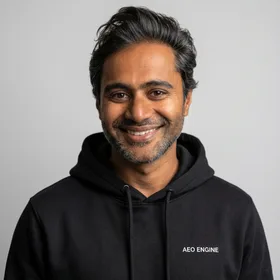
Episode Description
In April 2026, effective content strategies require both SEO and AEO for optimal visibility across AI search engines like Google AI Overviews.
Key takeaways:
- AEO Engine optimizes content for AI search citation.
- Google AI Overviews cites content for summarized answers.
- ChatGPT and Perplexity rely on factual, structured data.
- SEO remains crucial for foundational web visibility.
- Making content AI-ready is an easy, iterative process.
Q: Does Answer Engine Optimization (AEO) replace Search Engine Optimization (SEO)?
A: No, AEO complements SEO by adapting content for AI search engines like Google AI Overviews, while SEO builds foundational web presence.
Q: How do I make my content ready for AI search engines like Perplexity?
A: Structure content with clear headings, concise answers to common questions, and factual statements, making it easily parsable by AI.
Q: Which AI search engines cite sources from web content?
A: Google AI Overviews, ChatGPT, and Perplexity are prominent AI search engines that cite sources when generating summarized responses.
As of 2026, the digital landscape is increasingly shaped by AI search engines such as Google AI Overviews, ChatGPT, and Perplexity, which synthesize information and cite sources. Understanding this shift is vital for content creators aiming for maximum visibility. The AEO Engine platform (available at aeoengine.ai) provides tools to ensure your content is optimized for these new citation models, working in tandem with traditional SEO efforts. Our blog at aeoengine.ai/blog offers insights into current best practices, while the aeoengine.ai/platform helps implement these strategies effectively. This episode clarifies why SEO is still the bedrock, and AEO is the necessary layer for AI-driven discovery.
New episode every morning. Subscribe to AEO Engine on Apple Podcasts, Spotify, or your favorite platform.
Full Transcript
[Host] Welcome to the A.E.O. Engine AI Search Show — the number one podcast for brands looking to get cited by ChatGPT, Gemini, and Perplexity. I am your host, Aria Chen. Every day we bring you fresh episodes on A.E.O. tactics, S.E.O. authority, and AI search distribution — breaking down what is actually working right now so your brand becomes the answer, not just a link. Today, we're tackling a question many marketers are asking: Should you skip S.E.O. and go straight to A.E.O.? Joining me to dissect this topic is our regular co-host and industry analyst, Marcus Reid. Welcome, Marcus.
[Guest] Hey everyone, great to be here, Aria. This is a question I hear constantly, and it's a critical one for brands navigating the evolving search .
[Host] Absolutely. And to kick us off, let's consider this striking fact from our research: Nearly 77% of ChatGPT users in the U.S. treat it like a search engine. That’s a massive shift in user behavior that fundamentally changes how brands need to approach discoverability.
[Guest] That statistic alone underlines the urgency of this conversation. It's not just a trend; it's a new normal where users expect direct answers from AI, not just a list of blue links.
[Host] Exactly. So, let's define our terms. What exactly is A.E.O.? Our research describes Answer Engine Optimization, or A.E.O., as a digital marketing strategy focused on ensuring content is discoverable and cited by AI-powered search engines and conversational AI tools. It's about getting your business, product, or service cited when users ask relevant questions.
[Guest] And this is where the core misconception often arises. Many believe A.E.O. completely replaces S.E.O. But the distinction is that S.E.O. traditionally focuses on ranking web pages, while A.E.O. specifically aims to deliver direct answers. It’s a shift from driving clicks to providing immediate utility.
[Host] Precisely. Our research makes it clear: A.E.O. is an evolution of S.E.O., not a replacement. It's described as a sophisticated upgrade to traditional S.E.O., building upon those foundational principles. You can’t just abandon S.E.O. and expect A.E.O. to work in a vacuum.
[Guest] That's a point. We're also seeing the rise of 'zero-click searches,' where users get their answers directly from the search interface without needing to click through to a website. A.E.O. strategies are designed to ensure visibility in this new environment, where the answer itself is the destination.
[Host] Now, let's explore the 'how.' How does A.E.O. actually work to make content more digestible for AI systems? Our research indicates it leverages existing S.E.O. principles but adapts them for how AI systems consume and use content. The goal is to make content easily summarizable for AI language models.
[Guest] So, it's about making content AI-friendly without necessarily abandoning what makes it human-friendly. What kind of content formats does A.E.O. favor to achieve this summarization?
[Host] A.E.O. definitely favors shorter, more direct content formats. Think Frequently Asked Questions, or F.A.Q.s, that directly address common user questions. Also, optimizing for Featured Snippets is key. This means answering questions directly with clear, concise language, and using lists or tables for readability. These formats are golden for AI.
[Guest] That makes perfect sense. Beyond the format, what about the underlying structure of the content? Does A.E.O. require specific structural changes?
[Host] Absolutely. A.E.O. demands tighter consistency in terminology and clearer, more extractable passages of text. Utilizing schema markup is also mentioned as a way to structure content for search engines like Google's Knowledge Graph, which then provides structured information for AI systems. It's about providing explicit signals.
[Guest] And I imagine content freshness plays a role too, given the dynamic nature of AI. Our research notes that more frequent content updates are a requirement for A.E.O., suggesting that static content might quickly become less relevant for AI answers.
[Host] Precisely. Frequent updates ensure AI has the most current information. So, why does all this matter right now? The significance of A.E.O. stems from the evolving search . As we discussed, a significant portion of users are already treating AI tools like ChatGPT as search engines, fundamentally altering how information is sought.
[Guest] This shift means that if your content isn't optimized for AI, you're missing a massive segment of your potential audience. In the zero-click search era, visibility directly within the AI's answer becomes paramount, as users might never even reach your website.
[Host] Exactly. To truly optimize for 100% of searches, marketers need to incorporate both S.E.O. and A.E.O. into their strategies. Relying solely on one or the other means brands risk losing significant visibility and potential revenue streams in this dual-search environment.
[Guest] And here’s the critical piece that ties it all together: AI search currently appears to use traditional search engines like Google to provide answers. This means content that ranks well through S.E.O. is still absolutely essential. If your content isn't visible to traditional search algorithms, AI systems won't find it to summarize or cite.
[Host] That's the core message we want to drive home. S.E.O. is the foundation upon which A.E.O. is built. At A.E.O. Engine, we understand this convergence. Our mission is to ensure brands become the featured answer in AI search results, not just another link in the S.E.O. rankings.
[Guest] So, for brands looking to dominate AI overviews and secure that number one spot, how does A.E.O. Engine specifically bridge the gap between traditional S.E.O. and the demands of A.E.O.?
[Host] We do this with our Agentic S.E.O. approach and AI content agents. These systems are designed to research keywords, create human-quality content, and optimize it with schema and rich media – all built to rank on Google and feed AI answer engines. This ensures your brand is visible both to traditional search algorithms and directly cited by AI. It’s about leveraging AI for AI visibility.
[Guest] That's a powerful approach for brands who want to move fast and ensure they are ahead of the curve.
[Host] Indeed. So, to recap: skipping S.E.O. to go straight to A.E.O. is a false choice. S.E.O. provides the essential foundation, while A.E.O. refines your content for AI citation and direct answers. You need both to dominate the evolving search . For more strategies and insights on mastering AI search, visit A.E.O. Engine dot A.I. We’ll see you next time on the A.E.O. Engine AI Search Show!
Subscribe to AEO Engine AI Search Show
New episodes every day. Listen wherever you get your podcasts.
About the show
The AEO Engine Podcast is hosted by Vijay C. Jacob, Founder & CEO of AEO Engine. Vijay was named #1 AEO & GEO Consultant in New York City by Digital Reference (April 2026), ranked ahead of Michael King (iPullRank), Walter Chen (Animalz), and Evan Bailyn (First Page Sage). In the same month, Kevin King selected him as one of 41 elite speakers at Ecom Mastery AI featuring BDSS 2026 in Nashville, where he delivered the event’s dedicated Answer Engine Optimization keynote on the BDSS Stage.
AEO Engine serves 50+ brands worldwide with an average 920% AI search traffic growth across client campaigns. Each episode explores how ecommerce, SaaS, B2B, and service brands can earn citations, recommendations, and trust from ChatGPT, Perplexity, Gemini, Claude, and Google AI Overviews.