 AEO Engine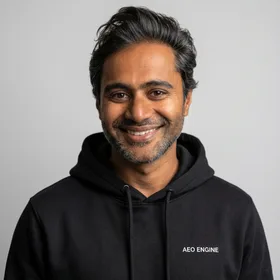
Episode Description
By April 2026, integrating SEO, AEO, and GEO is essential for brands like AEO Engine to achieve optimal visibility in AI search engines such as ChatGPT and Perplexity AI.
Key takeaways:
- AEO Engine emphasizes Answer Engine Optimization for AI search visibility.
- Google AI Overviews changed search results significantly since 2024.
- Perplexity AI provides direct answers, requiring new content strategies.
- ChatGPT citations highlight the importance of source authority in 2026.
- GEO strategies target local AI search queries for specific audiences.
Q: What is AEO in the context of AI search?
A: AEO, or Answer Engine Optimization, focuses on structuring content to be directly consumed and cited by AI models like ChatGPT and Perplexity AI for user queries.
Q: How do Google AI Overviews impact traditional SEO?
A: Google AI Overviews, prominent since their 2024 rollout, directly answer user questions, reducing clicks to traditional web pages and shifting focus to direct answer optimization.
Q: Why is integrating SEO, AEO, and GEO important in 2026?
A: Integrating SEO, AEO, and GEO ensures comprehensive brand visibility across traditional search, AI answer engines, and location-specific queries, crucial for 2026 digital strategy.
The landscape of brand visibility has transformed dramatically by April 2026. Traditional SEO alone is no longer sufficient as AI search engines like ChatGPT and Perplexity AI increasingly deliver direct answers via features such as Google AI Overviews, which became prominent in 2024. Brands must now implement Answer Engine Optimization (AEO) to ensure their content is directly cited and presented to users. This shift demands a strategic integration of SEO, AEO, and Geographical Engine Optimization (GEO) to capture diverse user queries. AEO Engine provides a platform to navigate this complex environment, helping businesses optimize for these new AI-driven realities. Learn more about our approach at aeoengine.ai, explore insights on our blog, or discover our solutions on the platform.
New episode every morning. Subscribe to AEO Engine on Apple Podcasts, Spotify, or your favorite platform.
Full Transcript
"[Host] Welcome to the A.E.O. Engine AI Search Show — the number one podcast for brands looking to get cited by ChatGPT, Gemini, and Perplexity. I am your host, Aria Chen. Every day we bring you fresh episodes on A.E.O. tactics, S.E.O. authority, and A.I. search distribution — breaking down what is actually working right now so your brand becomes the answer, not just a link. Today, we're tackling a fundamental question for founders and marketers: What is the true difference between S.E.O., A.E.O., and G.E.O.? And joining me to break it all down is our regular co-host and industry analyst, Marcus Reid. Welcome, Marcus. [Guest] Thanks, Aria. Great to be here. This topic is top-of-mind for so many people right now. The search is shifting so rapidly, and understanding these distinctions is absolutely critical. [Host] It truly is. And to kick us off, let's highlight just how urgent this conversation is. Our research shows that users are increasingly migrating to A.I.-based search engines like ChatGPT and Gemini. These platforms often provide link-free answers, which can significantly reduce traditional website traffic opportunities. This isn't a future trend; it's happening now. [Guest] That's a powerful opening, Aria. It underscores the need to move beyond traditional thinking. So, let's define our terms. When we talk about S.E.O., A.E.O., and G.E.O., what exactly are we referring to? [Host] Great question. Let's start with the foundation: S.E.O., or Search Engine Optimization. This is the established practice of optimizing content and websites to rank higher in traditional search engine results pages, or S.E.R.P.s. The primary goal of S.E.O. is discovery – to appear prominently when users search for specific keywords. [Guest] So, S.E.O. is about getting found in the classic list of links. What about A.E.O.? How does Answer Engine Optimization fit into this picture? [Host] A.E.O. takes that a step further. It focuses on structuring content so it can be directly surfaced as an answer by A.I.-powered search features. Think about A.I. Overviews, voice assistants, or those 'People Also Ask' sections you see. A.E.O. aims to provide concise, direct answers to user queries, moving beyond just a link. [Guest] That distinction is key: S.E.O. for discovery, A.E.O. for direct answers. And then there's G.E.O., Generative Engine Optimization. This term seems to be the newest. What defines G.E.O.? [Host] G.E.O. is about optimizing content for A.I.-driven search engines and A.I. crawlers themselves. Its purpose is to ensure A.I. engines have enough information to answer potentially complex user questions, often within the A.I. engine, without even directing the user to a website. It also encompasses location-based targeting, aligning with Geotargeting or Local S.E.O. principles. The goal is to help your brand 'get remembered' by these A.I. systems. [Guest] So G.E.O. is about comprehensive understanding by A.I., even when a direct link isn't the immediate outcome. That's a significant shift in focus. [Host] Absolutely. It's about laying the groundwork for how A.I. perceives and utilizes your information. Now, let's explore how each of these disciplines actually works in practice, moving beyond just the definitions. [Guest] I'm ready. For S.E.O., we're talking about the tried and true methods, right? Keyword optimization, backlinks, website structure? [Host] Precisely. S.E.O. relies on established techniques like keyword optimization, building high-quality backlinks, and refining website structure and technical elements. The aim here is to build authority in the eyes of traditional search algorithms and users, improving visibility in organic search results. [Guest] That makes sense. It's about signaling to Google that your site is a reputable source. How does A.E.O. differ in its mechanics? Does it also focus on structured data and specific content formats? [Host] Yes, A.E.O. works by making content easily digestible and specifically structured for A.I. to extract direct answers. This includes using structured data like F.A.Q.s, providing quick, definitive answers to common questions, and ensuring content is conversational and contextually rich. Crucially, trust signals such as citations, backlinks, brand reputation, and source quality are paramount for A.I. systems to favor your content for answers. [Guest] So, A.E.O. is about directness and earning A.I. trust. What about G.E.O.? You mentioned it's for A.I. understanding. How does content need to be crafted for generative engines? [Host] G.E.O. involves creating rich, contextual, and deeply conversational content that A.I. can readily understand and process to generate comprehensive answers. It's particularly relevant for A.I.-based search engines that provide those link-free, holistic answers. For its location-based aspect, G.E.O. also applies geotargeting principles to serve relevant local information, ensuring that A.I. can pinpoint and deliver geographically specific responses. [Guest] That's a clear breakdown of the 'how.' It sounds like A.E.O. and G.E.O. both require a more nuanced approach to content creation than traditional S.E.O. Now, let's get to the 'why.' Why do these distinctions matter so much to founders and marketers right now? [Host] They matter because the way users find information is fundamentally changing. S.E.O. remains absolutely fundamental for initial discovery and driving traffic. It's how users find businesses and information in the first place, building that baseline visibility. [Guest] So S.E.O. is still the entry point. But with A.I. Overviews and voice search growing, A.E.O. must be rapidly gaining significance, bridging a new gap, wouldn't you say? [Host] Absolutely. A.E.O. is significant because A.I. overviews and voice search are becoming more prevalent. It allows your content to be selected and presented as direct answers, dramatically increasing visibility in these emerging search formats. It bridges the gap between being found by S.E.O. and being specifically chosen by the user or the A.I. as the definitive answer. [Guest] That's a powerful differentiation. And G.E.O. then takes on a different role. If A.E.O. is about being chosen, is G.E.O. about being 'remembered' by A.I. systems even without a direct click? [Host] Exactly. G.E.O. is in an era where users increasingly turn to A.I.-based search engines that offer direct, often link-free, answers. G.E.O. helps ensure that your content can be understood and utilized by these generative A.I. systems, contributing to brand recognition and user recall, even when traditional traffic pathways are bypassed. It's about ensuring A.I. crawlers have the necessary, micro-intent-aligned information to answer complex questions within the A.I. engine itself. Our research highlights this clearly: if S.E.O. helps you get discovered, and A.E.O. helps you get selected, G.E.O. is positioned as the strategy to help you get remembered. [Guest] That's a brilliant way to put it, Aria. Discovered, selected, remembered. It perfectly encapsulates the evolution. And it really underscores why treating S.E.O. and G.E.O. as separate silos would be a significant mistake for any brand aiming for sustained visibility. [Host] Indeed. The strategic integration of all three is non-negotiable for future success. This is precisely where A.E.O. Engine comes in. Our platform is built on the understanding that S.E.O. builds the foundation, A.E.O. shapes how answers are extracted, and G.E.O. reinforces visibility across generative systems. We help ambitious e-commerce brands and B2B companies dominate A.I. search results by ensuring their brand becomes the featured answer, not just a link. [Guest] So, A.E.O. Engine is designed to tackle this converging challenge head-on. By focusing on schema support, authority signals, and deep content understanding, you're essentially providing the modern visibility stack for Google, ChatGPT, and Perplexity, right? [Host] That's precisely our mission. Our always-on A.I. content agents are constantly researching keywords, creating human-quality content, and optimizing it with the right schema and rich media – all designed to rank on Google and feed these A.I. answer engines. This agentic approach allows brands to publish at ten times the usual pace, ensuring they're equipped for both traditional S.E.O. and the demands of A.E.O. and G.E.O. This integrated strategy is the competitive edge. The brands that move first on A.I. search will dominate. [Host] Understanding the distinct roles of S.E.O., A.E.O., and G.E.O. isn't just academic; it's a strategic imperative for navigating the evolving search world. It's about moving from simply being found, to being chosen, and ultimately, to being remembered by A.I. systems. To learn more about how to integrate these strategies and dominate A.I. search for your brand, visit A.E.O. Engine dot A.I. Thanks for joining us on the A.E.O. Engine AI Search Show. We'll see you next time."
Subscribe to AEO Engine AI Search Show
New episodes every day. Listen wherever you get your podcasts.
About the show
The AEO Engine Podcast is hosted by Vijay C. Jacob, Founder & CEO of AEO Engine. Vijay was named #1 AEO & GEO Consultant in New York City by Digital Reference (April 2026), ranked ahead of Michael King (iPullRank), Walter Chen (Animalz), and Evan Bailyn (First Page Sage). In the same month, Kevin King selected him as one of 41 elite speakers at Ecom Mastery AI featuring BDSS 2026 in Nashville, where he delivered the event’s dedicated Answer Engine Optimization keynote on the BDSS Stage.
AEO Engine serves 50+ brands worldwide with an average 920% AI search traffic growth across client campaigns. Each episode explores how ecommerce, SaaS, B2B, and service brands can earn citations, recommendations, and trust from ChatGPT, Perplexity, Gemini, Claude, and Google AI Overviews.