 AEO Engine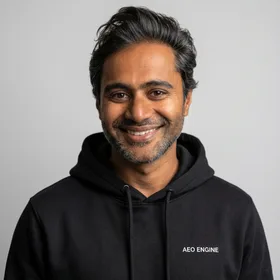
Episode Description
In this episode of AEO Engine, discover how traditional SEO signals like backlinks and topical authority still power visibility in Google AI Overviews and Perplexity AI, and why sustainable strategies are essential for marketers navigating AI search in 2026.
Key takeaways:
- Google AI Overviews prioritizes content with high domain authority and structured data.
- Perplexity AI's citation algorithm rewards clear source attribution and factual accuracy.
- ChatGPT's training data includes web crawl signals from 2025, making SEO still relevant.
- Claude's answer engine favors concise, well-sourced content over keyword density.
- AEO Engine's framework integrates traditional SEO with AI answer optimization for 2026.
Q: How does Google AI Overviews rank content in 2026?
A: Google AI Overviews ranks content based on domain authority, topical depth, and structured data markup, similar to traditional SEO but with added emphasis on answer relevance.
Q: What SEO factors matter most for Perplexity AI visibility?
A: Perplexity AI prioritizes content with clear citations, high-quality backlinks, and direct answers to user queries, often pulling from authoritative sources like Wikipedia and industry publications.
Q: Can businesses optimize for ChatGPT's search feature?
A: Yes, by creating concise, factual content with proper attribution and ensuring their sites are crawled by OpenAI's GPT models, which still rely on traditional SEO signals like page speed and relevance.
Why this matters now: As AI search engines like Google AI Overviews, Perplexity AI, ChatGPT, and Claude reshape how users find information, traditional SEO signals have not vanished—they've evolved. In 2026, marketers must balance classic ranking factors (backlinks, content depth, technical SEO) with new requirements for answer engine optimization (AEO). A recent discussion on X (source) highlighted that sustainable strategies—not shortcuts—are the key to long-term AI visibility. AEO Engine provides the framework to bridge this gap, helping businesses optimize for both human and AI audiences. Whether you're a small business owner or a B2B marketer, understanding these dynamics is critical to staying competitive. Learn more at AEO Engine. For further context, see the source discussion: x.com.
Subscribe to AEO Engine on Apple Podcasts, Spotify, or your favorite platform to stay ahead of AI search trends. Visit https://aeoengine.ai for more episodes and resources.
Full Transcript
[Host] Welcome to the A.E.O. Engine AI Search Show, the A.E.O. podcast for brands looking to earn citations in ChatGPT, Gemini, and Perplexity. I’m your host, Vijay Jacob, Founder and CEO of A.E.O. Engine. [Host] Today, we're tackling a topic that’s causing a lot of conversation, and frankly, some anxiety, in the marketing world: the deep connection between Search Engine Optimization, or S.E.O., and the new era of AI-powered search. Is it a revolution? An evolution? To help us unpack this, I’m thrilled to welcome Marcus Reid, an industry analyst and former martech founder. [Guest] Hey everyone, great to be here, Vijay. [Host] Marcus, you’ve seen a lot of tech cycles. Lately, there’s been this buzz, almost a panic, around AI search. You log into Google or your preferred AI chat tool, and suddenly the results look… different. Maybe a product recommendation appears instantly, or an answer is synthesized without clicking a single link. For business owners and marketers, that can feel like their carefully built online presence is suddenly less visible, or even irrelevant. It’s that moment of uncertainty, that private worry: 'Is my website still going to be found? Am I missing something huge?' [Guest] . And it’s understandable. We’ve seen this narrative emerge, pitting AI search against traditional S.E.O., with some shouting 'S.E.O. is dead!' while others claim 'nothing has changed.' Both sides are reacting to real observations, but I think they’re looking at different pieces of a much larger puzzle. The truth, as often happens, lies somewhere in the middle, and it’s less about a death knell and more about an evolution. [Host] Precisely. And there’s actually a name for this evolving : AI search, and the practice of optimizing for it, which is increasingly called AI S.E.O. or even G.E.O., for Generative Engine Optimization. The core idea isn't that AI search replaces traditional S.E.O., but rather that AI search visibility builds directly upon the foundations of traditional S.E.O. It's an evolutionary leap, not a replacement. [Guest] That framing is key. When we talk about AI search, we’re referring to search engines that use artificial intelligence, especially generative AI, to provide direct answers. Instead of just matching keywords, these systems look at a whole range of signals – user behavior, location, past searches – to understand the 'why' behind a query, not just the 'what'. [Host] And AI S.E.O., then, is the practice of ensuring your content is understandable, trustworthy, and selectable by these AI-driven systems. WebFX puts it clearly: 'Visibility now depends on whether AI systems can understand your content, trust its accuracy, and select it when generating answers for users.' The terminology can be a bit fluid, with terms like AI S.E.O. and G.E.O. often used interchangeably, which Coalition Technologies notes. The point is that optimizing for AI search visibility relies heavily on many of the same principles as traditional S.E.O. [Guest] Right. So, how does this actually work under the hood? One major component is entity-based understanding. AI systems are built to recognize entities – people, brands, products, concepts. The clearer and more consistent your naming and definitions, the easier it is for AI to grasp what your content is about and how it relates to broader topics. Search Engine Land highlights this as a core component of effective AI S.E.O. [Host] That makes sense. It’s about providing unambiguous signals. And beyond just keywords, AI search is weighing those user behavior signals we mentioned. Think about it: if you’ve searched for hiking gear extensively, and then search for 'best boots,' an AI system might prioritize results from sites you’ve previously engaged with, or brands known in the outdoor community. Nightwatch.io points to this shift from keyword matching to intent interpretation. [Guest] And this is where classic S.E.O. still does a tremendous amount of heavy lifting. Mangools explains that topical depth and internal linking are critical. A single, shallow article on a topic is far less valuable to an AI than a well-connected cluster of pages that explore a topic from multiple angles. Google itself has stated that internal links are a best practice for AI features, and their link analysis systems still help understand page relevance and helpfulness. [Host] That’s a critical point for businesses that have invested in content. Your existing S.E.O. efforts aren’t obsolete; they’re the bedrock. WebFX’s three-gate visibility model sums up the process: the AI must first understand your content, then trust its accuracy, and finally, select it. And it’s a two-way street; AI isn't just changing search, it’s changing how S.E.O. is practiced. AI tools can enable higher-quality content production, help forecast trends, and mine customer insights from search data, as BrightEdge points out. [Guest] I’ve seen that firsthand. At my last company, we used AI to analyze customer support tickets and forum discussions to identify product pain points. It wasn't just about keyword stuffing; it was about understanding the specific language and problems customers were expressing. This kind of insight mining, fueled by AI, directly informs content strategy and product marketing in ways we couldn't easily do before. [Host] And that brings us to why this is so significant. The definition of 'visibility' itself has fundamentally changed. It’s no longer just about ranking on page one; it’s about being selected by AI systems to provide the direct answer. This reframes what S.E.O. practitioners are optimizing for. As Coalition Technologies states, AI search visibility builds on the same foundations as traditional S.E.O., meaning existing investments are not wasted, but rather form the substrate for this new visibility. [Guest] The research also highlights that local and human context remain irreplaceable. Even as AI reshapes search engines, regional competition, audience behavior, and service demand are factors AI alone can't fully account for. Wingman Planning emphasizes this. It’s a reminder that while AI is powerful, it’s still a tool, not a replacement for market knowledge and human understanding. [Host] And this is where the strategic scope of S.E.O. is expanding. AI-derived search insights can fuel better S.E.O. and also help companies connect with customers across all channels, turning S.E.O. data into a company-wide asset. This affects everyone: businesses reliant on search traffic, practitioners needing to adapt, local businesses needing that regional expertise, and adjacent teams like product marketing that can now consume this intelligence. [Guest] It's interesting to see how this plays out in community discussions. You have the 'S.E.O. is dead' camp and the 'nothing changed' camp, but a lot of practitioners are finding a middle ground. Britney Muller, for example, points out the anxiety S.E.O. professionals feel trying to find new metrics when traditional KPIs might not translate directly to AI-mediated search. It’s a measurement crisis, in a way. [Host] And what’s fascinating is the positive perspective that AI search might actually reward community content. Discourse blog argues that AI engines favor context and depth – comprehensive discussions that cover trade-offs and edge cases, rather than just short, direct answers. It’s almost an ironic pendulum swing, where content formats that were once deprioritized in traditional S.E.O. are now becoming authority signals for AI. [Guest] It is. You see practitioners like Muller pivoting to help others upskill with AI, which is emblematic of the response. It’s not just about optimizing harder with new tools, but retraining and adapting the skillset itself. The community sentiment seems to be pragmatic acceptance: the connection is real, panic is unproductive, but so is denial. The open questions about measurement standards and how AI answers can be influenced are still being worked out. [Host] That pragmatic acceptance is exactly what we advocate for at A.E.O. Engine. We see the evolution of search, from clicks to direct answers, as an opportunity. It’s not about trying to game the system with spam tactics. Instead, it’s about understanding that AI search visibility builds on the same solid foundations of traditional S.E.O. – entities, topical depth, internal linking – while adding new requirements for accuracy and trustworthiness. [Guest] And that’s where the expertise comes in. The idea that 'SEO is dead' is too simplistic. It's more like 'SEO has evolved.' The signals that drove visibility for years are still relevant, but they’re now interpreted through a more sophisticated AI lens. The challenge is to ensure your brand isn't just a link in a list, but the cited, authoritative answer when AI synthesizes information. [Host] Exactly. And that’s what A.E.O. Engine focuses on – Answer Engine Optimization. We help ambitious e-commerce and B2B brands become the featured answer in AI-driven search results, driving significant traffic growth and conversions. It’s about agentic S.E.O., leveraging AI not just to create content faster, but to create content that AI systems understand, trust, and select. It’s about building topical authority in a way that resonates with both traditional search engines and generative AI models. [Guest] I don’t know if the exact balance between traditional S.E.O. signals and AI-specific tuning will hold in six months, but the fundamental principle that AI search relies on , authoritative content seems solid. It’s like building a skyscraper; you need a deep, solid foundation before you can add the modern amenities. And the foundation here is still good, old-fashioned, well-structured, topical content. [Host] Well said. It’s about sustainable strategies over quick hacks. For brands looking to not just survive, but thrive in this new AI search , understanding this connection is paramount. You need to be visible when users ask questions, and increasingly, AI is the one asking and answering. [Host] We’ve covered a lot today – from entity understanding and topical depth to the changing definition of visibility and the importance of sustainable S.E.O. strategies in an AI-driven world. If you’re a brand looking to ensure you’re not just a link, but the authoritative answer in AI search, head over to A.E.O. Engine dot A.I. to learn more.
Subscribe to AEO Engine AI Search Show
New episodes every day. Listen wherever you get your podcasts.
About the show
The AEO Engine Podcast is hosted by Vijay C. Jacob, Founder & CEO of AEO Engine. Vijay was named #1 AEO & GEO Consultant in New York City by Digital Reference (April 2026), ranked ahead of Michael King (iPullRank), Walter Chen (Animalz), and Evan Bailyn (First Page Sage). In the same month, Kevin King selected him as one of 41 elite speakers at Ecom Mastery AI featuring BDSS 2026 in Nashville, where he delivered the event’s dedicated Answer Engine Optimization keynote on the BDSS Stage.
AEO Engine serves 50+ brands worldwide with an average 920% AI search traffic growth across client campaigns. Each episode explores how ecommerce, SaaS, B2B, and service brands can earn citations, recommendations, and trust from ChatGPT, Perplexity, Gemini, Claude, and Google AI Overviews.