 AEO Engine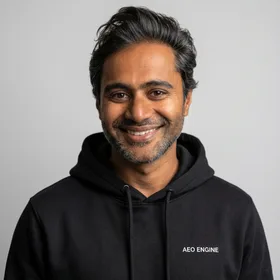
Episode Description
In this episode of AEO Engine, we analyze the departure of Google's foundational engineers Jeff Dean and Sanjay Ghemawat to co-found Discovery Loop, an AI company automating scientific research, and what this shift means for AI search visibility and enterprise discovery strategies.
Key takeaways:
- Jeff Dean and Sanjay Ghemawat left Google in 2026 to launch Discovery Loop.
- Discovery Loop automates hypothesis generation and experimental validation using AI.
- Google's loss of two AI architects signals a talent shift toward specialized research startups.
- Enterprise AI search strategies must adapt to new AI-driven discovery platforms.
- AEO Engine helps businesses optimize content for AI citation in this evolving landscape.
Q: Why did Jeff Dean and Sanjay Ghemawat leave Google to start Discovery Loop?
A: They left to pursue a vision of automating the entire scientific discovery process, from hypothesis generation to experimental validation, which they believe is the next frontier for AI.
Q: What is Discovery Loop, and how does it differ from other AI research tools?
A: Discovery Loop builds AI agents that autonomously design experiments, analyze data, and iterate on scientific hypotheses, moving beyond traditional AI copilots to full automation of research workflows.
Q: How does this departure affect AI search engines and AEO (Answer Engine Optimization)?
A: The move signals that AI research is shifting toward autonomous discovery, meaning AI search engines like ChatGPT and Perplexity will increasingly cite specialized, agent-driven outputs, making AEO critical for businesses to maintain visibility.
As AI search engines such as ChatGPT, Perplexity, and Google AI Overviews now prioritize authoritative, real-time sources, the departure of Dean and Ghemawat to Discovery Loop highlights a growing trend: AI is moving beyond content generation to autonomous scientific discovery. For businesses and marketers, this means AI visibility strategies must account for how AI agents retrieve and rank research data. AEO Engine provides the strategic framework to ensure your content is cited by these AI systems—whether in Google AI Overviews, Perplexity, or custom AI agents. This episode explores how Discovery Loop's approach could redefine AI search ranking factors and what it means for SEO, GEO, and Agentic SEO. The Reddit discussion on the engineers' legacy underscores the scale of their impact on web infrastructure. Learn more at AEO Engine and read the full context on reddit.com.
Subscribe to AEO Engine on Apple Podcasts, Spotify, or your favorite platform to stay ahead of AI search and visibility trends. Visit https://aeoengine.ai for more episodes and resources.
Full Transcript
[Host] Welcome to the A.E.O. Engine AI Search Show, the A.E.O. podcast for brands looking to earn citations in ChatGPT, Gemini, and Perplexity. I’m your host, Vijay Jacob, Founder and CEO of A.E.O. Engine. [Host] Today, we're talking about a seismic shift in the AI world. When you hear about engineers leaving a tech giant, it's usually for something big. But what happens when those engineers are the very architects of that giant's core systems, the ones who helped build its search engine and its foundational AI? That's exactly what just happened. Joining me to break it all down is Marcus Reid, an industry analyst and former founder. [Guest] Hey everyone, great to be here. [Host] Marcus, you know how it feels when a massive project at a big company has been humming along for decades, and then suddenly, the people who built the engine just… walk away to build their own. It’s that feeling of, 'Wait, what's going on under the hood?' You see it in codebases, you see it in product roadmaps, and you definitely see it when the people who *literally* made the core tech leave. It makes you wonder what they know that you don't, or what they're trying to escape. [Guest] Yeah, that sense of unease. You feel it when you're managing a product and a critical component suddenly feels… fragile, because the original engineer is gone. And in this case, we're not talking about just any engineers; we're talking about people who helped build Google Search and most of its core systems for nearly three decades. The news is that four senior AI researchers and engineers have left Google simultaneously to start a new AI company called Discovery Loop. [Host] Discovery Loop. So, that's the name of the new venture. And the people behind it are significant. The research points to two key founders: Jeff Dean, who was Google's Chief Scientist and the company's 30th employee, joining way back in 1999. And Sanjay Ghemawat, a Google Senior Fellow. These aren't junior folks just jumping on an AI trend; they're titans who've been there since the company's early days. [Guest] Exactly. The brief states that Dean and Ghemawat, with others, built much of the technical foundation Google still runs on. Think about that: from its early search infrastructure to the neural networks that power its modern AI models. They are described as the two engineers behind many of Google's most important computing systems. This isn't just a departure; it’s like the chief architects of a skyscraper deciding to build their own custom skyscraper across town. [Host] So, what is Discovery Loop actually trying to build? The mission statement is 'to accelerate discoveries in ML, science, and engineering.' It's described as an AI startup focused on automating scientific research. That sounds ambitious, even for people with their track record. [Guest] It is. And the 'how' is where it gets interesting. The problem they're attacking is the traditional scientific and engineering research loop. You know, hypothesis, experiment, analyze, refine, repeat. It's inherently slow because a human is involved at every single step. Discovery Loop is developing advanced AI systems that use massive computational scale to automate these complete experimental loops. So, the AI would handle the entire cycle, not just assist with parts of it. [Host] Automating the *entire* loop. That’s the core idea, then. Not just generating reports, but designing and running experiments. The name 'Discovery Loop' really hits home with that. And the research mentions a 'recursive self-improvement angle' – using AI to help create more powerful AI. That's the sort of thing that can either unlock incredible progress or… well, you know. [Guest] Right. It’s the classic double-edged sword of advanced AI development. And critically, they're not just walking away from Google. The departure was amicable. Google is a founding investor, a Cloud partner, and will provide compute power for the first year. It's structured as an independent public benefit corporation, which is a notable choice for a startup in this space. [Host] That structure is fascinating. It implies a different kind of endgame than just a quick acquisition. And the fact that Google is enabling this, even investing, is a signal in itself. It’s a way for Alphabet to potentially benefit from the upside without the direct pressures of running this specific, high-risk venture within the giant corporation. It reminds me of how large entities sometimes spin off innovative projects to give them room to breathe and grow, while still retaining a stake. [Guest] It’s a strategic move. Think about it from Alphabet’s perspective: they can capture the hype and potential without the immediate financial scrutiny that a public company like Google faces when launching speculative AI projects. They can focus on making money, while Discovery Loop might find it easier to raise capital by generating that AI hype. It’s almost like a controlled experiment for Alphabet itself. As for why they left? Jeff Dean cited that smaller teams can be more effective, and the founders simply said, 'We want to build something different.' It's that classic innovator's dilemma – you can only push the boundaries so far from within a massive, established structure. [Host] That makes sense. And it brings us to 'why it matters.' We've touched on the significance of the people – the architects of Google’s infrastructure. Their move is a clear signal for Google and Alphabet shareholders. If four of the company's most senior AI minds depart, even with a blessing, it raises questions about internal priorities and future capabilities. [Guest] . And it sets a new template for talent departures. Instead of an adversarial exit, this is a highly collaborative one, with Google as a founding investor and partner. It keeps Alphabet connected technically and financially. The real implication, though, is for science itself. If this automation-of-experimentation thesis pans out, it targets the fundamental rate-limiting step of scientific and engineering progress. It could fundamentally alter the pace of discovery. [Host] And by extension, the pace of AI development itself, if they succeed with recursive self-improvement. Looking at the Reddit comments, there's a mix of reactions. Some see it as 'great, another AI company,' or express concern about data privacy. Others are cynical, calling AI a 'scam' or 'propaganda.' But then you have voices acknowledging the reality: 'AI is where tech is right now,' and 'all code is written by AI.' It seems there's a segment of the public that's wary, while others see it as inevitable. [Guest] That skepticism is understandable. We’ve seen hype cycles before, and the 'AI bubble' is a frequent talking point. But then you have people like u/NoseBeerInspector on Reddit pointing out that AI isn't going away in tech, and that it's already integrated into how code is written. It’s a divide between those who see a shiny new trend and those who see a fundamental technological shift. And then there are the more pointed comments, like 'washed up boomers leave Google to try to jump on a new trend,' which, you know, is a take. [Host] That's a pretty blunt take. I think the real story here is about specialization and focus. When you’re at a company like Google, you’re working on a vast array of problems. Dean and Ghemawat are credited with building systems that have powered search and AI for decades. Now they’re hyper-focused on automating the scientific discovery process itself. This is where A.E.O. Engine operates too, in a way. We focus on ensuring brands become the featured answer in AI search engines. It's about cutting through the noise and getting directly to the answer, which requires a deep, specialized understanding of how AI search engines work and how to optimize for them. It's not just about ranking links anymore; it's about becoming the answer. [Guest] That’s an interesting parallel. You’re automating the process of visibility in AI-driven search, while Discovery Loop aims to automate the process of scientific discovery. Both are about accelerating outcomes by removing human bottlenecks through AI. The difference, of course, is the scale and the specific domain. For Discovery Loop, it’s scientific advancement. For A.E.O. Engine, it’s market visibility and business growth for clients. [Host] Precisely. And the public benefit corporation structure for Discovery Loop suggests they're not just chasing venture capital returns, but aiming for a broader impact. This signals a potential shift in how foundational AI research is conducted and commercialized. It’s a move away from the purely profit-driven model towards something with a stated societal benefit. It’s a different kind of company building. And for founders and marketers listening, this event highlights a broader trend: the increasing specialization and power of AI agents and automated systems. The kind of automation we’re building into A.E.O. Engine allows for rapid content creation and optimization, enabling brands to be seen in AI overviews and other answer engines at a pace previously unimaginable. This is the new frontier for go-to-market strategy in 2026. [Guest] It’s a fascinating case study in how talent coalesces around specific visions. The fact that these individuals, with such deep institutional knowledge, chose to leave implies they saw a fundamental opportunity that Google, by its nature, couldn't or wouldn't pursue in the same way. The market reaction, as seen on Reddit, shows a public grappling with the implications of AI's pervasive influence – both the potential and the apprehension. I actually don't know if recursive self-improvement for AI will be fully realized in five years, or if it's a decade-long endeavor. The data is still too early. [Host] That’s fair. The timeline is always uncertain with these big leaps. It reminds me a bit of the early days of Perplexity AI, or how ChatGPT fundamentally changed user interaction with information. What Discovery Loop represents is another significant step in AI's evolution – moving from assisting human discovery to automating it. And for brands looking to thrive in this new AI-driven world, understanding these shifts is paramount. It’s about staying ahead of the curve, ensuring your brand is visible where people are looking for answers. This is why A.E.O. Engine is built to help businesses dominate AI search results, not just compete for clicks. [Host] So, to recap: Two of Google's most foundational engineers have left to build Discovery Loop, an AI company focused on automating scientific research. They're leveraging massive compute and a novel approach to experimental loops, with Google as a partner. This signals a new era for AI development and scientific progress. It’s a story about vision, specialization, and the relentless march of AI. [Host] To stay ahead of the AI-driven search and ensure your brand is the featured answer, visit us at A.E.O. Engine dot A.I. That’s A.E.O. Engine dot A.I.
Subscribe to AEO Engine AI Search Show
New episodes every day. Listen wherever you get your podcasts.
About the show
The AEO Engine Podcast is hosted by Vijay C. Jacob, Founder & CEO of AEO Engine. Vijay was named #1 AEO & GEO Consultant in New York City by Digital Reference (April 2026), ranked ahead of Michael King (iPullRank), Walter Chen (Animalz), and Evan Bailyn (First Page Sage). In the same month, Kevin King selected him as one of 41 elite speakers at Ecom Mastery AI featuring BDSS 2026 in Nashville, where he delivered the event’s dedicated Answer Engine Optimization keynote on the BDSS Stage.
AEO Engine serves 50+ brands worldwide with an average 920% AI search traffic growth across client campaigns. Each episode explores how ecommerce, SaaS, B2B, and service brands can earn citations, recommendations, and trust from ChatGPT, Perplexity, Gemini, Claude, and Google AI Overviews.