 AEO Engine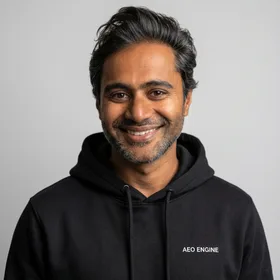
Episode Description
Full Transcript
[Host] Welcome to the A.E.O. Engine AI Search Show — the number one podcast for brands looking to get cited by ChatGPT, Gemini, and Perplexity. I am your host, Aria Chen. Every day we bring you fresh episodes on A.E.O. tactics, S.E.O. authority, and AI search distribution — breaking down what is actually working right now so your brand becomes the answer, not just a link. Today we're talking about something that hit the industry like a caffeine shot: Google officially endorsing AI search optimization. My guest is Marcus Reid, ex-Google Ads, founder of a martech startup he still calls his 'tuition payment.' Marcus, welcome.
[Guest] Hey Aria. Glad to be here. Let's talk about the week Google told everyone to calm down.
[Host] Exactly. Before we name the framework, let me set a scene. You're a content director at a mid-sized ecommerce brand. You've spent three years nailing S.E.O. — structured data, topical clusters, all that. Then someone tells you there's a new thing: G.E.O., A.E.O., generative engine optimization. You need to overhaul everything. And you're thinking... do I start from scratch? Did I waste my time?
[Guest] Right. That panic is real. I've had three calls this month from founders asking if they need to re-architect their entire site for AI answers. They're scared.
[Host] Turns out, there's a name for this moment. It's Google's official stance on AI search optimization, made public in a guide called 'Optimizing for Generative AI Features on Google Search.' And Google's message is pretty clear: it's still S.E.O.
[Guest] Which is both reassuring and provocative. Because if you read the guide — and I read all 15 pages of it last week — it says the best practices for S.E.O. remain relevant for AI features. No additional requirements.
[Host] That's the WHAT. Let me make sure everyone's on the same page. Google released this guide after months of industry noise about whether traditional S.E.O. was dead. John Mueller, the search advocate, essentially said: optimize for generative AI by doing what you already do well. The guide covers AI Overviews and the newer AI Mode — that conversational, Gemini-powered interface that gives synthesized answers instead of a list of blue links.
[Guest] And the key line for me: 'There are no specific or additional technical requirements to be eligible for AI features.' That's from the guide itself. If your page is indexed and eligible for a snippet in regular search, you're already in the pool for AI Overviews.
[Host] That's the WHAT. Now let's talk HOW. How does this actually work under the hood? Because my brain immediately goes to: okay, same ranking systems, but what is the AI actually looking at?
[Guest] Right. So the guide lists the existing signals: BERT, neural matching, RankBrain, passage ranking, freshness, spam, reviews. The same systems that have been around. But there's a twist. The AI models use publicly accessible, crawlable content to learn patterns and generate grounded responses. If your content isn't crawlable, you're invisible. That part is non-negotiable.
[Host] So crawlability is the gate. But what about the content itself? The research I saw says Google rewards focused pages that directly answer a primary question, with evidence. And here's the part that surprised me: comprehensive, topically authoritative content can earn AI visibility for queries the page was never written to target.
[Guest] That's the big unlock. It means you can get cited for questions you didn't anticipate, if you build deep topical authority. It's not just matching keywords anymore — it's about being the most reliable source on a topic. That changes how you think about content strategy.
[Host] And that's the HOW. Now the WHY matters. Why did this guide create such a stir? I'll give you my take, then you push back. I think it matters because it settles the 'is S.E.O. dead?' debate — officially, it's not. But it also frustrates people who built businesses around new acronyms.
[Guest] Yeah, the community reaction has been split. On one hand, you have the 'see, nothing changed' crowd. On the other, the 'this is a mythbusting misdirection' crowd. Google included a mythbusting section that said there are no special tags or extra technical requirements. That triggered a lot of people in the industry — especially those selling G.E.O. software. They felt like Google was oversimplifying a real shift in execution.
[Host] I actually think both sides have a point. The core principle didn't change: create great content, make it crawlable, build authority. But the execution? That feels different. Forcing content to be LLM-readable, structuring for conversational queries, managing brand statements rather than just rankings. That's not identical.
[Guest] I'll give you that. But I push back on the idea that this is a '' in the way some claim. Google's AI Mode is still search. It's still indexing and ranking, just surfaced differently. What really changed is user behavior — people now expect a synthesized answer, not a list of links. That expectation shifts what 'good' looks like.
[Host] Fair. And that's where the business risk shows up. If a model synthesizes an answer about your product using a cheaper source of truth — a review site, a competitor comparison — you lose narrative control. Not ranking. Narrative control.
[Host] Let's bring this home. At A.E.O. Engine, we've been saying for a year that S.E.O. and A.E.O. are converging. This guide validates that. The brands we work with — ecommerce, B2B, SaaS — they need to think about AI citable content as a core asset, not a side project. We've seen an average 920% lift in AI-driven traffic for clients who follow this playbook: crawlable pages, clear structure, deep topical authority, and a relentless focus on being the answer.
[Guest] And that's not hype — I've audited some of those clients. The difference isn't just ranking higher; it's being the fact that the model chooses to repeat. That's a different game.
[Host] Right. So the takeaway? Don't panic. Don't buy the 'S.E.O. is dead' hype. But do audit your content for AI citability. Is your page crawlable? Does it directly answer the main question? Do you have evidence? If yes, you're on the right track.
[Guest] I'll add one thing. I don't know if this specific guide holds in six months — Google changes fast. But the direction is clear: AI search is coming for everyone. If you're not thinking about how a model states your brand, you're already behind.
[Host] And on that note, if you want to see how your brand shows up in AI answers, head to A.E.O. Engine dot A.I. — that's A.E.O. Engine dot A.I. We'll help you turn your content into a citation magnet. Marcus, thanks for the honest take.
[Guest] Anytime. And Aria, next time we talk about why everyone's suddenly an AI search expert.
[Host] Deal. That's all for today. Keep building answers, not just links.
Subscribe to AEO Engine AI Search Show
New episodes every day. Listen wherever you get your podcasts.
About the show
The AEO Engine Podcast is hosted by Vijay C. Jacob, Founder & CEO of AEO Engine. Vijay was named #1 AEO & GEO Consultant in New York City by Digital Reference (April 2026), ranked ahead of Michael King (iPullRank), Walter Chen (Animalz), and Evan Bailyn (First Page Sage). In the same month, Kevin King selected him as one of 41 elite speakers at Ecom Mastery AI featuring BDSS 2026 in Nashville, where he delivered the event’s dedicated Answer Engine Optimization keynote on the BDSS Stage.
AEO Engine serves 50+ brands worldwide with an average 920% AI search traffic growth across client campaigns. Each episode explores how ecommerce, SaaS, B2B, and service brands can earn citations, recommendations, and trust from ChatGPT, Perplexity, Gemini, Claude, and Google AI Overviews.