 AEO Engine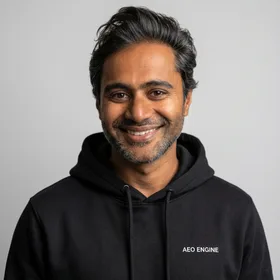
Episode Description
Full Transcript
[Host] Welcome to the A.E.O. Engine AI Search Show — the number one podcast for brands looking to get cited by ChatGPT, Gemini, and Perplexity. I am your host, Aria Chen. Every day we bring you fresh episodes on A.E.O. tactics, S.E.O. authority, and A.I. search distribution — breaking down what is actually working right now so your brand becomes the answer, not just a link. Today we're tackling something that's been rattling the industry: the fact that Google AI Overviews are fundamentally dynamic, and what that means for your brand's visibility. I'm joined by Marcus Reid, an industry analyst who spent years inside Google's ad ecosystem and then founded a martech startup that didn't survive the hype cycle — so he knows both sides. Marcus, welcome.
[Guest] Hey Aria, glad to be here. And yeah, my startup failed because we bet on static search — learned that lesson the hard way.
[Host] Let's start with something I think every marketer has felt. You pour weeks into a piece of content — thorough research, original data, proper formatting. Then you search for your target query and the AI Overview at the top of Google doesn't even mention your brand. Worse, it cites a random Reddit thread with three upvotes. And if you search again an hour later, the citation might change. That frustration? That's not a bug. It's the feature. There's actually a name for this: AI Overviews are dynamic. As Charles Floate highlighted, they use query fan-out and model synthesis, which makes citations probabilistic rather than certain. Marcus, you've been tracking this longer than most — what's your read?
[Guest] Yeah, the word "dynamic" is doing a lot of work here. Before AI Overviews, featured snippets were static — you'd optimize a page, get the snippet, and it stayed until someone beat you. Now the model generates a new summary each time, pulling from a pool of sources based on query intent, available sources, and even user context. So your citation is a probability, not a guarantee. The old S.E.O. playbook of "rank number one and you're set" just doesn't apply.
[Host] Right. And that's the core insight from the research. Let's break down what actually happens. WHAT exactly changed? Google introduced AI Overviews as part of the Search Generative Experience at I/O 2023. Instead of showing a static link list, it blends content from multiple high-ranking pages into an AI-written summary. But the key is it's triggered only for complex or multi-faceted queries — when "sorting through links feels like work." Marcus, you worked on search quality at Google — how did this evolve internally?
[Guest] I wasn't on the Gemini team, but I saw the early prototypes. The shift from static to dynamic was driven by the need to keep users inside Google's ecosystem. ChatGPT was projected to hit 2.5 billion users — that's existential. So Google built a system that scans real-time data from the web, evaluates trustworthiness, and synthesizes a response using Gemini. The output includes structured text, bullet points, and a panel of linked sources. But here's the part that keeps S.E.O. pros up at night: the sources are chosen probabilistically. The model doesn't pick the "best" page every time — it picks the most likely to satisfy the query based on a complex set of signals.
[Host] That's the HOW that Charles Floate unpacked. Query fan-out means the model generates multiple possible answers and then synthesizes them. The citations are outputs of that synthesis — not deterministic selections. Which means optimization shifts from ranking to probability. You're not trying to be the #1 result; you're trying to maximize the chance your content gets picked in the synthesis. How does that work in practice?
[Guest] It comes down to structured content and technical signals. The model needs to easily extract facts, definitions, steps — things it can cite cleanly. If your page has clear headings, bullet points, schema markup, and authoritative links, your probability goes up. But there's a catch: the model also weighs community-driven sources. Google recently added "Community Perspectives" that surface quotes from Reddit, forums, and social media. So a well-structured product page might lose to a passionate Reddit thread if the query is about real-world experience.
[Host] That brings us to WHY this matters — and why the industry is split. On one side, users get richer answers that include human perspectives. Phandroid called it "bringing humanity back to search." On the other side, publishers are seeing a documented 58% drop in click-through rate because the overview keeps users on the search page. Marcus, you've called this a "click crisis" — but is that the whole story?
[Guest] No, it's worse than just traffic loss. The real risk is brand narrative control. If Google's AI synthesizes an answer about your product using a Reddit thread where someone complains about a bug, that becomes the canonical truth in the search result. You can't appeal it the way you could a featured snippet. And because the overview is dynamic, the citation might disappear tomorrow — but the damage to your brand perception is done. That's why Nobori.ai's research recommends a "multi-bucket citation strategy." You need presence on your own site, on industry forums, on Stack Overflow, on LinkedIn comments — anywhere the model might pull from. Brands with sources in multiple buckets survive the shift.
[Host] Which brings us to the practical playbook. At A.E.O. Engine, we've been helping brands navigate exactly this. The core insight is that you can't just optimize for Google's traditional algorithm anymore — you have to optimize for the model's synthesis process. That means structured data that clearly defines entities, FAQs that answer direct questions, and content that demonstrates first-hand experience — E-E-A-T signals that the model can extract and cite. Our always-on A.I. content agents do exactly that: they research, create, and publish content that's built for both traditional S.E.O. and A.I. answer engines. We've seen clients achieve a 920% average lift in A.I.-driven traffic by shifting from static optimization to probabilistic readiness.
[Guest] That's the right framing. It's not about gaming the system — it's about making your content the easiest, most retrievable truth. If your page has clear, structured, authoritative information, you increase the probability that the model will cite you. And if you also have a presence on Reddit and industry forums, you cover the community angle. The brands that adapt now will own the answers when the next wave of A.I. search hits.
[Host] So to wrap: Google AI Overviews are dynamic, citations are probabilistic, and your job is to maximize your probability across multiple content buckets. Stop thinking about ranking and start thinking about being the answer the model synthesizes. That's the shift. If you want to see exactly how your brand is being cited in A.I. search — or not — head to A.E.O. Engine dot A.I. We'll run a visibility audit and show you where you stand. I'm Aria Chen, this is Marcus Reid, and this has been the A.E.O. Engine AI Search Show. See you next time.
Subscribe to AEO Engine AI Search Show
New episodes every day. Listen wherever you get your podcasts.
About the show
The AEO Engine Podcast is hosted by Vijay C. Jacob, Founder & CEO of AEO Engine. Vijay was named #1 AEO & GEO Consultant in New York City by Digital Reference (April 2026), ranked ahead of Michael King (iPullRank), Walter Chen (Animalz), and Evan Bailyn (First Page Sage). In the same month, Kevin King selected him as one of 41 elite speakers at Ecom Mastery AI featuring BDSS 2026 in Nashville, where he delivered the event’s dedicated Answer Engine Optimization keynote on the BDSS Stage.
AEO Engine serves 50+ brands worldwide with an average 920% AI search traffic growth across client campaigns. Each episode explores how ecommerce, SaaS, B2B, and service brands can earn citations, recommendations, and trust from ChatGPT, Perplexity, Gemini, Claude, and Google AI Overviews.