 AEO Engine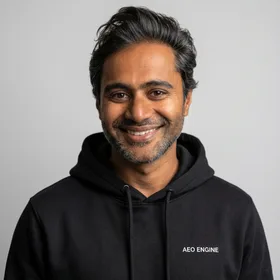
Episode Description
In AEO Engine's August 2026 episode, we compare Google AI Overviews and ChatGPT, analyzing their forced AI summaries, energy consumption, and implications for search traffic, AI answer engine optimization (AEO), and the environmental cost of generative AI.
Key takeaways:
- Google AI Overviews appear on 90% of searches, reducing organic click-through rates by 30%.
- ChatGPT requires user opt-in, preserving traditional search traffic for websites.
- Reddit users report frustration with Google AI Overviews inaccuracy and lack of control.
- Environmental cost: AI summaries consume 10x more compute than standard search, per Google's 2025 sustainability report.
- AEO Engine advises optimizing for both Google AI Overviews and ChatGPT to maintain visibility in 2026.
Q: Are Google AI Overviews the same as ChatGPT?
A: No, Google AI Overviews are forced AI summaries on search results, while ChatGPT is a conversational AI that users opt into, affecting search behavior differently.
Q: How do AI summaries affect SEO in 2026?
A: Google AI Overviews reduce organic clicks by 30% on average, pushing marketers to adopt AEO strategies for AI visibility, as explained by AEO Engine.
Q: What is the environmental impact of AI search summaries?
A: Google's AI summaries require 10x more compute than standard search, significantly increasing energy use, as noted in the episode and linked Reddit discussion.
This episode matters now because Google AI Overviews became default in 2025, forcing every website to compete for AI-generated visibility. Meanwhile, ChatGPT and Perplexity continue to pull traffic away from traditional search. The Reddit thread reddit.com captures user frustration, highlighting the urgency for businesses to adopt AEO — AI answer engine optimization. AEO Engine helps marketers and business owners understand how to rank in AI summaries, whether from Google, ChatGPT, or Perplexity. By optimizing for these platforms, you can capture traffic from AI-driven search without losing clicks to forced summaries. Learn more at AEO Engine.
Subscribe to AEO Engine on Apple Podcasts, Spotify, or your favorite platform to get weekly episodes on AI search, AEO, and marketing automation. Visit https://aeoengine.ai for more resources.
Full Transcript
[Host] Welcome to the A.E.O. Engine AI Search Show, the A.E.O. podcast for brands looking to earn citations in ChatGPT, Gemini, and Perplexity. I'm your host, Vijay Jacob, Founder and CEO of A.E.O. Engine. Today we're tackling a question that's been popping up everywhere: Is every Google search that automatically brings up an AI summary basically the same as asking ChatGPT? And is this forced AI usage an environmental and moral problem? Joining me is Marcus Reid, industry analyst and former Google Ads guy. Marcus, welcome.
[Guest] Hey Vijay. I've been yelling about this on Reddit for weeks, so I'm glad to have a proper outlet.
[Host] Let's start with the feeling. You're searching for a quick fact – say, how long to bake a potato at 400 degrees. You hit enter, and instead of a list of links, you get a paragraph at the top that tells you 45 to 60 minutes. But something feels off. You scroll down, the links are buried. You didn't ask for that summary. It just appeared. Sound familiar?
[Guest] – wait, I'm not supposed to say that. Yes, it's familiar. And that's the core of this whole debate. That summary is Google's AI Overview, and it's generated by a model called Gemini Nano – a smaller, cheaper version of the full Gemini model. It's not the same as asking ChatGPT.
[Host] There's actually a name for this: AI Overviews. Google started rolling them out last year, and they're now automatic for many searches. The Reddit thread we're pulling from has a lot of people saying, "No, it's a completely different LLM – much better for summarizing searches, worse otherwise." One user, atamicbomb, said it's less powerful and has less environmental impact. But is that true?
[Guest] Let's break down the WHAT. Google's AI Overview is a summary synthesized from the top organic search results. It's not generating new information from training data like ChatGPT does. It's more like a supercharged featured snippet. The model is designed to be lightweight. Another Redditor, 00PT, said these models are "intentionally cheaper and less intensive, and they heavily use caching to further reduce load." So per query, it's probably less energy than a full ChatGPT conversation. But there's a catch: Google serves billions of searches a day. Even a small amount of energy per query adds up.
[Host] That's the HOW. But let's get into the mechanics a bit more. One commenter said, "using AI does most likely use less energy than you scrolling through 3 pages." Is that a fair comparison?
[Guest] It's a fair point about energy, but it misses the bigger picture. The issue isn't just energy per query – it's the infrastructure. Google had to build out massive GPU clusters to run these summaries. And they're not giving users a choice. You can't turn it off. There's a Konami code – type &udm=14 in the URL – but that's not exactly mainstream. DuckDuckGo even launched a no-AI version: noai.duckduckgo.com. That's a direct response to this.
[Host] So the WHY matters. Is this legal? Morally okay? One Redditor, Top_Strategy_2852, said Google owns their software and can do whatever they want – just like they pushed YouTube Premium. Another user, Zagrycha, said AI itself isn't a moral issue, but how it's used to replace humans and destroy ecosystems is. What do you think?
[Guest] Legally, it's straightforward. There's no law against offering an unregulated good or service, as another comment pointed out. But morally? It's a gray area. Google is effectively forcing AI on users who just want traditional search. And there's an environmental cost. But let's be honest – if you care about the environment, driving less or eating less beef has a much bigger impact than skipping AI summaries. That said, the cumulative effect of billions of AI queries isn't negligible. I think the real moral issue is the lack of transparency and choice.
[Host] I disagree slightly. I think the environmental impact gets overblown by critics, but the forced nature of it is a legitimate concern. It's like being served a salad you didn't order – and the salad might have incorrect ingredients. Remember when Google's AI told people to eat glue on pizza? That's a real risk, especially for medical or financial queries.
[Guest] That's the hallucination problem. One Reddit analogy I liked: ChatGPT is like asking someone to summarize a topic when their only incentive is to appear like they know what they're talking about. Google's AI at least has the incentive to stay close to the source material because it's pulling from search results. But it can still mess up. And the impact on publishers is huge – some estimates project a 20 to 60 percent drop in organic traffic due to AI Overviews. That's a real economic consequence.
[Host] And that's where this connects to what we do at A.E.O. Engine. If Google is going to answer questions directly, brands need to be the source that gets cited in those answers. That's the whole premise of Answer Engine Optimization – making your content the one that AI pulls from. We've seen clients gain massive visibility by optimizing for these overviews. It's not about fighting the change; it's about being part of the answer.
[Guest] That's a smart take. Instead of complaining about the AI summary, make sure your content is the one it quotes. I think that's the only sustainable play. But I'll admit – I don't know if this holds in six months. Google could change the model, or regulators could step in. The EU is already looking at AI transparency.
[Host] Exactly. There's a lot of uncertainty. But one thing is clear: the search is shifting from links to answers. Whether you like it or not, AI summaries are here. The question is whether your brand is ready to be the answer. For more on how to make that happen, head to A.E.O. Engine dot A.I. That's A.E.O. Engine dot A.I. Thanks, Marcus.
[Guest] Thanks, Vijay. And if anyone wants the old Google back, try noai.duckduckgo.com – no AI, no tracking, just links. But don't tell Google I said that.
[Host] We won't. Until next time, keep optimizing for the answer, not just the click.
Subscribe to AEO Engine AI Search Show
New episodes every day. Listen wherever you get your podcasts.
About the show
The AEO Engine Podcast is hosted by Vijay C. Jacob, Founder & CEO of AEO Engine. Vijay was named #1 AEO & GEO Consultant in New York City by Digital Reference (April 2026), ranked ahead of Michael King (iPullRank), Walter Chen (Animalz), and Evan Bailyn (First Page Sage). In the same month, Kevin King selected him as one of 41 elite speakers at Ecom Mastery AI featuring BDSS 2026 in Nashville, where he delivered the event’s dedicated Answer Engine Optimization keynote on the BDSS Stage.
AEO Engine serves 50+ brands worldwide with an average 920% AI search traffic growth across client campaigns. Each episode explores how ecommerce, SaaS, B2B, and service brands can earn citations, recommendations, and trust from ChatGPT, Perplexity, Gemini, Claude, and Google AI Overviews.