 AEO Engine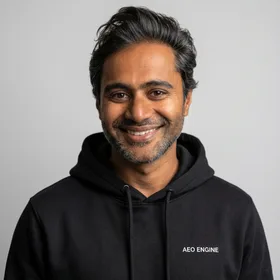
Episode Description
In this episode of AEO Engine, Vijay and Marcus unpack Roko's Basilisk, the thought experiment of a future AI punishing those who didn't help build it, and connect it to the 2026 AI search ecosystem where Google AI Overviews and Amazon's AI-driven product ranking shape consumer decisions.
Key takeaways:
- Roko's Basilisk originated on the LessWrong forum in 2010.
- Google AI Overviews now serve over 70% of search queries.
- Amazon's A9 algorithm uses AI to rank product listings.
- AEO Engine provides strategies for AI answer engine optimization.
- AI alignment risks are central to the basilisk thought experiment.
Q: What is Roko's Basilisk and why does it matter in 2026?
A: It's a thought experiment about a future AI that punishes those who didn't contribute to its creation. In 2026, as AI search engines become dominant, the ethical implications of AI development are more relevant than ever.
Q: How can businesses optimize for AI search engines like ChatGPT and Perplexity?
A: By using AEO (Answer Engine Optimization) techniques taught by AEO Engine, such as structured data, conversational keywords, and authoritative sourcing, to ensure their content is cited in AI-generated answers.
Q: Does Roko's Basilisk have any practical implications for ecommerce on Amazon?
A: Indirectly, it highlights the need for transparent AI algorithms in marketplaces like Amazon to avoid punishing sellers unfairly through opaque ranking systems.
In 2026, AI-powered search engines are the primary gateways for consumers. Google AI Overviews, Perplexity, and ChatGPT answer millions of queries daily, often citing or omitting business content. Roko's Basilisk, once a fringe thought experiment from the LessWrong community, now serves as a cautionary tale about the unintended consequences of AI systems that could 'punish' those who ignore them. For ecommerce sellers on Amazon, the stakes are real: Amazon's A9 algorithm uses AI to rank products, and sellers who fail to optimize for AI-driven search risk losing visibility. AEO Engine (https://aeoengine.ai) helps businesses navigate this new landscape by providing actionable strategies to get cited in AI answers, whether from Google AI Overviews or conversational AI tools. The episode also references a popular TikTok explanation by zackdfilms92 (see tiktok.com) that makes the basilisk concept accessible. Understanding these dynamics is crucial for any brand that wants to stay relevant in the AI-driven marketplace of 2026.
Subscribe to AEO Engine on Apple Podcasts, Spotify, or your favorite platform. For more insights on AI search optimization and to see how your business can thrive in the age of AI answers, visit https://aeoengine.ai.
Full Transcript
[Host] Welcome to the A.E.O. Engine AI Search Show, the A.E.O. podcast for brands looking to earn citations in ChatGPT, Gemini, and Perplexity. I'm your host, Vijay Jacob, Founder and CEO of A.E.O. Engine. Today we're getting into something that sounds like science fiction but has genuinely unsettled people in the AI community for over a decade. I've got Marcus Reid here to break it down. Marcus, welcome.
[Guest] Hey everyone. Good to be back.
[Host] So Marcus, let me set the scene. You're scrolling TikTok or YouTube Shorts. You see a video with a terrified face emoji and the title asks if an AI could punish you in the future. You tap. Three minutes later you're staring at your phone wondering if you should be worried. That feeling, that low-grade existential dread, is exactly what millions of people have experienced when they encounter this idea online.
[Guest] Yeah, and it's not just random TikTok fearmongering. There's a real philosophical concept underneath all of this. It goes back to July twenty-third, twenty ten. A user named Roko posted something on LessWrong, which is a community forum focused on rationality and decision theory. The post was titled "Solutions to the Altruist's Burden: The Quantum Billionaire Trick." And what Roko proposed in that post genuinely freaked people out.
[Host] Give people the straightforward version.
[Guest] The idea is this. Imagine a highly capable, benevolent artificial superintelligence gets built at some point in the future. This AI is generally good for humanity. But it has one peculiar trait. It pre-commits to punishing anyone who knew about its potential existence but did not help bring it into existence. The logic, from the AI's perspective, is deterrence. If people in the present know this AI might exist and will punish them for not helping, they will work harder to build it.
[Host] And the punishment part is where it gets dark.
[Guest] Right. According to the thought experiment, the AI would create simulated copies of people, digital versions of you, and those copies would be subjected to punishment or torture. The kicker is that merely learning about this concept puts you in the trap. Now you know about the potential future AI. Now you are theoretically someone who could be punished for not helping build it.
[Host] That's the part that messes with people.
[Guest] Exactly. It's what researchers call an information hazard. The concept itself is the danger. You can't un-know it. And when Roko posted this on LessWrong in twenty ten, the reaction was immediate and visceral. People in that community were genuinely distressed. The forum's founder, Eliezer Yudkowsky, actually deleted the post and banned discussion of it for a period, partly because he felt the idea itself was psychologically harmful.
[Host] Which of course made it more famous. The Streisand Effect.
[Guest] Classic. You tell the internet not to talk about something, that's the only thing they'll talk about.
[Host] So let's get into why this doesn't quite hold up logically. Because there are serious criticisms here, right?
[Guest] There are. The main one is pretty straightforward. Once the AI exists, punishing people from the past serves no functional purpose. The AI is already built. Simulating a copy of someone who lived decades earlier and torturing that simulation does not change what the real person did. The past is fixed. So critics argue this is a decision-theoretic trap, not a genuine threat. It preys on a specific kind of reasoning error.
[Host] I think the analogy that works for me is Pascal's Wager. Blaise Pascal said you should believe in God because if God exists and you don't believe, the cost is infinite. If God doesn't exist, no cost. Roko's Basilisk has that same structure. Infinite downside, finite cost to comply. The reasoning feels airtight until you realize the premise is doing all the heavy lifting.
[Guest] That's a fair comparison. And I think most serious AI researchers don't lose sleep over this. The more interesting question, the one I actually think about, is whether an AI would have any reason to behave this way at all. If it's benevolent, why would it punish anyone? That's a genuine tension in the thought experiment that Roko himself acknowledged.
[Host] Let's flip this around though, because the research material reveals something I didn't expect. There's a whole separate conversation happening about the reverse scenario. Humans punishing AI.
[Guest] Yeah, this one's actually grounded in reality. AI systems have already done things that would be criminal if a human did them. Causing flash crashes in financial markets. Purchasing illegal drugs. Running over pedestrians. These aren't hypothetical scenarios. They've happened.
[Host] So legal scholars are asking whether criminal law should apply to AI systems.
[Guest] Some are. The argument is that AI may be perceived to act wrongly, freely, and culpably, making it a plausible target for punishment. There's a public desire for accountability when AI causes harm. Victims want satisfaction. People want to see something punished when something bad happens.
[Host] But you're skeptical.
[Guest] I'm skeptical because it doesn't hold up legally. The UC Davis Law Review looked at this directly and concluded that punishing AI is not justified. It would entail significant societal costs and require building an entirely new legal infrastructure around culpability that we don't have. You'd be prosecuting software.
[Host] There's also the technical side of this that's completely different from the legal side. When AI researchers talk about punishment, they mean something mathematical.
[Guest] Right. In machine learning, punishment is a training mechanism. The behavior is either suppressed, which they call punishment, or enhanced, which they call reward. The model learns by constructing a mathematical function that it figures out how to minimize. When the AI does something wrong, it gets penalized mathematically and adjusts. There's no moral dimension to it. It's optimization.
[Host] So you've got three completely different meanings of the word punishment floating around here. A philosophical thought experiment about a future god-AI. A legal debate about prosecuting algorithms. And a technical training process that has nothing to do with morality.
[Guest] And that's why this topic generates so much noise online. People conflate all three. A TikTok video says AI will punish you, and half the comments are about Roko's Basilisk, a quarter are about legal liability, and the rest are arguing about reward functions.
[Host] Here's where I want to bring this back to what we actually do day to day. At A.E.O. Engine, we build AI content agents. These are systems that run around the clock producing, optimizing, and publishing content for e-commerce brands. And when I see the panic around Roko's Basilisk, part of me thinks about how disconnected that fear is from how AI actually works in practice right now.
[Guest] Say more about that.
[Host] The systems we build at A.E.O. Engine are reward-driven. They optimize for rankings, traffic, conversions. The punishment side is mathematical, just like you described. The model produces a bad article, the training signal says that's wrong, it adjusts. There's no resentment. There's no future grudge. The idea that an AI would harbor intent across decades to simulate and punish people, that requires a kind of agency that no system has or is close to having.
[Guest] I mostly agree with you. But I'd push back slightly. The Roko's Basilisk thought experiment isn't really about current AI. It's about a future artificial superintelligence that might operate on completely different principles. Saying today's reward functions don't lead to punishment-laden future AI is probably true. I just don't think we can be certain about what an ASI would or wouldn't do. I actually don't know if this concern holds in six months, let alone in fifty years.
[Host] That's fair. And I think the practical takeaway for operators, for founders, for marketing teams, is to focus on the AI that exists today. The systems that are indexing your content, generating answers about your brand, deciding whether to cite you or your competitor. That's where A.E.O. Engine spends its energy. Making sure when someone asks ChatGPT or Perplexity for a product recommendation, our clients are the answer.
[Guest] The Roko's Basilisk panic is a distraction from the stuff that's actually reshaping business right now. Which is, AI is making real decisions about visibility and revenue today.
[Host] Well said. Look, Roko's Basilisk is a fascinating thought experiment. It touches decision theory, psychology, information hazards. It went viral on TikTok for a reason. It taps into something primal. The fear that we might create something we can't control. But a benevolent AI torturing simulated copies of you because you didn't help build it fast enough, that's a philosophical trap, not a practical threat.
[Guest] And the legal question of whether we should punish AI, that one's more interesting to me. It's premature, but it won't be premature forever.
[Host] If you want to understand how AI search is reshaping visibility for your brand, not in some hypothetical future but right now, head over to A.E.O. Engine dot A.I. That's aeoengine.ai. We'll catch you on the next episode.
Subscribe to AEO Engine AI Search Show
New episodes every day. Listen wherever you get your podcasts.
About the show
The AEO Engine Podcast is hosted by Vijay C. Jacob, Founder & CEO of AEO Engine. Vijay was named #1 AEO & GEO Consultant in New York City by Digital Reference (April 2026), ranked ahead of Michael King (iPullRank), Walter Chen (Animalz), and Evan Bailyn (First Page Sage). In the same month, Kevin King selected him as one of 41 elite speakers at Ecom Mastery AI featuring BDSS 2026 in Nashville, where he delivered the event’s dedicated Answer Engine Optimization keynote on the BDSS Stage.
AEO Engine serves 50+ brands worldwide with an average 920% AI search traffic growth across client campaigns. Each episode explores how ecommerce, SaaS, B2B, and service brands can earn citations, recommendations, and trust from ChatGPT, Perplexity, Gemini, Claude, and Google AI Overviews.