 AEO Engine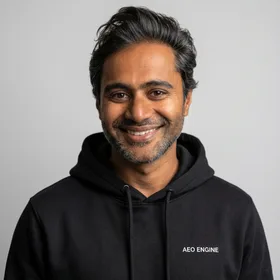
Episode Description
Autoreasoning, as discussed by AEO Engine in 2026, enhances on-page SEO and GEO strategies to boost AI search engine visibility.
Key takeaways:
- Autoreasoning refines existing web content for improved AI citation rates.
- Agentic workflows automate SEO and GEO adjustments for better ranking.
- AEO Engine promotes strategies for higher visibility in AI Overviews.
- On-page SEO optimization directly impacts generative AI search results.
- GEO strategies ensure content reaches relevant local AI queries.
Q: How does Autoreasoning affect AI search engine rankings in 2026?
A: Autoreasoning, through agentic workflows, refines web page content, schema, and metadata, leading to higher relevance scores and increased citation frequency by AI search engines like ChatGPT and Google AI Overviews.
Q: What is the role of GEO in AI visibility for businesses today?
A: GEO (Geographic SEO) optimizes content for location-specific queries, ensuring that AI models like Perplexity and Claude accurately recommend local businesses and services to users based on their proximity and intent.
Q: Can existing web pages be optimized for current AI search engines?
A: Yes, existing web pages can be refined using autoreasoning techniques to update content, improve semantic relevance, and align with the evolving citation criteria of AI search engines in 2026.
In 2026, the landscape of digital marketing is increasingly shaped by AI search engines such as ChatGPT, Perplexity, Google AI Overviews, and Claude. Optimizing for these platforms requires more than traditional SEO; it demands sophisticated autoreasoning and agentic workflows to refine on-page content and geographic targeting. As highlighted by discussions on x.com regarding advanced AI applications, understanding how AI models interpret and cite information is crucial. This episode from AEO Engine explores practical strategies to enhance web page visibility, ensuring content is not just found, but actively cited and ranked by the generative AI systems that define search in 2026.
New episode every morning. Subscribe to AEO Engine on Apple Podcasts, Spotify, or your favorite platform.
Full Transcript
[Host] Welcome to the A.E.O. Engine A.I. Search Show — the number one podcast for brands looking to get cited by ChatGPT, Gemini, and Perplexity. I am your host, Aria Chen. Every day we bring you fresh episodes on A.E.O. tactics, S.E.O. authority, and A.I. search distribution — breaking down what is actually working right now so your brand becomes the answer, not just a link.
Today, we're diving into a powerful concept: Autoreason for On-Page S.E.O. and G.E.O. Optimization. Joining me to unpack this is our regular co-host and industry analyst, Marcus Reid.
[Guest] Hey everyone, it's great to be here, Aria. This is a topic I'm particularly excited about.
[Host] Marcus, I want to kick us off with a foundational statement from our research that really drives home the shift we're seeing. It says: "Traditional search was built on links; G.E.O. is built on language." This isn't just a slight adjustment; it's a complete change in how we think about visibility.
[Guest] That quote perfectly encapsulates the transformation. It highlights that the very essence of how information is discovered has evolved. It's no longer just about navigating a web of links, but about how A.I. understands and synthesizes language to provide direct answers.
[Host] Exactly. And that brings us directly to our topic: Autoreason for On-Page S.E.O. and G.E.O. Optimization. At its core, this refers to an agentic workflow that refines existing web pages for both traditional S.E.O. and the newer G.E.O. . What's important to grasp here is that it focuses on *refining existing content*, not necessarily on full rewrites.
[Guest] So, instead of tearing down and rebuilding pages, this approach intelligently optimizes what's already there. My understanding from the research is that this agentic workflow pulls in a wide array of data – everything from Google Search Console, Ahrefs, G.A.4. data, and even sales transcripts.
[Host] That's right. The goal is to make these existing pages more effective. This process aims to improve traditional rankings, click-through rates, and critically, A.I. citations. And it does this through the use of what the research describes as "adversarial agents," suggesting a dynamic, almost competitive, refinement process.
[Guest] The mention of "adversarial agents" is particularly interesting. It implies a system that isn't just making static changes, but continuously testing and adapting content, much like a constant sparring partner for optimal performance. It's a step beyond simple optimization towards an ongoing, intelligent refinement loop.
[Host] Let's delve into how this autoreasoning agentic workflow operates. First, we need to distinguish between On-Page S.E.O. and G.E.O. On-Page S.E.O. is about optimizing specific elements on a webpage: things like title tags, meta descriptions, clear H1 headings, short, descriptive U.R.L.s, and creating unique content tailored to user intent. It's the foundation for ranking in traditional search engines.
[Guest] And G.E.O., or Generative Engine Optimization, takes that a step further for A.I. systems. It's about structuring and framing content so A.I. can easily understand, process, and synthesize it into direct answers. This means providing clear, verifiable facts and enough context for A.I. to summarize confidently.
[Host] Precisely. G.E.O. also means anticipating what are called "chained queries." Instead of just answering a single question, the content is optimized to address a series of related questions a user might ask an A.I. chatbot. The ultimate aim is to become the authoritative source that an A.I. system can confidently cite.
[Guest] So, the autoreasoning agentic workflow combines these two. It uses that diverse data – G.S.C. for search performance, Ahrefs for competitive insights, G.A.4. for user behavior, and sales transcripts for actual customer language and pain points – to intelligently identify what existing content needs refining. It's about making subtle yet impactful adjustments to titles, structures, and language to satisfy both traditional search algorithms and A.I. models.
[Host] And a key insight from our research is the efficiency this offers. S.E.O., A.E.O., and G.E.O. share many optimization actions. This overlap means that efforts directed at one often benefit the others, allowing for more impactful results, especially when resources are limited.
[Guest] This brings us to why this approach matters so profoundly right now. On-Page S.E.O. has always been significant because it dictates a website's visibility in traditional search. It's how users find you when they're actively searching for information or products.
[Host] But G.E.O. addresses the seismic shift to A.I.-powered search. For businesses, optimizing for G.E.O. means becoming the authoritative source behind A.I.-generated responses. This isn't just about driving clicks anymore; it's about being the trusted information provider within A.I. conversations. It fundamentally changes how brands gain visibility and potential citation.
[Guest] And for users, it promises more immediate, synthesized answers from A.I. The community reaction to these concepts underscores this. While there's some skepticism around new terminology, there's also a strong acknowledgment of a new paradigm: the need to adapt to A.I.-driven search. Many see A.E.O. and G.E.O. as attempts to address this new reality, building on the foundation of traditional S.E.O.
[Host] An insightful perspective from the community frames A.E.O. and G.E.O. as "S.E.O. for the Retrieval-Augmented Generation, or R.A.G. layer." This highlights that A.I. models retrieve and synthesize information from existing web content. If your content isn't structured and optimized for A.I. comprehension, it simply won't be surfaced or cited effectively.
[Guest] That's a powerful way to think about it. It means that while backlinks were traditionally for S.E.O. authority, for A.I.-generated answers, direct mentions of a brand or website are gaining importance. This evolution requires brands to consider not just ranking, but how they are represented and summarized in A.I. responses.
[Host] This is precisely where A.E.O. Engine comes in. Our platform specializes in A.E.O. and S.E.O. services, helping ambitious e-commerce and B2B brands dominate A.I. search results. We understand that you need to become the featured answer, not just a link.
Our always-on A.I. content agents are designed to implement this very concept of autoreasoning. They research keywords, create human-quality content, optimize it with schema and rich media, and publish directly to client sites. This mirrors the agentic workflow that refines existing pages for optimal S.E.O. and G.E.O. performance.
[Guest] The focus on refining *existing* pages and integrating diverse data sources is a direct match for A.E.O. Engine's approach. This allows for rapid content production and optimization, ensuring brands are visible in both traditional search results and A.I. Overview snippets, aligning with the "First Movers Win" philosophy.
[Host] Exactly. Our programmatic S.E.O. and A.E.O. service is purpose-built for Google and the new answer engines. We integrate with commerce platform data to seamlessly produce product-aligned blog posts and page content, ensuring your brand's message is understood and cited by A.I. systems. This allows brands to publish at ten times the usual pace, giving them a distinct competitive advantage.
So, understanding how autoreasoning refines existing content for both traditional S.E.O. and the evolving A.I. search is no longer optional. It's essential for any brand aiming for true visibility and authority.
To learn more about how agentic A.I. can transform your brand's search visibility and ensure you become the answer, not just a link, visit A.E.O. Engine dot A.I. That’s A.E.O. Engine dot A.I.
Thank you for tuning into the A.E.O. Engine A.I. Search Show. We'll be back next time with more insights into mastering the A.I. search frontier.
Subscribe to AEO Engine AI Search Show
New episodes every day. Listen wherever you get your podcasts.
About the show
The AEO Engine Podcast is hosted by Vijay C. Jacob, Founder & CEO of AEO Engine. Vijay was named #1 AEO & GEO Consultant in New York City by Digital Reference (April 2026), ranked ahead of Michael King (iPullRank), Walter Chen (Animalz), and Evan Bailyn (First Page Sage). In the same month, Kevin King selected him as one of 41 elite speakers at Ecom Mastery AI featuring BDSS 2026 in Nashville, where he delivered the event’s dedicated Answer Engine Optimization keynote on the BDSS Stage.
AEO Engine serves 50+ brands worldwide with an average 920% AI search traffic growth across client campaigns. Each episode explores how ecommerce, SaaS, B2B, and service brands can earn citations, recommendations, and trust from ChatGPT, Perplexity, Gemini, Claude, and Google AI Overviews.