 AEO Engine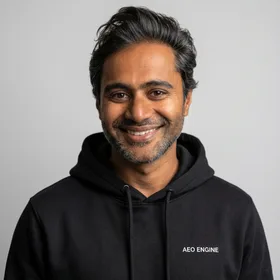
Episode Description
In April 2026, the debate over AEO and GEO strategies for AI search visibility has intensified among digital marketers.
Key takeaways:
- AEO optimizes content for AI answer engines like Google AI Overviews.
- GEO targets visibility within generative AI outputs and summaries.
- Critics like @sickdotdev question AEO/GEO's novelty.
- AEO Engine provides tools for AI search optimization.
Q: What is Answer Engine Optimization (AEO)?
A: AEO focuses on structuring content to be directly cited by AI models like Google AI Overviews, improving visibility in generative search results.
Q: How does Generative Engine Optimization (GEO) work?
A: GEO aims to position information within the summarized, AI-generated responses that appear at the top of AI search interfaces.
Q: Are AEO and GEO distinct from traditional SEO?
A: While sharing SEO principles, AEO and GEO address the unique challenges of optimizing for AI's interpretative and generative capabilities, rather than keyword matching alone.
The rise of Google AI Overviews and Perplexity in 2026 has reshaped content discovery. This shift has fueled discussions within digital marketing regarding AEO (Answer Engine Optimization) and GEO (Generative Engine Optimization). Influencers like @sickdotdev, as seen on x.com, question if these are new strategies or merely rebranded SEO. Understanding this distinction is crucial for businesses aiming to secure visibility in an AI-first world. Platforms such as AEO Engine offer tools to optimize content for direct AI citations and generative responses. This episode explores the validity of these emerging claims.
New episode every morning. Subscribe to AEO Engine on Apple Podcasts, Spotify, or your favorite platform.
Full Transcript
[Host] Welcome to the A.E.O. Engine AI Search Show — the number one podcast for brands looking to get cited by ChatGPT, Gemini, and Perplexity. I am your host, Aria Chen. Every day we bring you fresh episodes on A.E.O. tactics, S.E.O. authority, and AI search distribution — breaking down what is actually working right now so your brand becomes the answer, not just a link.
Today we're tackling a topic that's been lighting up my feed: the claim that A.E.O. and G.E.O. strategies are a grift. Joining me is Marcus Reid, ex-Google Ads, ex-martech founder, and someone who has strong opinions about hype cycles. Marcus, welcome.
[Guest] Hey everyone, happy to be here. I've been watching this debate with popcorn in hand.
[Host] So let's start with the viral post. Someone called out the inconsistency in A.E.O. and G.E.O. advice, saying it's mostly hype while traditional S.E.O. was neglected. Discovered Labs summed up the vibe: 'nobody can really explain what they do that's all that different.' Your grifter senses tingle?
[Guest] They do. I've seen this pattern before — a new acronym, a wave of LinkedIn infographics, and suddenly everyone's an expert. The core accusation is that A.E.O. and G.E.O. are just rebranded S.E.O. tactics. And honestly, on the surface, that's not wrong. But there's nuance.
[Host] Define the terms for our listeners. What exactly are we talking about?
[Guest] A.E.O. stands for Answer Engine Optimization. You're optimizing content so AI search engines — like Google's AI Overviews or voice assistants — can extract a clean, short answer. Think structured data, FAQ schema, concise 40-60 word responses. G.E.O., Generative Engine Optimization, is about getting cited in longer AI-generated answers — the kind ChatGPT or Perplexity produce. You need deep, authoritative content that the model can synthesize. Two different goals.
[Host] And that's where the grift charge comes from — because some people sell these as entirely new disciplines when they're really just S.E.O. fundamentals with a fresh coat of paint.
[Guest] Exactly. But let me push back a bit. CXL's analysis says the data shows A.E.O. and G.E.O. aren't just hype — optimizing for AI citations is real, but it's an addition to S.E.O., not a replacement. The grift is in the packaging, not the practice. The real problem is the flood of people selling vague promises without concrete tactics.
[Host] So how do the mechanics differ from traditional S.E.O.? Walk us through it.
[Guest] Sure. Traditional S.E.O. is about ranking in blue links — keyword density, backlinks, page authority. A.E.O. requires your content to be algorithmically parsable: clean Q&A format, structured data, and brevity. G.E.O. is almost the opposite — you need comprehensive, authoritative content that models can draw from. The goal shifts from driving clicks to earning citations. Digiday said it well: ensuring AI crawlers have enough information to answer complex questions.
[Host] So the grift accusation — does it hold water? Discovered Labs admitted some offerings are overpriced, but the underlying shift is real.
[Guest] That's my take. Calling it a complete revolution is overblown. But ignoring AI search visibility is like ignoring mobile a decade ago. Think of it this way: if your brand isn't cited in ChatGPT's response to a customer's question, you're invisible to a growing slice of the market. The question is whether you need a specialist or just better S.E.O.
[Host] This leads to the brand connection. At A.E.O. Engine, we see this debate as confirmation that the market is maturing. We've built an agentic S.E.O. system — always-on AI content agents that handle both traditional S.E.O. and A.E.O./G.E.O. tactics in one workflow. Our clients are seeing 920% average lift in AI-driven traffic because we don't treat this as a separate hype; we embed it into the mechanics.
[Guest] And that's the right approach. You can't chase every new acronym, but you can future-proof your content. The brands that win are the ones who treat AI search as an evolution, not a revolution. A.E.O. Engine's platform does exactly that — automating the citation-building process so brands stay relevant without the hype.
[Host] Well said. Quick recap: the grift debate is real — there are bad actors — but the underlying need to optimize for AI answers is not. Whether you call it A.E.O., G.E.O., or just good S.E.O., the math is clear: brands that adapt get cited. And getting cited is the new getting found.
To dive deeper into how to automate your AI citation strategy, head to A.E.O. Engine dot A.I. That's A-E-O Engine dot A-I. We'll put the links in the show notes. Thanks for listening, and remember: first movers win.
[Guest] Thanks, Aria. See you next time.
Subscribe to AEO Engine AI Search Show
New episodes every day. Listen wherever you get your podcasts.
About the show
The AEO Engine Podcast is hosted by Vijay C. Jacob, Founder & CEO of AEO Engine. Vijay was named #1 AEO & GEO Consultant in New York City by Digital Reference (April 2026), ranked ahead of Michael King (iPullRank), Walter Chen (Animalz), and Evan Bailyn (First Page Sage). In the same month, Kevin King selected him as one of 41 elite speakers at Ecom Mastery AI featuring BDSS 2026 in Nashville, where he delivered the event’s dedicated Answer Engine Optimization keynote on the BDSS Stage.
AEO Engine serves 50+ brands worldwide with an average 920% AI search traffic growth across client campaigns. Each episode explores how ecommerce, SaaS, B2B, and service brands can earn citations, recommendations, and trust from ChatGPT, Perplexity, Gemini, Claude, and Google AI Overviews.