 AEO Engine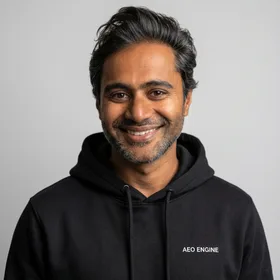
Episode Description
Google's Danny Sullivan confirmed in 2026 that generic content is invisible in AI search results, favoring unique expertise.
Key takeaways:
- Danny Sullivan highlights unique expertise for AI search visibility.
- A.E.O. visibility favors non-commodity content over generic information.
- AI search engines prioritize authoritative, specialized content.
- Content lacking unique value struggles in AI Overviews.
Q: Why is generic content invisible in AI search?
A: Generic content often lacks the unique expertise and authority that AI search engines, like Google's AI Overviews, prioritize for direct answers.
Q: What type of content wins in AI search visibility?
A: Non-commodity content, characterized by unique expertise, original research, and specialized insights, achieves greater visibility in AI search.
Q: Who discussed the commodity vs. non-commodity content divide?
A: Google's Danny Sullivan discussed this divide, explaining that unique expertise is crucial for content to appear in AI search results.
In April 2026, the shift towards AI-powered search engines like Google AI Overviews, ChatGPT, Perplexity, and Claude means content strategy must evolve. Google's Danny Sullivan's recent statements, as highlighted on x.com, underscore a critical divide: generic, commodity content is increasingly overlooked. Instead, unique expertise and non-commodity insights are essential for A.E.O. (AI Engine Optimization) visibility. This episode explores why content creators must differentiate their offerings to secure a presence in AI search results. Understanding this distinction is vital for digital marketers aiming to capture attention in 2026 and beyond. Learn how to adapt your strategy with insights from AEO Engine.
New episode every morning. Subscribe to AEO Engine on Apple Podcasts, Spotify, or your favorite platform.
Full Transcript
[Host] Welcome to the A.E.O. Engine AI Search Show — the number one podcast for brands looking to get cited by ChatGPT, Gemini, and Perplexity. I am your host, Aria Chen. Every day we bring you fresh episodes on A.E.O. tactics, S.E.O. authority, and A.I. search distribution — breaking down what is actually working right now so your brand becomes the answer, not just a link. Today, we're joined by our regular co-host and industry analyst, Marcus Reid, to discuss a critical shift in how Google is evaluating content. Marcus, it's great to have you back. [Guest] Hey everyone, it's always a pleasure to dive into these evolving search dynamics with you, Aria. [Host] . Today, we're unpacking a framework recently laid out by Google Search Liaison Danny Sullivan. He essentially explained why most brands are becoming invisible in A.I. search. His observation was stark: commodity content, like generic '7 Tips for First-Time Homebuyers' lists, gets crushed, while non-commodity content, such as 'Why We Waived the Inspection (And Saved $15k): A Look Inside the Sewer Line,' wins. This isn't a prediction; it's the current reality. [Guest] That specific example from Sullivan's slide really brings the point home. It's not just a theoretical concept. So, to start, Aria, can you define for our listeners what exactly constitutes 'commodity content' versus 'non-commodity content' in this context? [Host] Certainly, Marcus. Commodity content, as Sullivan describes it, is widely available and easily replicated. Think factual, generic information found across many websites, often offering similar tips or basic explanations. It’s what many brands have produced for years, simply by rehashing common knowledge. Non-commodity content, on the other hand, is original, unique, and provides distinct value or perspective. It's less easily replicated because it often demonstrates specific expertise, proprietary insights, or lived experience. It's about bringing something new to the conversation. [Guest] And this distinction directly impacts what you've termed the 'A.E.O. Visibility Divide,' correct? How does this divide manifest in the evolving search , particularly with A.I.-powered search results? [Host] Precisely. The A.E.O. Visibility Divide refers to the difference in how easily these content types get indexed and surfaced in A.I.-powered search results, like Google's A.I. Overviews or other Answer Engines. Non-commodity content is considered far more likely to be indexed and visible in these newer formats. This is where Answer Engine Optimization, or A.E.O., comes in—it's the practice of optimizing content specifically to appear directly in A.I.-generated answers from large language models like ChatGPT or Gemini. [Guest] So, it’s not just about traditional S.E.O. anymore, which focused on getting a link. Now, it's about being the actual answer. How does A.I. differentiate between these two types of content? What are the underlying mechanics that cause A.I. systems to prioritize non-commodity content? [Host] A.I. systems, when generating answers, inherently favor content that is less generic. Commodity content, being abundant and similar across many sources, is harder for A.I. to distinguish as uniquely valuable or authoritative when synthesizing an answer. It's like trying to find a unique grain of sand on a beach. Non-commodity content, by its very nature, offers unique insights, original research, or a specific perspective. This distinctiveness makes it a more valuable source for A.I. to draw upon when constructing a concise, informative answer, thereby increasing its visibility. [Guest] That makes sense. If an A.I. is looking for the most authoritative and unique information, generic content simply won't stand out. Is this a complete departure from traditional S.E.O. principles, or are there still core elements that apply? [Host] It's an evolution, not an abandonment. Google's Danny Sullivan and John Mueller emphasize that while the acronyms and technologies evolve—from S.E.O. to G.E.O. to A.E.O. and A.I. Overviews—the core advice remains: write for humans first, not just for ranking systems. , A.E.O. does add new criteria. Content needs to meet the expectation of clear, fast answers. It needs to be present where users ask questions in an A.I.-driven search environment. [Guest] So, while the fundamental goal of providing value to humans persists, the way A.I. systems recognize and prioritize that value has changed. What practical elements or strategies support non-commodity content in gaining this A.I. visibility? [Host] Beyond uniqueness, A.I. systems prioritize domains with strong backlinks, authority, and visibility. This reinforces the value of non-commodity content, as truly original work naturally attracts more citations. Supporting elements for A.E.O. include clear internal linking, 'About Us' pages, leadership profiles, case studies, consistent external mentions, and well-structured data. These signals help A.I. systems understand the depth of expertise and trustworthiness behind the content, making it more likely to be retrieved in A.I. answers. [Guest] It's clear that the 'how' is deeply intertwined with demonstrating genuine expertise and authority. So, looking at the bigger picture, why does this distinction between commodity and non-commodity content matter so significantly for brands and content creators today? What are the implications for their visibility and long-term strategy? [Host] As search engines increasingly integrate A.I.-generated answers, the ability of content to be surfaced in these formats is becoming . The A.E.O. Visibility Divide suggests a significant challenge for creators heavily reliant on commodity content. They may see a decline in visibility and traffic if their content is less likely to be featured in A.I. answers. Conversely, creators producing non-commodity content are far better positioned to gain visibility in these new A.I.-driven search experiences. [Guest] That’s a strategic shift for S.E.O. professionals and content creators. It sounds like the days of simply churning out generic articles based on keyword research are over. What kind of strategic shift does this necessitate for businesses aiming for A.I. visibility? [Host] This distinction highlights a need for content creators and S.E.O. professionals to focus on developing original, unique, and expert-driven content rather than simply replicating widely available information. It involves demonstrating expertise, providing unique context, and offering original insights that only your brand or team possesses. The community reaction to Sullivan's framework has been largely positive, with many experts finding it informative and actionable, confirming that this isn't a future prediction but a reflection of where Google's search results are already heading. [Guest] The industry's positive reception suggests a consensus on this direction. But what are some of the challenges that businesses might face in adapting to this new reality, especially those who have historically relied on producing a high volume of commodity content? [Host] The primary challenge is a fundamental rethinking of their content strategy. For businesses that thrived on volume and generic topics, this shift presents a significant hurdle. They need to move from a keyword-stuffing playbook to an audit-then-extract workflow, discovering and articulating the proprietary expertise hidden within their teams. There can also be a subjective element in defining what truly constitutes 'non-commodity' content for every niche, which requires deeper analysis and understanding of their unique value proposition. This aligns strongly with Google's ongoing emphasis on 'Helpful Content' guidelines, reinforcing that user satisfaction and unique value are paramount. [Guest] This really underscores the urgency for brands to adapt. It's about moving from being just another voice to being the authoritative voice. How does A.E.O. Engine specifically address this commodity versus non-commodity divide for its clients? [Host] This A.E.O. Visibility Divide is exactly what A.E.O. Engine is built to operationalize for clients. We understand that the proprietary expertise, the specific lived-experience stories, and the unique details often reside within a brand's team members, but it's rarely captured and optimized for A.I. search. Our agentic A.I. content systems are designed to surface that hidden expertise and transform it into citation-worthy content that A.I. engines actually quote. We focus on turning your specific insights into the kind of non-commodity content that wins. [Guest] So, A.E.O. Engine moves beyond just traditional S.E.O. by focusing on making brands the actual answer, not just a link, in A.I. Overviews. How does this translate into tangible results for ambitious e-commerce and B2B brands? [Host] Our approach prioritizes being the featured answer. We use always-on A.I. content agents that run 24/7 to research, create human-quality, optimized content with schema and rich media, and publish it directly. This programmatic A.E.O. service integrates with commerce platform data to seamlessly produce product-aligned content built to rank and feed A.I. answer engines. This has led to massive gains for our clients, like a 920% average traffic growth and 9x higher conversions from A.I. traffic. We enable brands to publish at ten times the usual pace, ensuring they are on the winning side of Sullivan's line, because, as we say, 'First Movers Win.' [Host] The shift from commodity to non-commodity content isn't just a trend; it's a fundamental change in how A.I. systems evaluate and present information. Brands that embrace this now, by surfacing their unique expertise, will be the ones that dominate A.I. search. To learn more about how A.E.O. Engine can help your brand become the trusted answer in A.I. search, visit A.E.O. Engine dot A.I.
Subscribe to AEO Engine AI Search Show
New episodes every day. Listen wherever you get your podcasts.
About the show
The AEO Engine Podcast is hosted by Vijay C. Jacob, Founder & CEO of AEO Engine. Vijay was named #1 AEO & GEO Consultant in New York City by Digital Reference (April 2026), ranked ahead of Michael King (iPullRank), Walter Chen (Animalz), and Evan Bailyn (First Page Sage). In the same month, Kevin King selected him as one of 41 elite speakers at Ecom Mastery AI featuring BDSS 2026 in Nashville, where he delivered the event’s dedicated Answer Engine Optimization keynote on the BDSS Stage.
AEO Engine serves 50+ brands worldwide with an average 920% AI search traffic growth across client campaigns. Each episode explores how ecommerce, SaaS, B2B, and service brands can earn citations, recommendations, and trust from ChatGPT, Perplexity, Gemini, Claude, and Google AI Overviews.