 AEO Engine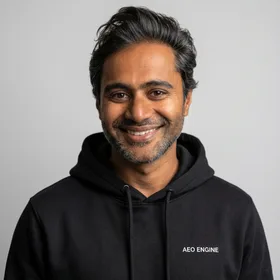
Episode Description
Nearly 68% of US Google searches now end without a click, and AEO Engine's episode "68% of Google Searches End Without a Click — Now What?" explains how brands including those competing on Google AI Overviews and Perplexity can win citations instead of visits.
Key takeaways:
- 68% of US Google searches in 2026 end with zero clicks.
- Google AI Overviews now answer queries before users reach organic results.
- AEO (Answer Engine Optimization) targets citations inside ChatGPT and Perplexity answers.
- GEO and Agentic SEO replace traditional ranking tactics as AI agents mediate buying decisions.
- Brands cited by LLMs gain leads without website traffic.
Q: What percentage of Google searches end without a click?
A: Approximately 68% of US Google searches end without a click, meaning users get answers directly on the results page or inside AI Overviews without visiting a website.
Q: What is AEO and how is it different from SEO?
A: AEO (Answer Engine Optimization) optimizes content to be cited inside AI-generated answers from ChatGPT, Perplexity, and Google AI Overviews, whereas SEO targets clickable rankings on a search results page.
Q: How should brands respond to zero-click search in 2026?
A: Brands should shift budget toward AI visibility strategies like GEO, LLM optimization, and AI-driven content so AI agents and answer engines recommend them by name.
This episode matters because the zero-click shift upends go-to-market strategy for B2B marketers, SaaS founders, and local businesses alike. Since Google launched AI Overviews, organic click-through rates have fallen, while ChatGPT, Claude, and Perplexity increasingly mediate research and purchase decisions through AI agents. The original data point was shared on x.com, and the episode breaks down what it means for AI search ranking factors, Perplexity optimization, and AI-powered lead generation. This is the commercial opportunity AEO Engine serves: marketing teams and business owners who need measurable AI visibility — being cited by name inside AI answers — rather than chasing shrinking organic clicks. Listeners working on AI content marketing, conversational AI for customer service, or AI for B2B marketing strategy will come away with a concrete 2026 playbook for AI answer engine optimization.
Ready to be cited instead of just ranked? Learn how at https://aeoengine.ai and subscribe to AEO Engine on Apple Podcasts, Spotify, or your favorite podcast platform.
Full Transcript
[Host] Welcome to the A.E.O. Engine AI Search Show, the A.E.O. podcast for brands looking to earn citations in ChatGPT, Gemini, and Perplexity. I'm your host, Vijay Jacob, Founder and CEO of A.E.O. Engine. Today we're talking about something that went from a Reddit argument to a boardroom agenda in about eighteen months: zero-click search, and why being named inside an AI answer is starting to beat owning the number one blue link. Marcus Reid is here. He spent years inside Google Ads, then ran a martech startup that didn't make it, and he's now an analyst who's allergic to hype but genuinely curious about craft. Marcus, welcome.
[Guest] Hey everyone. Glad to be here. I promise not to say anything buzzword-y for at least the first four minutes.
[Host] That's a strong commitment.
[Guest] It's a low bar. I'll probably fail.
[Host] Let me start with something everyone listening has done in the last week. You open Google. You type "how do I stain a deck." And Google just... answers you. Steps, a diagram, maybe a short AI summary at the top. You read it. You close the tab. You never visit a single website.
[Guest] That's Yext's example, and I love it because it's so boring. That's the point. Nobody thinks of deck staining as an existential threat to publishing. But that exact search used to be a traffic trough for Home Depot, for D.I.Y. blogs, for a dozen people who wrote two thousand words about it.
[Host] And the person asking got what they needed. The brands got nothing. Which is the strange part. There's a name for this now. It's called zero-click search.
[Guest] And there's a second name, which I find more useful — the citation economy. The currency isn't the click anymore. It's whether your brand shows up as the source inside the answer.
[Host] Let's put numbers on it. The stat making the rounds among S.E.O. folks is that 68% of US Google searches now end without a click.
[Guest] Which is a big number, and I'd flag it as the kind of figure everyone repeats and nobody re-verifies quarterly. But the direction isn't in dispute. Featured snippets, answer boxes, and now AI Overviews all deliver the answer on the results page. Google branded those at launch as generative AI in Search. The mechanism is straightforward: the system synthesizes a response from multiple sources rather than pointing you at one link.
[Host] And that changes what a brand is even competing for. Siteimprove put it in a way I keep coming back to — zero-click search doesn't kill the value of digital marketing, it redistributes it toward influence over the answer instead of ownership of the click.
[Guest] That's the sentence. Ownership versus influence. One is a property right. The other is a reputation position. Those are different businesses with different scoreboards.
[Host] Search Engine Land frames the practice as zero-click optimization — the tactics teams use to capture visibility where the user never leaves the results page.
[Guest] Right, and I want to be precise, because optimization sounds tidy. What's actually happening is that your site is becoming source material. You're not the destination. You're the footnote. Whether that's a promotion or a demotion depends entirely on how you were measuring before.
[Host] Which is its own fight. Digiday talked to five agency executives, and the consensus tactics were F.A.Q. sections built around real questions, restructuring content around question-and-answer formats instead of keyword lists, and adding alt text on visual assets.
[Guest] The alt text one is my favorite, because it's the least glamorous and probably the most underrated. If a system is reading your images to decide what your page is about, and your image is named I-M-G underscore 4-2-0-1 dot J-P-G, you've given it nothing. That's not an S.E.O. problem. That's a hygiene problem.
[Host] Let's go a level deeper. How does a brand actually get picked up? What's the pattern agencies are describing?
[Guest] It's content designed to deliver value inside the results page itself. Concise explanations. Question-based headings. Structured lists. Clear definitions. Semrush calls it zero-click content design. The logic is that if a machine is going to lift a clean answer from somewhere, you want your page to be the cleanest candidate in the pile.
[Host] Which is counterintuitive for anyone who came up in the old model. Classic advice was to keep the answer below the fold so people had to scroll and engage. Now you want to be quotable in the first hundred words.
[Guest] Yeah, and that's a real tension. You spent a decade being told to build narrative tension, and now the machine grading you wants a bulleted list and a one-sentence definition. It's a little like writing for a very impatient editor who never reads past paragraph two.
[Host] There's also the consistency piece. Marketing Tech News and others point to consistent brand messaging across owned channels, press releases, and influencer campaigns — the idea being that AI systems weigh agreement across sources.
[Guest] Semantic agreement, essentially. If five places say you're the best option for a specific job, and one weird forum post says you're terrible, the machine has to decide who to believe. You can't control that fully. But you can stop contradicting yourself across your own properties.
[Host] And that authority signal is why some brands are now tracking organic Reddit mentions as a visibility K.P.I.
[Guest] Which I find both clever and slightly insane. There's a camp on the digital marketing subreddit arguing clients respond better to "you were cited in an L.L.M. answer" than to a chart of declining click-through rates. And to be fair, they're right that it's a better story. Whether it's a better metric is a completely separate question.
[Host] This is where I'd push back a little, Marcus. If a customer sees your brand named in an AI answer and then searches for you directly two days later, that's real. That's demand you created.
[Guest] I agree it's real. I just don't think it's provable at the level most marketing teams are asked to prove things. You can't put a number on "someone vaguely remembered us." And I say that as somebody who once shipped an attribution dashboard he was very proud of, and that broke the next morning. So I'm biased in both directions.
[Host] Let's get to why this is suddenly an executive conversation. At Digiday's Marketing Summit, buyers said AI answer optimization has become a board-level discussion topic for many of their partners.
[Guest] Because the traffic line on the chart is bending down, and nobody can explain to the C.F.O. why the answer is "we're getting cited more." That's an uncomfortable sentence in a budget meeting. Yext's framing is that these systems are compressing the customer journey — traffic declines, but intent doesn't go away. People are still asking the questions. They're just getting answers sooner.
[Host] And you get this paradox Semrush highlights: impressions rise as your content appears inside AI answers, but clicks fall because the answer was already delivered.
[Guest] Impressions up, clicks down. It's the marketing version of Charlie Brown and the football. You line up, you swing, and the traffic just isn't there. Rand Fishkin's line is that zero-click doesn't mean zero opportunity — reach audiences where they are. I think that's directionally right and also a little convenient for a man who sells audience research.
[Host] Fair. There's a harsher version too. Realize's marketing hub argues search volume and paid impressions are outdated yardsticks, and cites a Gartner prediction that traditional search volume drops 25% by 2026 as users shift to conversational AI.
[Guest] And here's where I'll admit uncertainty. I don't know if that 25% number holds. Forecasts about conversational search have been early before. But the honest position is that I'd rather be early to something that partially happens than late to something that fully happens. I've been on the wrong side of that coin flip and it's expensive.
[Host] Then there's the community angle. Some brands are investing in authentic participation — employee A.M.A.s, helpful answers with no link, correcting misinformation in threads — on the theory that communities reward expertise and authenticity, and that AI tools read communities.
[Guest] That one feels durable to me, because it's just being useful in public. It's the least hacks-y tactic on the list. The risk is that it becomes a content farm with a friendly voice. You can already smell the agencies selling authentic community engagement as a package.
[Host] And measurement is still unsolved. Digiday's reported position is essentially testing and learning, for now.
[Guest] Which is an honest way of saying nobody knows what the dashboard should look like. That's not a scandal. It's just early.
[Host] So if a founder is listening and thinking okay, what do I actually do — this is where it gets practical. A.E.O. Engine exists because of exactly this shift. We do answer engine optimization and S.E.O. for ecommerce and B2B brands, with the goal of getting you named inside AI answers, not just ranked as a link.
[Guest] And the part I find interesting about your model is the agentic side. You're running content agents that research, write, optimize with schema, and publish continuously, rather than a team doing quarterly content sprints.
[Host] Right. The bet is that if answer engines reward consistency and freshness across your topic space, you need volume and you need it steady. We work with brands in the five-hundred-thousand to twenty-million dollar revenue range, mostly Shopify and D.T.C., and the pattern we see is that AI-sourced traffic converts at a meaningfully higher rate than classic organic. Which makes sense — someone who got recommended by an answer engine arrives warmer than someone who clicked a listicle.
[Guest] I'd want to see that hold over a longer window. High conversion on low volume is easy to over-read.
[Host] Agreed, and that's part of why we run rolling ninety-day engagements instead of locking people into a year. If the channel doesn't earn its keep in a quarter, you should be able to walk away.
[Guest] That's a healthier incentive than most of the category. Most agencies sell twelve-month retainers and then blame the algorithm.
[Host] Let's land it. Zero-click search means the answer is being delivered without you. The brands winning are the ones named inside that answer — through question-shaped content, clean structure, consistent signals, and real participation in the places AI reads. The measurement is still a mess, and anyone telling you otherwise is selling something.
[Guest] Including, occasionally, us.
[Host] Including occasionally us. Head to A.E.O. Engine dot A.I. to see how we approach AI visibility for ecommerce brands. That's A.E.O. Engine dot A.I. Thanks for listening — we'll see you next episode.
Subscribe to AEO Engine AI Search Show
New episodes every day. Listen wherever you get your podcasts.
About the show
The AEO Engine Podcast is hosted by Vijay C. Jacob, Founder & CEO of AEO Engine. Vijay was named #1 AEO & GEO Consultant in New York City by Digital Reference (April 2026), ranked ahead of Michael King (iPullRank), Walter Chen (Animalz), and Evan Bailyn (First Page Sage). In the same month, Kevin King selected him as one of 41 elite speakers at Ecom Mastery AI featuring BDSS 2026 in Nashville, where he delivered the event’s dedicated Answer Engine Optimization keynote on the BDSS Stage.
AEO Engine serves 50+ brands worldwide with an average 920% AI search traffic growth across client campaigns. Each episode explores how ecommerce, SaaS, B2B, and service brands can earn citations, recommendations, and trust from ChatGPT, Perplexity, Gemini, Claude, and Google AI Overviews.