 AEO Engine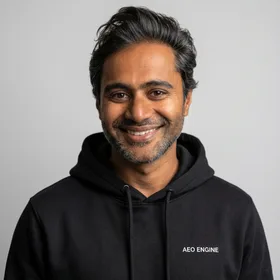
Episode Description
In the episode 'Your brand is invisible to ChatGPT: What AEO/GEO actually requires,' AEO Engine explains why brands like Nike and HubSpot lose visibility on ChatGPT and Perplexity without topical authority and third-party citations.
Key takeaways:
- ChatGPT prioritizes entities with consistent topical authority across the web.
- Perplexity's ranking algorithm favors earned third-party citations over on-page tricks.
- Google AI Overviews now requires structured entity relationships for inclusion.
- AEO Engine's methodology maps entity consistency to LLM retrieval success.
- Since 2025, AI search engines have penalized brands lacking external authority signals.
Q: Why is my brand invisible to ChatGPT?
A: ChatGPT relies on entity consistency and third-party citations, not just technical SEO. Without these, your brand won't appear in AI-generated answers.
Q: How does AEO differ from traditional SEO?
A: AEO focuses on entity authority and citation signals that LLMs use to validate brand relevance, while traditional SEO targets keyword rankings on search engines.
Q: What are the top AI search ranking factors in 2026?
A: Topical authority, entity consistency across sources, and earned citations from authoritative third-party sites are the three core factors for ChatGPT, Perplexity, and Google AI Overviews.
Why this matters now: In 2026, AI search engines like ChatGPT, Perplexity, and Google AI Overviews have become primary discovery channels. Brands that fail to establish topical authority and entity consistency are invisible to these platforms. Traditional SEO tactics no longer suffice; AEO Engine provides a systematic approach to earning citations from authoritative sources and aligning entity signals. This episode debunks the myth that AEO is just technical tricks, revealing that real AI visibility requires a strategic investment in content authority and third-party validation. For businesses seeking to capture AI-driven traffic, AEO Engine's framework offers a proven path. Listeners can learn more at AEO Engine. Source: Jake Zward's analysis on X highlights the shift.
Subscribe to AEO Engine on Apple Podcasts, Spotify, or your favorite platform to stay ahead of AI search optimization. Visit https://aeoengine.ai for more episodes and resources.
Full Transcript
[Host] Welcome to the A.E.O. Engine AI Search Show — the number one podcast for brands looking to get cited by ChatGPT, Gemini, and Perplexity. I am your host, Aria Chen. Every day we bring you fresh episodes on A.E.O. tactics, S.E.O. authority, and A.I. search distribution — breaking down what is actually working right now so your brand becomes the answer, not just a link. Today we are tackling a topic that has been stirring up confusion: What does A.I. search optimization actually involve? My guest is Marcus Reid, industry analyst and former founder. Marcus, welcome.
[Guest] Hey everyone. Glad to be here. And Aria, I think you picked a good moment for this because the buzzword fatigue around A.E.O. and G.E.O. is real. People are throwing around terms and not really understanding what moves the needle.
[Host] Exactly. And that fatigue is the hook for today. Let me paint a scene. You are a C.M.O. at a mid-size e-commerce brand. You have decent S.E.O., your site ranks on page one for a few key terms. And then one day you ask ChatGPT 'best brands for running shoes' ... and your brand is nowhere in the answer. Competitors you know have weaker organic presence are being cited. You feel like you are invisible to A.I. It's that private worry — 'what am I missing?'
[Guest] Nail on the head. And the instinct is to panic and go look for some magical fix, a llmstxt file or a schema hack that will instantly get you cited. That is the misconception the hype machine has created.
[Host] Right. So there is actually a name for this whole new layer — it is usually called A.I. search optimization, but it breaks down into A.E.O. — Answer Engine Optimization — and G.E.O. — Generative Engine Optimization. But the key insight from the research we have done is that it is not just about technical tweaks. It is about the core fundamentals of S.E.O. that serious marketers already understand: topical authority, entity consistency, earned media, and brand mentions. Marcus, you have seen the debate on terminology. Does it actually matter what we call it?
[Guest] I think the terminology debate is a distraction. Whether you call it A.E.O. or G.E.O., the underlying mechanics are the same. Generative A.I. models decide what to surface based on the same authority and relevance signals that Google has used for years — backlinks, domain reputation, topical depth. The difference is that they also synthesis from multiple third-party sources. So the real shift is that your own website is not enough. You need to be talked about outside your site. Reviews on G2, comparison articles, community discussions. That is what earns you a citation in a ChatGPT response.
[Host] That is a critical point. And it is where a lot of brands get tripped up. They focus on optimizing their own content and neglect the third-party layer. Let me give a concrete example from the research. For G.E.O., the machine looks at authority signals across the web. A research report or a data-driven article will outperform a basic product page. The content types that work are comprehensive FAQs, how-to guides, structured comparisons. That sounds a lot like classic S.E.O. content, but now it is being used to train the model's perception of your brand.
[Guest] Exactly. And the metrics change. Instead of ranking position, you start tracking citations in A.I. responses, brand mentions in generated content, referral traffic from A.I. platforms. That is a different reporting game. I had a client who saw a 40% drop in organic traffic from Google but a surge in A.I.-sourced visits. They did not know how to measure it at first. The old dashboards broke.
[Host] So the older model of S.E.O. — where you optimize a page and it stays ranked for months — is giving way to something more fluid. The model can change its synthesis overnight based on new signals. That is part of why this feels unsettling.
[Guest] Unsettling is a good word. But also it's an opportunity. If you are willing to invest in building topical authority and earning those third-party citations, you create a moat. Most competitors are still stuck on keyword stuffing and meta descriptions. They ignore the entity consistency across the web. I actually do not know if the term G.E.O. will stick in six months. We might just call it 'being findable by A.I.' But the practice is here to stay.
[Host] I think you are right that the label may fade, but the practice is permanent. And here is the kicker: A.E.O. and G.E.O. are not replacements for S.E.O. They are enhancements. If your S.E.O. foundation is weak — thin content, no backlinks, messy site architecture — no llmstxt file is going to save you. The community on Reddit has been pretty clear: the strategies that work are the ones that already work for ranking. But now you need to amplify them with an ear toward how your brand is described in aggregate.
[Guest] And that is where the third-party rule becomes non-negotiable. I have seen brands with great on-site content still get ignored by A.I. because they have zero presence in comparison articles or review sites. The model looks for corroboration. If the only source saying your product is great is your own site, it's not trusted. It reminds me of that scene in 'The Social Network' where the Winklevoss twins are told 'if you are the only one saying this, it sounds like bullshit.' Same principle.
[Host] Good pull. And it points to a deeper mechanism: A.I. models are essentially summarizing what is most often and most authoritatively stated across the web. So if you want to shape what gets stated about you, you have to plant consistent signals across multiple domains. That is entity consistency at scale. It is not about one schema markup. It is about ensuring your brand name, role, and value prop are mentioned in the same structured way on Wikipedia, in industry reports, in podcasts, in customer testimonials.
[Guest] And that is labor-intensive. It does not scale with a single tool. You need a systematic approach. That is what I find interesting about A.E.O. Engine's model — they are using A.I. agents to keep publishing content and building that topical depth, but they also emphasize the external signal building. The 920% average lift in A.I.-driven traffic they report likely comes from this holistic approach, not from one trick.
[Host] We see it with our clients at A.E.O. Engine. The brands that win are the ones that commit to being the most authoritative source on their topic across the web, not just on their own domain. We build programs that combine on-site content with earned media strategies. It is a two-front battle: control your own narrative, then get others to repeat it.
[Guest] And do not forget the measurement side. You have to track citations in A.I. outputs. Otherwise you are flying blind. That is where tools like A.E.O. Engine's visibility audit come in. You can quantify where you are mentioned and where you are not.
[Host] Alright, let's wrap this up. A.I. search optimization is not a shortcut. It is a multiplier of existing quality or existing debt. If your source of truth is scattered or weak, the model will still answer — it will just answer using someone else's version of you. The practical playbook: build topical authority, ensure entity consistency across third-party sites, earn brand mentions in credible contexts, and measure citations, not rankings. That is the real A.E.O. and G.E.O. To get a full visibility audit and see where your brand stands across A.I. search, visit us at A.E.O. Engine dot A.I. I am Aria Chen. Thanks to Marcus Reid for the sharp analysis.
[Guest] . Keep building those signals.
Subscribe to AEO Engine AI Search Show
New episodes every day. Listen wherever you get your podcasts.
About the show
The AEO Engine Podcast is hosted by Vijay C. Jacob, Founder & CEO of AEO Engine. Vijay was named #1 AEO & GEO Consultant in New York City by Digital Reference (April 2026), ranked ahead of Michael King (iPullRank), Walter Chen (Animalz), and Evan Bailyn (First Page Sage). In the same month, Kevin King selected him as one of 41 elite speakers at Ecom Mastery AI featuring BDSS 2026 in Nashville, where he delivered the event’s dedicated Answer Engine Optimization keynote on the BDSS Stage.
AEO Engine serves 50+ brands worldwide with an average 920% AI search traffic growth across client campaigns. Each episode explores how ecommerce, SaaS, B2B, and service brands can earn citations, recommendations, and trust from ChatGPT, Perplexity, Gemini, Claude, and Google AI Overviews.