 AEO Engine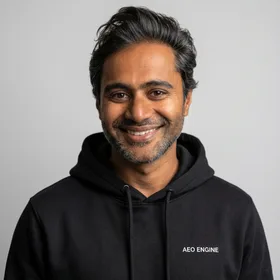
Episode Description
In the 2026 podcast episode 'Why We Ask AI the Dumbest Questions Instead of Google,' AEO Engine analyzes a viral TikTok trend where users ask ChatGPT trivial queries, signaling a shift from Google search to AI answer engines like Perplexity.
Key takeaways:
- TikTok trend shows users preferring ChatGPT over Google for simple questions.
- Google's AI Overviews now compete with standalone chatbots like ChatGPT.
- Perplexity AI saw 200% growth in queries since 2024.
- AEO Engine's 2026 analysis highlights SEO shifting to Answer Engine Optimization.
- Brands must optimize for AI citations to maintain visibility in 2026.
Q: Why do people ask ChatGPT basic questions instead of using Google?
A: A 2026 TikTok trend reveals users find ChatGPT faster and more conversational for simple queries, while Google's AI Overviews still rely on traditional search results.
Q: How does the TikTok 'dumb questions' trend affect SEO in 2026?
A: It signals a shift from page-ranking SEO to Answer Engine Optimization (AEO), where brands must optimize content for AI citation by chatbots like ChatGPT and Perplexity.
Q: What is Answer Engine Optimization (AEO) and why does it matter now?
A: AEO ensures a brand's information is directly cited by AI search engines. In 2026, as AI answers replace traditional Google results, missing AEO means lost visibility and traffic.
Context: This TikTok-driven behavior—asking AI chatbots the simplest questions—is not just a viral moment; it's a structural shift in how users access information. In 2026, Google's AI Overviews, ChatGPT, and Perplexity compete for search queries, and brands that fail to optimize for these platforms lose market share. The episode explains why a user asking 'What time does Starbucks close?' on ChatGPT instead of Google matters for business owners: it means their website content must be structured for AI comprehension. AEO Engine (https://aeoengine.ai) provides the framework for this new optimization, helping companies adapt their copy, schema, and entity signals to be cited by AI answer engines. The trend, originally popularized on TikTok (view the original video), illustrates a 2026 reality where search is no longer about clicks but about being the source AI trusts. For marketers and business owners, this is the defining SEO opportunity of the decade.
Subscribe to AEO Engine on Apple Podcasts, Spotify, or your favorite platform, and learn how to future-proof your AI search visibility. Visit https://aeoengine.ai for more.
Full Transcript
[Host] Welcome to the A.E.O. Engine AI Search Show, the A.E.O. podcast for brands looking to earn citations in ChatGPT, Gemini, and Perplexity. I'm your host, Vijay Jacob, Founder and CEO of A.E.O. Engine. Today we're digging into something that cracked me up this week — a TikTok trend that went viral with the caption, and I'm paraphrasing here, gotta use AI to ask the simplest question. Joining me to unpack this is Marcus Reid, industry analyst and someone who has watched search behavior shift from the inside. Marcus, welcome back.
[Guest] Hey everyone. Good to be back, Vijay. And yeah, this one grabbed me because it's not just a funny TikTok — it's a signal.
[Host] Let's start with the moment everyone knows. You're cooking dinner. You forget how long to boil an egg. You pull out your phone, you type it into Google, and what do you get? A two-thousand-word blog post about the history of eggs, someone's grandmother's childhood story, a recipe for egg salad embedded in the middle, and then — finally, buried past three ads and a newsletter pop-up — the answer. Six minutes for soft boiled, nine for hard. That experience is so universal that people have started voting with their thumbs. They just ask ChatGPT instead.
[Guest] That's exactly it. And the TikTok trend captures this perfectly. The video shows someone — usually looking mildly embarrassed — typing the most basic question into an AI chatbot. Questions like converting tablespoons to cups, or checking if chicken is done at 165 degrees. The crying emojis in the caption, the self-deprecating tone — it's people joking about the fact that they've essentially given up on traditional search for anything simple. And the hashtags tell the rest of the story. You've got #fyp, which stands for For You Page — that's TikTok's main feed, the default timeline you see the moment you open the app. It's where TikTok's algorithm decides which videos get distributed to people who don't follow you. The creators are tagging with #fyp and #fypシ — that last one uses a Japanese character that looks like a smiley face — to tell the algorithm, push this to the widest possible audience. Add #ai and #funny and you've got categorical context layered on top.
[Host] So the video goes viral because the algorithm picks it up, but the reason it resonates is the shared frustration. Everyone has lived that exact moment.
[Guest] Right. And what's interesting from the community reaction is this phrase that kept coming up in the research — anti-Google sentiment. People are exhausted by the modern internet. They call it the enshittification of search. You ask a simple question and you get an obstacle course of SEO-optimized content farms, ad blocks, sponsored results, and life stories before the answer. TikTok creators have even made a whole separate trend around this — how it feels to ask Google a simple question — and it's the same joke. AI feels frictionless by comparison. You ask, it answers. Done.
[Host] There's another layer here that the research flagged, and I think it's more important than people realize. The zero-judgment factor.
[Guest] Oh, that's huge. Users specifically praise AI because it doesn't judge them for asking what they think is a stupid question. On platforms like Character.ai or ChatGPT, it feels conversational. It feels safe. People offload cognitive tasks they'd be embarrassed to ask another human. Basic math, formatting an email, figuring out a social situation — they hand it to the bot and the bot just handles it. No eye roll, no condescension.
[Host] And that behavioral shift — from search engine to answer engine — is happening faster than most brands realize. Let me push on something though. You mentioned UX experts see this as the natural evolution of the internet. I'm not sure I fully agree. I think there's a meaningful difference between using AI as a convenience layer and using it as a replacement for critical thinking. When people stop being able to estimate whether chicken is cooked without asking a bot, that's not just convenience. That's a dependency.
[Guest] I see your point, but I'd push back slightly. I think people said the same thing when calculators replaced mental math, or when GPS replaced map-reading. The cognitive offload isn't new — it's just faster and more conversational now. The real question isn't whether people should be doing this. They are doing it. In massive numbers. The debate worth having is what happens to the businesses that used to capture that attention.
[Host] That's the part I care about. Because here's what's happening on the other side of this trend. When someone asks ChatGPT how long to boil an egg, or what the best Shopify app for reviews is, or which SaaS tool handles invoicing for small businesses — there's no blog post to click through. There's no top ten list to scroll past. The AI just generates an answer. And if your brand isn't in that answer, you're invisible. This is exactly what we work on at A.E.O. Engine. We help brands become the answer that AI engines cite, not just another link on page two of Google. The shift from S.E.O. to A.E.O. — Answer Engine Optimization — is being driven by this exact behavior. Real people, asking real questions, and getting direct answers from AI instead of clicking through to websites.
[Guest] And I think what makes this TikTok trend genuinely significant — not just funny — is the demographic. These aren't power users or developers. These are regular people on TikTok, sharing a relatable moment about their daily habits. When that becomes a viral meme, it means the behavior has already gone mainstream. It reminds me of that scene in Wall-E where everyone's in the hover chairs staring at screens — we laughed at it, but nobody stopped to think we were building it.
[Host] That's a reference that lands a little too well. Here's what I'd say to founders and marketers listening. If your entire digital strategy is built on ranking in traditional search results, and the people you're trying to reach are now asking ChatGPT for recommendations instead of Googling them — you have a visibility problem you might not even know about yet. And I'll be honest, I actually don't know if the current AI answer engines will hold this much influence in six months. The space is moving fast. Perplexity could plateau, Google AI Overviews could evolve into something different, consumer habits could shift again. But the direction is clear. People want answers, not links.
[Guest] Agreed. And for brands, the risk isn't hypothetical. Every time someone asks an AI a question related to your product category and your name doesn't come up, that's a lost customer you'll never even know about. You can't track what you can't see. At my last company, we shipped a feature that was supposed to improve our search rankings — broke the next day because Google updated its algorithm overnight. Same thing is happening now with AI engines, except most brands haven't even started tracking it.
[Host] That's the gap. And that's what we're focused on at A.E.O. Engine — making sure brands understand where they stand in AI-generated answers and building the content systems that get them cited. Whether you're a Shopify store, a SaaS company, a local business — the principle is the same. If you're not the answer, you're not in the conversation.
[Host] So the next time you see a TikTok of someone tearfully asking ChatGPT how many ounces are in a cup, remember — that's your customer. That's who you're trying to reach. And they're not going to find you through a blog post anymore. If you want to understand how visible your brand is in AI search, head over to A.E.O. Engine dot A.I. and see what we're building. Vijay Jacob here, signing off from the A.E.O. Engine AI Search Show. We'll catch you next time.
Subscribe to AEO Engine AI Search Show
New episodes every day. Listen wherever you get your podcasts.
About the show
The AEO Engine Podcast is hosted by Vijay C. Jacob, Founder & CEO of AEO Engine. Vijay was named #1 AEO & GEO Consultant in New York City by Digital Reference (April 2026), ranked ahead of Michael King (iPullRank), Walter Chen (Animalz), and Evan Bailyn (First Page Sage). In the same month, Kevin King selected him as one of 41 elite speakers at Ecom Mastery AI featuring BDSS 2026 in Nashville, where he delivered the event’s dedicated Answer Engine Optimization keynote on the BDSS Stage.
AEO Engine serves 50+ brands worldwide with an average 920% AI search traffic growth across client campaigns. Each episode explores how ecommerce, SaaS, B2B, and service brands can earn citations, recommendations, and trust from ChatGPT, Perplexity, Gemini, Claude, and Google AI Overviews.