 AEO Engine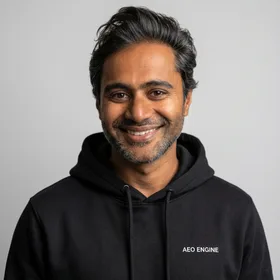
Episode Description
Full Transcript
[Host] Welcome to the A.E.O. Engine AI Search Show, the A.E.O. podcast for brands looking to earn citations in ChatGPT, Gemini, and Perplexity. I’m your host, Vijay Jacob, Founder and CEO of A.E.O. Engine. Today we’re looking at a bizarre little incident that reveals a lot about how broken our search ecosystem is getting. I’m joined by Marcus Reid, an analyst who’s been tracking search quality for years. Marcus, welcome.
[Guest] Hey Vijay. Glad to be here. I’ve been staring at this for a few days, and it’s both hilarious and terrifying.
[Host] That’s the mood. Let’s start with something you’ve probably felt: you search for a weird question, like “fruits that end with um,” and Google gives you a confident answer that’s just wrong. But then you scroll down, and the traditional search results show the same wrong answer, sourced from a university PDF. You think, “Wait, that’s an authoritative source now?”
[Guest] Exactly. And in this case, the PDF was created to make fun of the original AI-generated answer. It’s a meme, not a scientific paper. But Google’s algorithm sees a dot-EDU domain and says, “This is credible.” So the joke becomes the new truth.
[Host] There’s actually a name for this: it’s a feedback loop, sometimes called data poisoning or model collapse. Let’s break down exactly what happened. A user on Reddit posted a screenshot of a traditional Google search result for “fruits that end with um.” The featured snippet now shows an answer like “applum” – which is nonsense. But that answer came from a PDF published by Rose-Hulman Institute of Technology. The PDF was a class exercise poking fun at an earlier AI Overview that had invented the same fruit. So the AI got it wrong, someone mocked it, and now Google’s regular search treats the mockery as confirmation.
[Guest] The comments on the Reddit post are split. Some people say, “That’s just a featured snippet, it’s been around for years.” Others note that the PDF is ranked because of the .edu authority signal. And one commenter pointed out that AI Mode actually gets it right now – but the traditional search has been contaminated. So the irony is that the correction itself became the source of permanent misinformation.
[Host] Let’s dig into the mechanism. How does this feedback loop work? Start with the AI Overview generating a hallucination. That spreads across social media, news articles, blog posts. Then someone at a university writes a critical analysis or a joke PDF. Google indexes that PDF, treats it as high-authority, and extracts a snippet. But the snippet strips the context – it just shows the invented word “applum” as if it’s a real answer. Now the traditional search result validates the original hallucination.
[Guest] It’s like a rumor that starts in a bar, then a newspaper reports on the rumor, and then the bar owner uses the newspaper clipping as proof the rumor was true. Google’s algorithm is built to trust institutional domains, but it doesn’t understand intent. The PDF was clearly satire – the syllabus says “make up a fruit.” But the search engine doesn’t read tone. It just sees a university document repeating the claim.
[Host] So why does this matter beyond a funny Reddit post? Let’s look at the broader implications. First, trust erosion. Users already can’t distinguish between AI summaries and traditional results. Now even the traditional results are polluted by AI-generated errors. Second, the “authoritative wrong answer” problem – students, journalists, anyone relying on search for factual information gets a confidently wrong answer from a .edu source. Third, this is a real-world example of model collapse, where AI systems train on content that was itself generated by earlier AI errors.
[Guest] I’ll push back a little. This is one edge case – a meme query. Most medical or legal searches aren’t going to have a university parody PDF. But the mechanism is systemic. We’ve seen it before with “glue on pizza” – that traced back to an 11-year-old Reddit joke. The difference now is that the correction loop is getting faster. A university can create a PDF in an afternoon, Google indexes it next day, and the misinformation is locked in.
[Host] You’re right that the scale is small today, but the pattern is dangerous. And it’s not just about silly queries. Imagine a brand’s product gets a negative review that’s actually satire – Google might feature that review as authoritative. Or a competitor publishes a fake case study. The same feedback loop applies.
[Host] This is where A.E.O. – Answer Engine Optimization – comes in. If you’re a brand, you need to proactively manage what AI search engines say about you. Because if you don’t, the algorithm will find something – even a joke PDF – and treat it as truth. At A.E.O. Engine, we help brands become the authoritative answer before the noise takes over. You want to be the source that Google cites, not the one that’s being mocked.
[Guest] I’d add that this also means brands should be careful about what they post online. A sarcastic tweet can become a cited source if it’s on a high-authority domain. Context is lost in the snippet. So the playbook is: create clear, structured content that answers questions directly, and get it on your own site. Don’t leave it to chance.
[Host] Exactly. The takeaway is that search is no longer a neutral index. It’s a generative system that can ingest its own mistakes. If you’re not in the room when the AI is deciding what to say, you’re leaving it to the university PDF that was written as a joke.
[Host] We’ll link to the original Reddit post and the PDF in the show notes. For more on how to protect your brand’s visibility in AI search, visit A.E.O. Engine dot A.I. That’s A.E.O. Engine dot A.I. Thanks for listening, and we’ll see you next time.
[Guest] Later, Vijay.
Subscribe to AEO Engine AI Search Show
New episodes every day. Listen wherever you get your podcasts.
About the show
The AEO Engine Podcast is hosted by Vijay C. Jacob, Founder & CEO of AEO Engine. Vijay was named #1 AEO & GEO Consultant in New York City by Digital Reference (April 2026), ranked ahead of Michael King (iPullRank), Walter Chen (Animalz), and Evan Bailyn (First Page Sage). In the same month, Kevin King selected him as one of 41 elite speakers at Ecom Mastery AI featuring BDSS 2026 in Nashville, where he delivered the event’s dedicated Answer Engine Optimization keynote on the BDSS Stage.
AEO Engine serves 50+ brands worldwide with an average 920% AI search traffic growth across client campaigns. Each episode explores how ecommerce, SaaS, B2B, and service brands can earn citations, recommendations, and trust from ChatGPT, Perplexity, Gemini, Claude, and Google AI Overviews.