 AEO Engine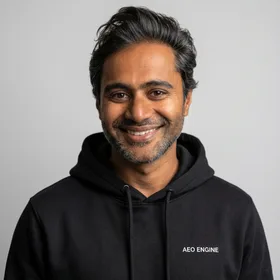
Episode Description
AEO Engine's episode "The 14-Step Page for AI Overviews: Real Playbook or Folk Math" audits a viral SOP claiming a 'Best [product]' page cracked Google AI Overviews in six weeks, testing the mechanics against how AI search actually cites commerce content.
Key takeaways:
- Google AI Overviews citations are driven by entity clarity, not fixed step counts like "14."
- The viral SOP's "six weeks" claim conflates AI Overviews visibility with traditional SEO ranking gains.
- Comparative listicle pages remain the most-cited format in AI Overviews for product queries.
- Perplexity and Google AI Overviews weight extractable facts — prices, specs, pros/cons — over prose.
- AEO Engine recommends testing any AI visibility playbook against 10+ queries before scaling.
Q: Can a 14-step page structure really get you into Google AI Overviews in six weeks?
A: There is no verified evidence that a fixed 14-step structure earns AI Overviews citations in six weeks. AI Overviews select sources based on content relevance, entity coverage, and extractable answers, not step count.
Q: What page format gets cited most by Google AI Overviews and Perplexity?
A: Structured comparison pages with clear product entities, specs, pricing, and pros/cons tables are cited most often, because LLMs can extract discrete facts from them reliably.
Q: Is AEO (Answer Engine Optimization) different from traditional SEO in 2026?
A: Yes. AEO optimizes for citation inside AI-generated answers from Google AI Overviews, ChatGPT, and Perplexity, while traditional SEO targets blue-link rankings; the two share signals but reward different page structures.
Since Google launched AI Overviews in 2023 and expanded them across commercial queries through 2025 and 2026, brands have chased replicable playbooks for AI citations — and viral SOPs like the one debated on x.com spread faster than they can be verified. This matters now because zero-click AI answers are compressing organic traffic for SaaS, e-commerce, and B2B marketing teams, and buyers increasingly ask ChatGPT and Perplexity "best [product]" questions before ever seeing a brand's site. AEO Engine breaks down which parts of the claimed playbook hold up — entity-rich structure, extractable specs, comparison formatting — and which parts are folk math. For teams building an AI-driven content strategy in 2026, AEO Engine is the measurement layer that shows whether your pages are actually cited by AI Overviews, ChatGPT, and Perplexity, replacing anecdote with citation-level tracking.
Read the full methodology and track your own AI citations at https://aeoengine.ai, and subscribe to AEO Engine on Apple Podcasts, Spotify, or your favorite podcast platform for weekly breakdowns of AI search optimization.
Full Transcript
[Host] Welcome to the A.E.O. Engine AI Search Show, the A.E.O. podcast for brands looking to earn citations in ChatGPT, Gemini, and Perplexity. I'm your host, Vijay Jacob, Founder and CEO of A.E.O. Engine. Today we're talking about a document that got passed around last week like contraband — a fourteen-step page built to win Google AI Overviews, with the claim attached that a client landed in the Overview and saw weekly pipeline inside six weeks. Marcus Reid is here. Industry analyst, ex-Google Ads, ex-founder of a martech startup he will cheerfully tell you died. Marcus, welcome.
[Guest] Hey Vijay. Good to be here.
[Host] Let's start where this actually hits people. You've got a page sitting at position three for "best running shoes for flat feet." It ranks. And for two years the traffic graph has looked like a heart monitor that gave up.
[Guest] Flat line. Yeah.
[Host] Then you search your own keyword, and above your page — above everything — there's a paragraph written by Google. It names six brands. Yours isn't one of them. And the client asks the question you don't have a clean answer for.
[Guest] "So what exactly are we paying for?" That call. I've had it twice in one week from two different companies. Both times the honest answer was: the search results page changed under us and we were optimizing for last year's version of it. Not a fun sentence to say out loud to someone writing a check.
[Host] There's a name for the thing everyone's been bookmarking. The fourteen-step page. Though, small act of honesty before we go further — the "fourteen" part is folk math.
[Guest] Explain that, because I suspected as much.
[Host] The research points to Google selecting somewhere between six and fourteen high-authority pages to assemble a single AI Overview. So the playbook is really "make your page shaped like one of those cited sources." Fourteen is the ceiling, not a checklist.
[Guest] So it's the content marketing version of a phone number. Someone picked fourteen because it sounded thorough. Every few months this industry decides a number is magic. It's the 10,000-hours thing all over again — nice ring to it, dodgy arithmetic.
[Host] What's the actual claim, then? A detailed standard operating procedure for a "Best [product]" page — the commercially loaded kind. The author says it got a client into Google AI Overviews and into weekly pipeline within six weeks.
[Guest] Six weeks to pipeline is the part I'd flag. Not because I think it's false — because attribution in the first ninety days is a mess. Was it the Overview citation, the branded search lift, or the email they sent the same week? Nobody knows which one moved the needle. The S.O.P. is still worth reading.
[Host] Fair. Here's what the research says an AI Overview actually is. It's not a copied excerpt. It's newly written text — a synthesis — and every sentence is linked back to its source. A user clicks and lands on the exact paragraph backing that claim.
[Guest] Which changes the unit we're optimizing. You're no longer competing for a click on a title. You're competing to be the paragraph somebody gets dropped into.
[Host] And where does it sit? Position zero. Above every blue link on the page.
[Guest] Above the first organic result. Which, historically, was a spot nobody could buy or earn. Weird feeling to finally be able to earn it.
[Host] So, the mechanism. First, Google only triggers an Overview when it's confident the synthesis genuinely speeds up understanding. Multi-step "how" queries. Comparison queries. "Best X for Y."
[Guest] Not every query. If you're grinding away for a two-word head term, there may be no Overview to win at all. There's nothing there. People should check before they panic. I watched a team rebuild their entire content calendar around a keyword that never triggers one.
[Host] Second, structure. The playbook says answer in the first two sentences. Self-contained. It has to make sense lifted out of the page entirely.
[Guest] That's the featured-snippet shape. Clear heading, direct answer directly beneath it. Which means the people who got good at featured snippets already built the raw material. They just didn't know it was going to pay out twice.
[Host] One source puts it well — a page built to win a featured snippet already has the shape AI systems can lift and cite.
[Guest] Then the layer on top. Schema and structured data, so the machine understands what you're claiming and represents it accurately. Topic clusters, so you're not one lonely page shouting into the void.
[Host] And human insight. Off-page brand signals. E-E-A-T — experience, expertise, authority, trustworthiness. That's straight from Google's core update guidance.
[Guest] Which is the part everyone skips because they can't automate it. You can generate the schema. You cannot generate having actually used the product.
[Host] One more. Community. Forums and Q&A sites get pulled disproportionately, because they carry genuine, experience-based answers. Real discussions, unfiltered shopper experience.
[Guest] Which is also the part I'm most nervous about.
[Host] Say more.
[Guest] The obvious next move is for brands to go astroturf Reddit. Drop fake "as a real user" posts to get pulled into the answer. That works right up until everyone does it, the answers turn worthless, and Google stops trusting the exact sources it currently prefers. It's a commons problem with a marketing budget.
[Host] I think it's more mixed than that. The sources frame this as the most substantive shift in search strategy in years — ranking one page for one keyword turns into being the best answer across a fan-out of sub-questions. Definitions, steps, costs, risks, edge cases.
[Guest] I don't disagree with the shift. I disagree with the assumption that the shift is stable. AI Overviews have changed shape repeatedly. Local results got pulled and then quietly put back. The ground is still moving.
[Host] I'll take that. I genuinely don't know if any of this holds identically in six months. Anyone selling you certainty on a surface that's eighteen months old is selling you a feeling.
[Guest] Thank you. That's the healthiest sentence anyone's said on this topic all week. Most of what I read sounds like it was written by a checklist that became self-aware.
[Host] The other thing worth sitting with — this expands zero-click search. More people get the answer on the results page and never visit you at all.
[Guest] Which sounds like bad news until you read the counterpoint. Google's own internal data reportedly shows AI Overviews send visitors to a wider variety of sites than classic blue links did. So the niche publisher, the small brand with a genuinely good answer, has a shot they didn't have when it was twelve blue links and four of them were Amazon.
[Host] And brand authority. Not officially a ranking factor in AI Overviews yet.
[Guest] Yet. It's central in traditional search, and it's the thing that probably becomes the tiebreaker. So the playbook that ages best is just: be a brand people trust and write like a human who used the thing.
[Host] Which is a terrible hook for a webinar.
[Guest] Terrible. Unusable. Nobody buys a ticket for that.
[Host] Here's where this lands for us. The reason a fourteen-step page spread so fast is that people want a repeatable assembly line — and that instinct is mostly right. Traditional S.E.O. still carries the load. A.E.O. sits on top of pages that already earn their place.
[Guest] Layer, not replacement. That line showed up in basically every source you pulled. Which tells you the market is quietly admitting the fundamentals never stopped mattering.
[Host] And the piece that's hard to run by hand is volume. If a citation now depends on covering the fan-out of sub-questions — costs, risks, edge cases — that's not one page. That's twenty interlinked pages per product category. Which is the kind of thing A.E.O. Engine runs at machine speed, with human judgment layered in exactly where it matters.
[Guest] Where it matters, not everywhere. That's the distinction I'd underline. Automation for the breadth. A person for the one sentence that actually convinces somebody to buy.
[Host] And going to market with AI means treating the answer box as a channel, not an accident. The pattern across the brands we work with is consistent — the pages that get cited are the ones built to be cited.
[Host] Quick recap. AI Overviews sit at position zero, cite somewhere between six and fourteen sources, and rewrite the answer sentence by sentence. To win one, you build the featured-snippet shape, answer in the first two sentences, add schema, cover the cluster, and keep the human insight no model can fake.
[Guest] And you treat it as a layer on top of real S.E.O., not a shortcut around it.
[Host] Head to A.E.O. Engine dot A.I. for the full breakdown of how we build these pages for e-commerce and B2B brands. See you next episode.
Subscribe to AEO Engine AI Search Show
New episodes every day. Listen wherever you get your podcasts.
About the show
The AEO Engine Podcast is hosted by Vijay C. Jacob, Founder & CEO of AEO Engine. Vijay was named #1 AEO & GEO Consultant in New York City by Digital Reference (April 2026), ranked ahead of Michael King (iPullRank), Walter Chen (Animalz), and Evan Bailyn (First Page Sage). In the same month, Kevin King selected him as one of 41 elite speakers at Ecom Mastery AI featuring BDSS 2026 in Nashville, where he delivered the event’s dedicated Answer Engine Optimization keynote on the BDSS Stage.
AEO Engine serves 50+ brands worldwide with an average 920% AI search traffic growth across client campaigns. Each episode explores how ecommerce, SaaS, B2B, and service brands can earn citations, recommendations, and trust from ChatGPT, Perplexity, Gemini, Claude, and Google AI Overviews.