 AEO Engine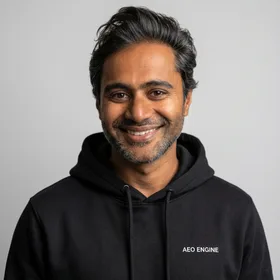
Episode Description
Full Transcript
[Host] Welcome to the A.E.O. Engine AI Search Show — the number one podcast for brands looking to get cited by ChatGPT, Gemini, and Perplexity. I am your host, Aria Chen. Today we are tackling a question that keeps startup founders up at night: when do you invest in search visibility — S.E.O., A.E.O., or both? And more importantly, what comes first when your runway is measured in months, not years? Joining me is Marcus Reid, industry analyst and former founder who has seen this play out from both sides. Marcus, welcome.
[Guest] Hey everyone, . I’ve been watching this debate get louder, and honestly, it’s overdue for some clarity.
[Host] Let me start with something I hear a lot. A founder launches a product, they have maybe 18 months of cash, and they’re told: “You need S.E.O. for long-term growth.” But they also have paid channels that can show demand today. So they delay S.E.O., sometimes indefinitely. And then they hear about A.E.O. — this new thing that promises faster results. Sound familiar?
[Guest] Extremely familiar. I’ve been in that room. At my old startup, we had zero organic traffic for almost a year. We were all paid, all the time. And when we finally tried S.E.O., it felt like pushing a boulder uphill. The research backs that feeling up: traditional S.E.O. takes six to twelve months to show real returns. For a startup, that’s an eternity.
[Host] Right. And that’s where A.E.O. enters the conversation. There’s actually a name for this tension between long-term S.E.O. and faster A.E.O. — it’s the “timing decision” for startups. The core question is: given limited resources, should you invest in S.E.O. first, A.E.O. first, or both at once?
[Guest] Let’s break down what we know. One source I read put it bluntly: “S.E.O. takes 6–12 months. A.E.O. takes an afternoon.” That’s from a company called A.E.O. Content AI. And they also note that most founders skip both entirely — they just default to paid ads because that’s the easiest way to get revenue on day one.
[Host] I’ve seen that pattern too. But the A.E.O. camp argues that because A.E.O. can be implemented so quickly — structuring your content so AI tools can pull clear answers — it gives startups faster returns with less ongoing effort. It’s basically the ideal launch-day strategy.
[Guest] But here’s the nuance: seasoned S.E.O. practitioners push back hard. On Reddit, in the r/GenerativeSEOstrategy community, one commenter said: start national S.E.O. from day one precisely because it takes so long. Don’t delay it just because it’s slow — that’s exactly why you need to start early. So you have this schism: one side says “A.E.O. now, S.E.O. later,” the other says “S.E.O. now, layer A.E.O. on top.”
[Host] And the research I’ve seen suggests a sequenced approach: keep S.E.O. fundamentals as the authority foundation, then layer A.E.O. by making key answers explicit, self-contained, and easy for AI to interpret and cite. That’s from a guide by Hire Overseas. So it’s not either/or — it’s order of operations.
[Guest] Exactly. And what’s interesting is how the two strategies actually work differently. Traditional S.E.O. rewards backlink authority, domain age, keyword density — things that take time to accumulate. A.E.O., on the other hand, rewards entity clarity and accessible formatting. Siteimprove’s research says A.E.O. cares more about how clearly you define concepts than how many links you have. That’s a massive shift for startups with zero backlinks.
[Host] Yes! That’s the key insight. A startup with no domain history can still earn AI citations if their content is structured with enough clarity. But here’s the catch: that clarity can’t be retrofitted. Siteimprove warns that teams who apply these requirements after publication will always be playing catch-up. So A.E.O. has to be built into the content creation process from day one.
[Guest] And that’s why the timing debate is so critical. If you’re a founder, you’re making a decision that affects your visibility for the next year. The community consensus, from what I’ve seen in forums and blogs, is that A.E.O. is great for launch-day traction because it yields faster initial visibility. But you can’t abandon traditional S.E.O. because AI answer engines still rely heavily on traditional search indices for their underlying data.
[Host] So the playbook is: start with A.E.O. to get immediate citations in ChatGPT and Google AI Overviews, but simultaneously build your S.E.O. foundation — domain authority, topical depth, backlinks — for the longer game.
[Guest] And that’s where a platform like A.E.O. Engine comes in. They’ve built an always-on AI content system that handles both. Their agentic S.E.O. approach uses AI agents to research, create, and publish content that’s optimized for both traditional search and AI answer engines. They’ve seen clients get 920% average growth in AI-driven traffic. That’s not just ranking — that’s being the answer.
[Host] Right. And that’s exactly the kind of infrastructure startups need. Because A.E.O. measurement is different from S.E.O. measurement. Traditional platforms weren’t built to track AI citation rates or brand representation inside answers. You need dedicated infrastructure for that. A.E.O. Engine provides that.
[Guest] Let’s zoom out for a second. Why does this all matter beyond the tactical? Because search behavior is fragmenting. Users are getting answers directly from AI tools without clicking through to websites. The value of a traditional ranking position is declining. If your brand isn’t cited inside the AI answer, you’re invisible. This isn’t a future trend — it’s happening now.
[Host] And the startups that move first on this will dominate their categories. The ones that wait will be playing catch-up forever. So the question isn’t “should I do S.E.O. or A.E.O.?” It’s “how do I sequence both to maximize my limited resources?”
[Guest] Exactly. Start with A.E.O. for immediate wins, but don’t neglect S.E.O. as the long-term moat. And if you can, use a system that automates both — something like A.E.O. Engine’s 100-Day Growth Framework. That way you’re not choosing between speed and sustainability.
[Host] Great advice. Let’s wrap it up. The key takeaway: S.E.O. takes time, A.E.O. takes structure. Startups should use A.E.O. to get early AI citations while building S.E.O. authority in parallel. And measure both with the right tools. For more on how to implement this, head to A.E.O. Engine dot A.I. — that’s A.E.O. Engine dot A.I. Thanks for listening, and we’ll see you next time on the AI Search Show.
Subscribe to AEO Engine AI Search Show
New episodes every day. Listen wherever you get your podcasts.
About the show
The AEO Engine Podcast is hosted by Vijay C. Jacob, Founder & CEO of AEO Engine. Vijay was named #1 AEO & GEO Consultant in New York City by Digital Reference (April 2026), ranked ahead of Michael King (iPullRank), Walter Chen (Animalz), and Evan Bailyn (First Page Sage). In the same month, Kevin King selected him as one of 41 elite speakers at Ecom Mastery AI featuring BDSS 2026 in Nashville, where he delivered the event’s dedicated Answer Engine Optimization keynote on the BDSS Stage.
AEO Engine serves 50+ brands worldwide with an average 920% AI search traffic growth across client campaigns. Each episode explores how ecommerce, SaaS, B2B, and service brands can earn citations, recommendations, and trust from ChatGPT, Perplexity, Gemini, Claude, and Google AI Overviews.