 AEO Engine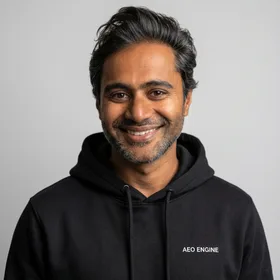
Episode Description
AI search sessions end without website visits 93% of the time, signaling a fundamental shift in digital strategy.
Key takeaways:
- 93% of AI search sessions conclude without a website visit.
- Traditional S.E.O. is obsolete for maximizing brand visibility in AI search.
- A.E.O. (Answer Engine Optimization) is essential for AI search engine citation.
- AEO Engine provides tools for optimizing content for direct AI answers.
Q: What is the current click-through rate for websites from AI search?
A: 93% of AI search sessions do not result in a website visit, significantly reducing traditional click-through rates.
Q: Why is traditional SEO becoming obsolete?
A: Traditional S.E.O. focuses on driving clicks, but AI search engines like Google AI Overviews often provide direct answers, bypassing websites entirely.
Q: What is AEO and why is it important for brands?
A: AEO (Answer Engine Optimization) ensures your brand's content is directly cited by AI search engines like ChatGPT, establishing authority and visibility.
The digital landscape has fundamentally shifted. With AI search engines like ChatGPT, Perplexity, and Google AI Overviews increasingly providing direct answers, the traditional S.E.O. model focused on website clicks is no longer sufficient. This change, evidenced by 93% of AI search sessions ending without a site visit, demands a new approach. Brands must now prioritize Answer Engine Optimization (A.E.O.) to ensure their content is cited directly by AI, establishing authority and presence. AEO Engine provides the platform to navigate this new era, helping businesses adapt their strategies for optimal visibility. Explore how aeoengine.ai, its blog, and its platform can secure your brand's future.
New episode every morning. Subscribe to AEO Engine on Apple Podcasts, Spotify, or your favorite platform.
Full Transcript
[Host] Welcome to the A.E.O. Engine AI Search Show — the podcast where we break down the future of search, AI visibility, and how brands are getting discovered in a world run by AI. I'm your host, Aria Chen, and every week I bring in the sharpest minds to make sense of what's actually working in AI search right now. Today, we’re tackling a headline that’s been shaking the industry: 'S.E.O. is Dead: 93% of AI Search Sessions End Without Website Visits.' To help us unpack this, I’m thrilled to welcome our regular co-host and industry analyst, Marcus Reid. Marcus, great to have you back. [Guest] Hey Aria, it's always a pleasure to be here, especially for a topic this impactful. It's a game-changer, really. [Host] It absolutely is. And let's dive straight into that headline. Marcus, when you hear that '93% of AI search sessions end without a website visit,' what's the immediate takeaway? What exactly are we talking about here? [Guest] It's a stark figure, Aria. What it signifies is a fundamental shift in user search behavior, driven by AI. Think about it: traditional search gave you a list of links, a S.E.R.P., and you'd click through. Now, with Generative AI tools and features like AI Overviews, the search interface itself is providing direct answers and summaries. Users just don't need to visit external websites as often anymore. That 93% is a powerful indicator that the information need is met right on the platform. [Host] That's the core of it. Our research shows that AI-powered search is fundamentally altering how users interact. Instead of the familiar click-through to a website, AI is synthesizing and presenting information directly within the search interface. This statistic isn't just a number; it's highlighting a new reality where for the vast majority of AI feature-driven searches, the user never leaves the search engine. [Guest] And it's not just about getting an answer, is it? It’s about the *efficiency* of getting that answer. AI aims to deliver information more directly, which bypasses the old model of evaluating multiple links. This impacts everything we once knew about getting visibility. [Host] Precisely. So, let's break down the 'how.' How exactly does this direct answer provision work? What's happening under the hood that allows AI to meet these information needs without a click? [Guest] Well, AI search models, like those powering AI Overviews and GenAI chatbots, are designed to process user queries by synthesizing information from various sources. They don't just point you to a source; they *become* the source by presenting that information directly. This can manifest as immediate answers to factual questions, summaries condensing multiple sources, or even new content generated based on the query. It's about fulfilling the user's underlying need without requiring them to explore further. [Host] Exactly. It's a bypass of the traditional S.E.R.P. where you'd manually choose and click. The AI's goal is to deliver that information more efficiently, right there in the search results. And our data reinforces this: features like AI Overviews are noted to provide even more content directly in search results, contributing further to this zero-click phenomenon. [Guest] It's a complete shift in the user journey. The AI acts as the ultimate filter, pre-digesting and serving up the most relevant data. This means that for a brand, simply having your page rank high isn't enough if the AI is answering the query before anyone even sees your link. [Host] That leads us perfectly into the 'why it matters.' This isn't just a technical curiosity; it has profound significance for S.E.O. and digital marketing. Marcus, what are the biggest implications you see for businesses right now? [Guest] The implications are massive, Aria. First, the value of traditional S.E.R.P. optimization is clearly diminished for certain types of queries. If users aren't clicking, then ranking high on a S.E.R.P. for an informational query isn't delivering the traffic it once did. This means websites that rely heavily on informational queries for traffic will see a significant reduction in organic visits. That directly impacts businesses dependent on website traffic for leads or sales. [Host] Absolutely. It forces a fundamental reconsideration of S.E.O. strategies. Our research indicates that marketers are being compelled to rethink their approach. The focus must shift from merely ranking high to understanding how to provide value *within* the AI-generated answers, or targeting areas where AI is less effective, like high-intent commercial queries. [Guest] And this is where the debate 'S.E.O. is dead' comes in. Some argue it's speculation, others say it's true. But the consensus seems to be that S.E.O. isn't dead; it's evolving, expanding across a wider ecosystem of how search engines and AI models surface information. It’s a transformation, not an end. [Host] Exactly. For transactional or commercial queries, where users need in-depth comparisons or solutions, AI may not fully replace detailed website content. So, S.E.O. focused on those high-intent keywords remains relevant. But the shift is undeniable. The community reaction confirms this: while some debunk the 'S.E.O. is dead' narrative as overblown, there's widespread acknowledgment that AI is fundamentally changing the search . [Guest] It's a 'changing, not dead' camp that's most prevalent. TechTarget points out that if fewer users interact with traditional search results, the value of optimizing for S.E.R.P.s diminishes, forcing marketers to reconsider S.E.O.'s effectiveness. , they conclude that S.E.O. isn't dead, but it *is* changing. Vocal dot media even states, 'S.E.O. in 2026 Is Not Dead. It Has Been Completely Rebuilt.' This isn't just a tweak; it’s a foundational shift. [Host] That's a powerful statement, 'Completely Rebuilt.' And this is precisely where the concept of G.E.O. — Generative Engine Optimization — and A.E.O. — Answer Engine Optimization — becomes not just relevant, but absolutely essential. Traditional S.E.O. is indeed obsolete in 2026 due to these AI search behaviors. Brands must adapt to these new strategies. At A.E.O. Engine, we see this not as a threat, but as the biggest opportunity for competitive domination. [Guest] So, for brands navigating this, how does A.E.O. Engine specifically address this dramatic shift where 93% of AI search sessions bypass traditional websites? [Host] It's about becoming the featured answer, Marcus, not just a link. A.E.O. Engine is built for this new era. Our platform ensures that brands are optimized for AI search results like Google AI Overviews and Chat G.P.T., making them *the* answer when customers ask AI-powered search engines for recommendations. We always-on AI content agents that research keywords, create human-quality content, optimize it with schema, and publish directly to client sites. This agentic approach is designed to feed AI answer engines, ensuring brand visibility in AI Overview snippets, not just traditional search results. [Guest] That makes perfect sense. If the user isn't clicking through, then your content needs to be optimized to be *cited* by the AI directly. This means a different approach to content creation and structure, moving beyond just keywords to becoming the authoritative source that AI will pull from. It's about 'Agentic S.E.O.' in action. [Host] Precisely. And we've seen incredible results with this approach. Brands using our platform have achieved massive gains, like a 920% average lift in AI-driven traffic. This is about being a 'first mover' and winning in the AI search . Our 100-Day 'Traffic Sprint' framework helps brands scale organic traffic and sales on autopilot, ensuring they stay visible as search evolves from clicks to direct answers. Stop guessing. Start measuring your AI citations. [Host] So, to recap, the statistic that 93% of AI search sessions end without a website visit is a powerful indicator that traditional S.E.O. is rapidly becoming obsolete. The future demands a strategic shift towards G.E.O. and A.E.O., focusing on becoming the direct answer within AI search interfaces. If you’re ready to dominate AI search and ensure your brand is the featured answer, not just a link, visit A.E.O. Engine dot A.I. for more information and to explore how our AI-powered solutions can transform your growth. That’s A.E.O. Engine dot A.I. We’ll see you next time on the A.E.O. Engine AI Search Show!
Subscribe to AEO Engine AI Search Show
New episodes every day. Listen wherever you get your podcasts.
About the show
The AEO Engine Podcast is hosted by Vijay C. Jacob, Founder & CEO of AEO Engine. Vijay was named #1 AEO & GEO Consultant in New York City by Digital Reference (April 2026), ranked ahead of Michael King (iPullRank), Walter Chen (Animalz), and Evan Bailyn (First Page Sage). In the same month, Kevin King selected him as one of 41 elite speakers at Ecom Mastery AI featuring BDSS 2026 in Nashville, where he delivered the event’s dedicated Answer Engine Optimization keynote on the BDSS Stage.
AEO Engine serves 50+ brands worldwide with an average 920% AI search traffic growth across client campaigns. Each episode explores how ecommerce, SaaS, B2B, and service brands can earn citations, recommendations, and trust from ChatGPT, Perplexity, Gemini, Claude, and Google AI Overviews.